




















Key Takeaways
- Nano-Cellulose Strength and Barrier Breakthroughs: The use of molecularly engineered cellulose fibres is transforming the structural capabilities of moulded pulp. By adding nano-fibrils, manufacturers can produce thinner, lighter packaging that possesses the strength of steel and the oxygen barrier properties previously only found in synthetic plastics.
- Next-Generation Manufacturing and Bio-Coatings: The shift toward waterless dry-moulding technology and the development of PFAS-free, lignin-based waterproof coatings are significantly reducing the environmental footprint of production. These innovations allow moulded fibre to compete with plastic in terms of speed, cost, and functionality while remaining 100% compostable and circular.
The moulded fibre industry is currently experiencing a technological renaissance. What was once a simple process for making egg cartons and industrial buffers has transformed into a high-tech sector at the forefront of material science. As the global demand for plastic alternatives reaches an all-time high, researchers and engineers are pushing the boundaries of what cellulose can do. The future innovations in moulded fibre packaging materials are not just about making slight improvements; they are about a fundamental shift in strength, flexibility, and barrier performance. From the molecular manipulation of wood fibres to revolutionary new manufacturing methods, these developments are setting the stage for a sustainable packaging future that is as high-performing as it is environmentally responsible.
The Power of Nano-Cellulose and Molecular Engineering
One of the most exciting areas of future innovations in moulded fibre packaging materials is the integration of Cellulose Nanofibrils (CNF) and Cellulose Nanocrystals (CNC). By breaking down plant fibres to the nanoscale, scientists have discovered a material that is stronger than steel on a weight-for-weight basis. When these nano-fibres are added to the traditional pulp slurry, they act as a “super-reinforcement,” dramatically increasing the tensile strength and stiffness of the final product.
This material development allows for the production of moulded fibre that is much thinner and lighter than ever before, without losing its protective qualities. Furthermore, nano-cellulose is being used to create incredibly dense “oxygen barrier” layers. These layers can prevent gases from passing through the packaging, which is the key to replacing plastic in the long-term storage of food and pharmaceuticals. This level of advanced packaging materials is a gamechanger, as it removes the last major hurdle for moulded fibre: its inherent permeability.
The Transition to Dry-Moulding Technology
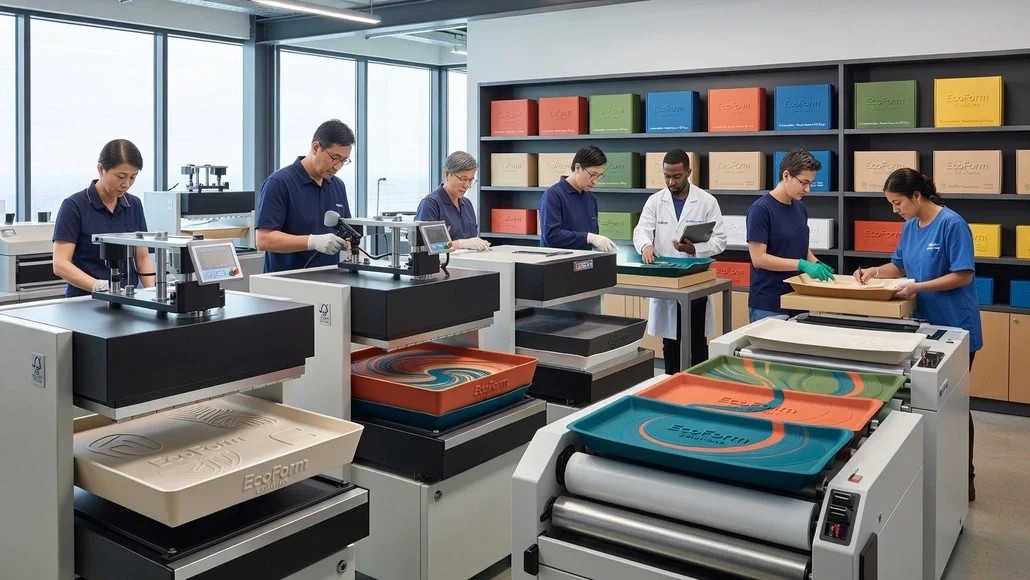
While material science is evolving, so is the manufacturing process. For decades, the industry has relied on “Wet-Moulding,” which uses a water-based slurry to form parts. However, a major future innovation in moulded fibre packaging materials is “Dry-Moulding.” This technology uses air instead of water to transport the fibres, which are then formed using heat and high pressure.
The advantages of dry moulding are profound. It uses up to 90% less water and significantly less energy than traditional methods because there is no need for an intensive drying phase. This not only lowers the carbon footprint of production but also allows for much faster cycle times. Dry-moulded products also tend to have a smoother, more refined finish and better dimensional stability. As this technology scales, it will allow moulded fibre to compete directly with plastic injection moulding on price and speed, representing a massive shift in packaging innovation trends.
Advanced Bio-Based Barriers and PFAS Alternatives
For moulded fibre to fully replace plastic in the food industry, it must be resistant to water and oil. Historically, this was achieved using PFAS (per- and polyfluoroalkyl substances). However, due to health and environmental concerns, the industry is rapidly moving toward advanced eco packaging technology solutions. Future innovations are focusing on bio-based coatings derived from natural sources like seaweed, mushrooms (mycelium), and agricultural waste.
One promising development is the use of “lignin-based” coatings. Lignin is a natural polymer found in wood that provides structural support and water resistance to trees. By extracting and refining lignin, researchers can create a 100% natural, waterproof coating that is fully compostable. Other innovations include the use of PHA (polyhydroxyalkanoates), a biopolymer produced by bacterial fermentation, which provides a high-performance barrier that breaks down easily in marine environments. These advancements ensure that the sustainable packaging future remains truly sustainable, without any “forever chemicals.”
Smart Packaging and Functional Integration
The next generation of moulded fibre will be “smart.” Future innovations in moulded fibre packaging materials include the integration of functional elements directly into the pulp. This includes “active packaging” that can absorb ethylene gas to slow the ripening of fruit, or antimicrobial fibres that can inhibit the growth of bacteria, extending the shelf life of fresh produce.
Furthermore, we are seeing the emergence of “digital-fibre” hybrids. This involves embedding thin, flexible NFC (Near Field Communication) tags or conductive ink circuits within the layers of the moulded fibre during the forming process. This allows consumers to scan the package with their smartphones to learn about the product’s origin, verify its authenticity, or receive recycling instructions. By making the package an interactive part of the product experience, brands can add value while maintaining their commitment to circularity. This intersection of material science and digital technology is a core pillar of modern packaging innovation trends.
Diversification of Raw Material Sources
The sustainable packaging future is also characterized by a move away from traditional wood pulp toward more diverse, regenerative fibre sources. Innovations are focusing on “non-wood” fibres such as bamboo, miscanthus (elephant grass), hemp, and agricultural residues like wheat straw and tomato skins. These plants grow much faster than trees and often require fewer pesticides and less water.
Using these diverse materials not only reduces the pressure on forests but also allows for regionalized production. For example, a facility in a wheat-growing region can use local straw to produce its packaging, reducing transport-related emissions. Each type of fibre brings unique properties to the table bamboo for strength, sugarcane bagasse for smoothness, and hemp for durability. The ability to create “blended” pulp recipes tailored to specific applications is one of the most important advanced packaging materials developments in the industry today.
Circularity and the “Waste-to-Resource” Model
Finally, the ultimate goal of all future innovations in moulded fibre packaging materials is the achievement of total circularity. The industry is moving toward a model where “waste” does not exist. This includes developing “re-mouldable” fibres that can be recycled an infinite number of times without losing quality and ensuring that every additive and coating is home-compostable.
New chemical recycling technologies are being developed that can break down old fibre packaging back into its constituent cellulose molecules, which can then be used to create high-purity nano-cellulose for the next generation of products. This “molecular recycling” ensures that the material stays in the loop forever. By combining these circular business models with breakthrough material science, the moulded fibre industry is proving that it is possible to have a global economy that provides high-performance packaging without leaving a lasting mark on the planet.