





















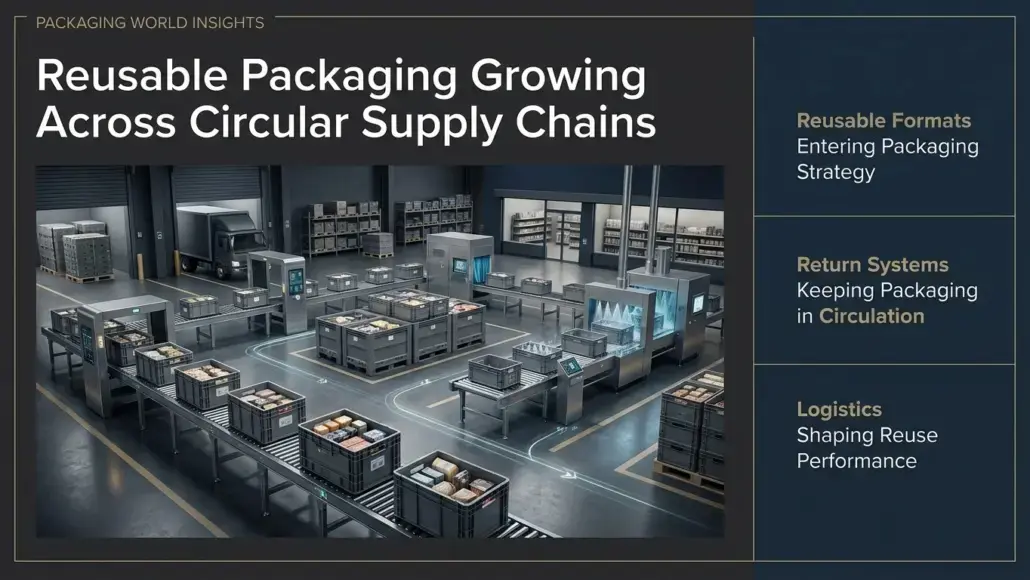
Packaging is increasingly being designed with more than its first use in mind. Reusable packaging is built to remain in circulation through repeated cycles of use, collection, preparation and redistribution. That changes the role of packaging from a product-delivery component into part of a wider operating system. The shift is gaining momentum as governments introduce specific reuse requirements and businesses build the infrastructure needed to support repeated circulation. The European Union’s Packaging and Packaging Waste Regulation (PPWR), Regulation (EU) 2025/40, establishes reuse and refill requirements across several packaging applications, with key targets beginning in 2030.
Reuse Targets Becoming More Defined
Transport packaging is one of the clearest areas where reuse is moving into formal packaging policy. Under the PPWR, at least 40% of specified transport packaging must be reusable within a reuse system from 2030, with an aspirational target of 70% by 2040. The regulation also establishes reuse targets for certain grouped packaging and beverage packaging. These requirements broaden the packaging decision. Companies are no longer looking only at material efficiency, weight or recyclability. They also need to consider whether a packaging format can function repeatedly within the logistics and return infrastructure required by a reuse model.
Regulatory Requirements Reshaping Packaging Strategy
- Transport packaging: The regulation sets a 40% reusable target from 2030 and an aspirational 70% target for 2040 across specified transport-packaging applications.
- Grouped packaging: Certain non-cardboard grouped packaging faces a 10% reusable target from 2030, rising to an aspirational 25% by 2040.
- Beverage packaging: Beverage distributors must ensure that 10% of covered products are in reusable packaging from 2030, rising to 40% by 2040.
- Reuse systems: The targets concern packaging operating within defined reuse systems, connecting the packaging format with the infrastructure needed to return and recirculate it.
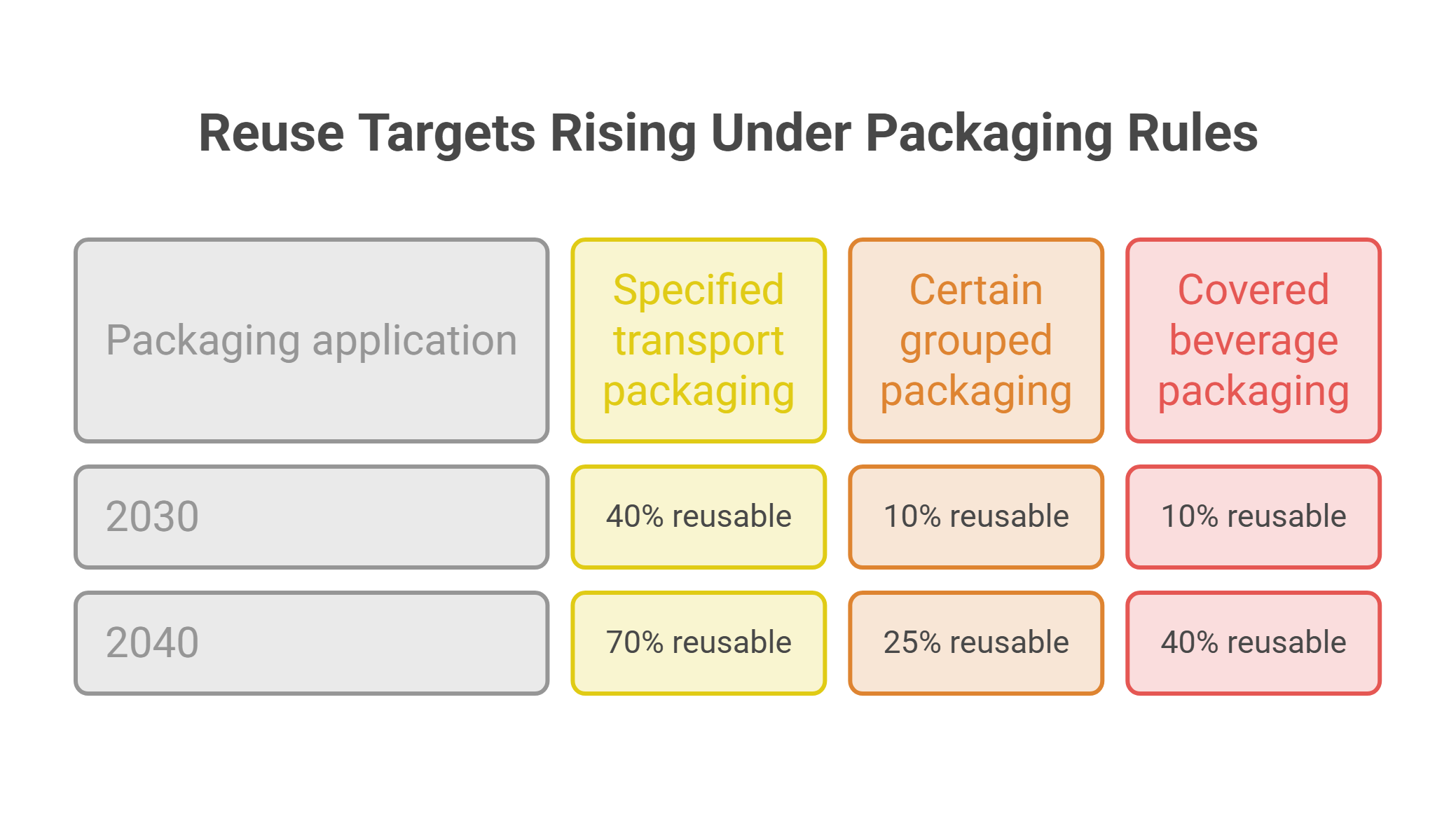

Reuse is moving toward defined regulatory requirements across multiple packaging applications, with transport and beverage formats among the areas facing clear targets from 2030.
Reuse Systms Expanding Beyond the Packaging Format
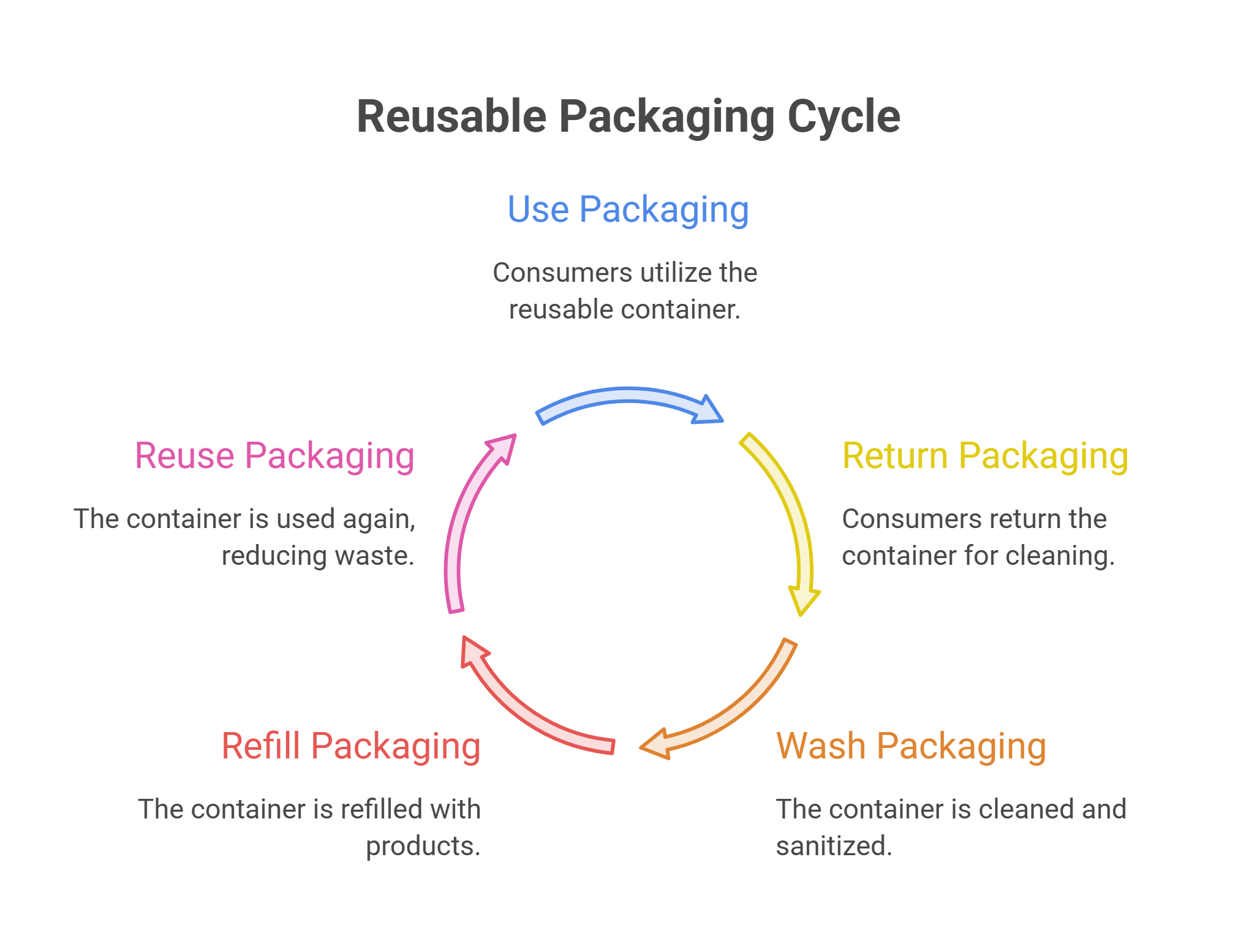
A reusable container cannot operate independently from the system around it. Once the product has been used, the packaging needs a practical route back into circulation, followed by the collection, sorting, cleaning and redistribution processes required for another cycle. The Ellen MacArthur Foundation identifies three key drivers for scaling returnable packaging: scale and shared infrastructure, packaging standardisation and pooling, and high return rates. Shared collection and cleaning infrastructure can improve system efficiency, while standardised packaging can simplify sorting, cleaning and storage.
Infrastructure Supporting Repeated Packaging Cycles
- Collection networks create reliable routes for used containers to return to the system.
- Cleaning infrastructure prepares packaging for another filling and distribution cycle.
- Standardised formats can reduce complexity across sorting, storage and cleaning operations.
- Pooling models allow multiple businesses to use shared packaging assets and infrastructure.
- Return rates determine how much packaging remains in circulation instead of being lost after use.
A growing number of initiatives are beginning to demonstrate this model at commercial scale. In France, the Citeo ReUse project had expanded to more than 360 stores and over 50 brands by 2026, using shared collection, logistics and washing infrastructure alongside standardised packaging. The project reported that monthly sales of reusable products had grown 13-fold since its launch in 2025. The development of these systems shows why reuse is becoming a supply-chain consideration rather than simply a packaging-format change. The container has to be designed for repeated handling, while the network around it has to make return, cleaning and redistribution practical enough to keep that container circulating.
Reusable Packaging Performance Depending on Repeated Cycles
The environmental case for reusable packaging depends on what happens after the first use. A reusable container carries a higher material and manufacturing requirement than a package designed for one cycle, so that initial burden needs to be spread across enough successful reuse cycles to deliver a measurable advantage. Research shows why the number of rotations matters. A 2024 life-cycle assessment of reusable plastic food packaging compared reusable and single-use formats across different numbers of uses and found that, under the study’s assessed conditions, six uses were the minimum point at which the reusable container delivered a global-warming-potential benefit over the single-use alternative. The result was specific to the packaging, system configuration and assumptions evaluated in the study.
Repeated Use Improving Packaging Performance
The number of completed cycles affects the environmental performance of a reusable container because its manufacturing impacts are distributed across those uses. A container used only once or twice cannot spread its initial footprint in the same way as one that successfully completes many return cycles. The study assessed reusable packaging across 10, 30 and 100 uses, illustrating how the performance of the system changes as the number of rotations increases. Its results demonstrate that reuse needs to be considered as a complete cycle rather than as a simple replacement of a single-use package.
Packaging Performance Changing with More Rotations
- Initial production: Materials and manufacturing contribute to the reusable container’s starting environmental burden.
- Additional cycles: Each successful reuse distributes that initial burden across another product cycle.
- Return and washing: Collection, transportation and cleaning introduce additional impacts that have to be included in the assessment.
- Lost containers: Packaging that fails to return does not contribute the expected number of rotations.
- System conditions: The result changes according to logistics, washing arrangements, packaging design and the number of completed uses.
Return Logistics Influencing the Environmental Result
More reuse cycles do not automatically guarantee a better outcome. The system has to bring packaging back efficiently, because every return trip adds transportation and handling impacts. Research into returnable e-commerce packaging found that transportation distance and the number of reuse cycles could substantially change the environmental results between reusable and single-use formats. The findings highlight why reuse models need to be designed around the geography and operating conditions of the supply chain. A reusable package circulating through a dense local network can face very different transport requirements from one that has to travel long distances before reaching a collection or cleaning facility. Several factors therefore influence the result:
- Return distance: Longer journeys can increase the transport burden of each reuse cycle.
- Collection density: Concentrated return networks can make reverse logistics more efficient.
- Cleaning operations: Energy and water requirements contribute to each additional cycle.
- Packaging durability: Containers need to withstand repeated handling without requiring frequent replacement.
- Utilisation: More completed cycles can help distribute the impacts associated with producing the reusable format.
This is why the environmental performance of a reuse model cannot be judged from the container alone. The packaging, reverse-logistics network, cleaning infrastructure and actual return behaviour all determine how effectively each additional cycle contributes to the system.
Reusable Packaging Becoming a Supply Chain Decision
Reusable packaging depends on container and return system. Performance varies with cycles, transport distance and cleaning.
- More cycles spread impacts.
- Returns sustain circulation.
- Transport affects performance.
- Cleaning adds resource requirements.
This connects with packaging compliance. Reusable packaging can support circular supply chains through repeated circulation.
References
- European Union – Regulation (EU) 2025/40 on Packaging and Packaging Waste – 2025
- Ellen MacArthur Foundation – Unlocking a Reuse Revolution: Scaling Returnable Packaging – 2023
- Yadav et al. – Life Cycle Assessment of Reusable Plastic Food Packaging – Journal of Cleaner Production, 2024
- Park et al. – Environmental Analysis of Returnable Packaging Systems in Different eCommerce Business and Packaging Management Models – Journal of Industrial Ecology, 2024