















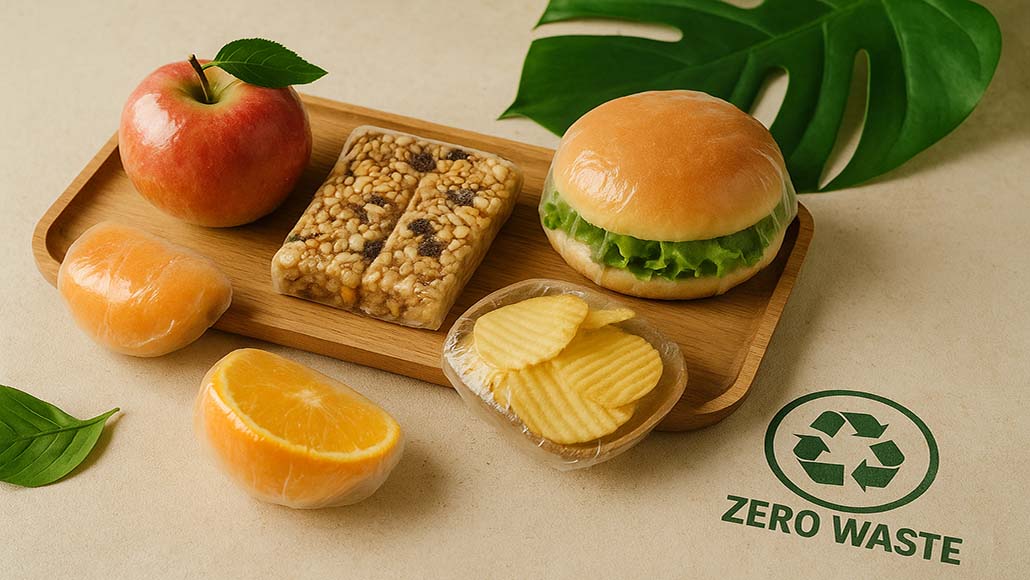

In the ongoing quest to reduce environmental impact, the food industry is increasingly confronted with the challenge of balancing convenience, safety, and sustainability. Packaging, long seen as a necessity for protection and preservation, now stands at the centre of a global shift in how waste is addressed. As conventional materials increasingly become the source of environmental issues, the quest for alternatives has led to the introduction of a radical yet functional idea—edible packaging.
This technology offers a fresh take on packaging, transforming it into an integral part of the consumption experience rather than just something to toss aside after use. By combining food waste with packaging waste, edible packaging solutions create a cohesive, waste-neutral solution that addresses two major issues at once. As discussions around zero-waste strategies become more mainstream in policy, business, and consumer sectors, edible packaging solutions enter into the picture not as a novelty, but as a deliberate shift in sustainable design thinking.
Its potential lies not only in its form but in what it represents: a fundamental departure from disposability and a move toward integration and minimalism.
Material Innovation and Technological Progress
The most important factor in edible packaging is the choice of material. Whereas traditional packaging uses synthetic compounds to build durability and barrier performance, edible packaging solutions challenge this standard by using natural ingredients that are safe to consume, biodegradable, and gentle on the environment once discarded.
These materials are often derived from plant-based sources or sometimes from by-products or underutilised agricultural products. They are selected based on the qualities they possess, like film-forming ability, flexibility, moisture resistance, and even flavour compatibility.
New processing methods now make these materials mouldable, stabilizable, and upgradeable for particular applications. while some are coated with protective agents that increase their resistance to moisture, others are neutral in taste to avoid interference with food profiles. As more research takes place, edible packaging finds functions in a broader area. In some instances, edible packaging can also serve a supplementary role, where it delivers nutrients in food or enhances food safety.
The adaptability of such materials is central. They can take form in many different ways—from films and wraps to containers and capsules—and thus can be suitable across various sectors of the food economy. What had previously been perceived as delicate or specialised is increasingly becoming technically feasible at scale.
Strategic Advantages for a Circular Food System
What makes edible packaging so relevant to the zero-waste system is that it avoids several waste-related steps altogether. Rather than competing with recycling or composting—both of which depend on infrastructure, energy, and regulations—edible forms dispense with post-use processes altogether. When eaten, they leave nothing behind; when uneaten, they tend to break down without much harm.
For manufacturers, it presents a number of operational benefits. Minimising packaging waste streamlines logistics, may reduce the cost of disposal, and may enhance sustainability performance. For customers, food-grade packaging can increase convenience while being consonant with values of ethics, especially if sustainability is becoming an increasingly important purchasing factor.
This approach promotes the use of renewable materials, cuts down on unnecessary waste, and focuses more on how products and packaging work together. Essentially, it aims to eliminate waste from the design phase instead of just dealing with it later on.
Additionally, it opens up opportunities for businesses to stand out. Companies that embrace edible packaging solutions might find themselves in a great position to attract eco-conscious consumers, particularly in markets where reducing waste is increasingly valued by both shoppers and policymakers.
Present trends in adoption
Edible packaging has already moved beyond the realm of experimentation. In certain segments of the foodservice and hospitality industries, it is being used to replace small, single-use items that traditionally go to landfills. Applications range from cutlery and sachets to containers and straws. These are usually launched as pilot schemes, but they mark a wider receptiveness to reconsidering packaging on a general basis.
Brands that venture into these formats tend to witness a surge in consumer interaction, most notably when the solution is innovative but subtle.
This is not a trend that will pass; it’s part of a larger transformation that battles against compostable materials, reusable design, and smart tracking systems. In the face of a constantly changing climate, edible packaging shines through by embracing minimalism with innovation and functionalism in fashion while enhancing consumer experience and safeguarding environmental integrity.
The Road Ahead
Looking ahead, the success of edible packaging is tied to how well it can be incorporated into our current food systems. It should be able to hold various foods, retain stability regardless of the weather, and also appeal to consumers.
In fast-paced environments such as cafes or delivery channels, edible packaging solutions can create buzz, build brand recognition, and simplify waste management at the point of use.
What is pushing adoption, however, is not merely consumer demand; it is the growing readiness of technology and supply chains to support novel forms of production. Machinery that’s built to shape, coat, or infuse edible materials is getting more precise and scalable by the day. The synergy between packaging engineers and food scientists is opening the door to innovations that comply with regulations, logistics, and sensory acceptance.
This is no longer a lone trend. It is part of an emerging shift that also encompasses compostable matter, reuse models, and intelligent tracking systems. In that environment, edible packaging occupies a singular role: it marries minimalism with novelty, function with form, and consumer experience with environmental integrity.
What was once a revolutionary concept is being refined into an economically viable substitute, yielding concrete dividends without needing a revolution in distribution models.
Most importantly, edible packaging is not about replacing all types of packaging. It is about recognising the instances where food and packaging are already proximate in structure or purpose and then eliminating the line between them. In doing so, the industry moves closer to packaging that is not just passive but contributory, designed with both utility and responsibility in mind.
The innovation is not technical here. It is conceptual. By refocusing the very essence of what packaging is for, by integrating it into the meal as opposed to packaging it, edible solutions provide a template for systems to prioritise harmony over excess.
This change accompanies a wider move towards circularity and regeneration. It represents a move away from externalising waste and towards internalising value. The road ahead is one of tweaking, rather than revolution—but the direction is evident.
Conclusion
Edible packaging is more than a technological shift; it is a philosophical one. It urges the food industry to think differently, not only about materials but also about the relationship between consumption and consequence. When packaging becomes part of the product itself, the distinction between what nourishes and what burdens the planet begins to blur.
This vision is still evolving, but its logic is compelling. If we can eat what we once threw away, we close one more loop in the chain of responsibility. AAnd by doing so, we open a new chapter in the design of systems that honour both human needs and environmental integrity.
As momentum builds, edible packaging may well become one of the defining solutions of a food industry reimagined—not through excess, but through elegance.