


















The Molecular Frontier: Nanotechnology in Food Packaging
The global food industry is currently facing a massive, double-edged challenge: the urgent need to feed a rapidly growing population while simultaneously reducing the staggering amount of food waste that occurs during transit and storage. In this complex context, nanotechnology in food packaging has emerged as a truly revolutionary solution that promises to fundamentally change how we store, protect, and monitor our food at every step of the journey. By manipulating matter at the scale of atoms and molecules—where one nanometer is a mere billionth of a meter—scientists are creating advanced food packaging materials that possess physical and chemical properties far superior to traditional plastics, paper, or glass. This isn’t just a minor incremental improvement; it is a complete paradigm shift that moves packaging from being a passive, static container to an active, intelligent participant in the preservation of food quality and safety.
Enhancing Barrier Properties for Unprecedented Shelf Life Extension
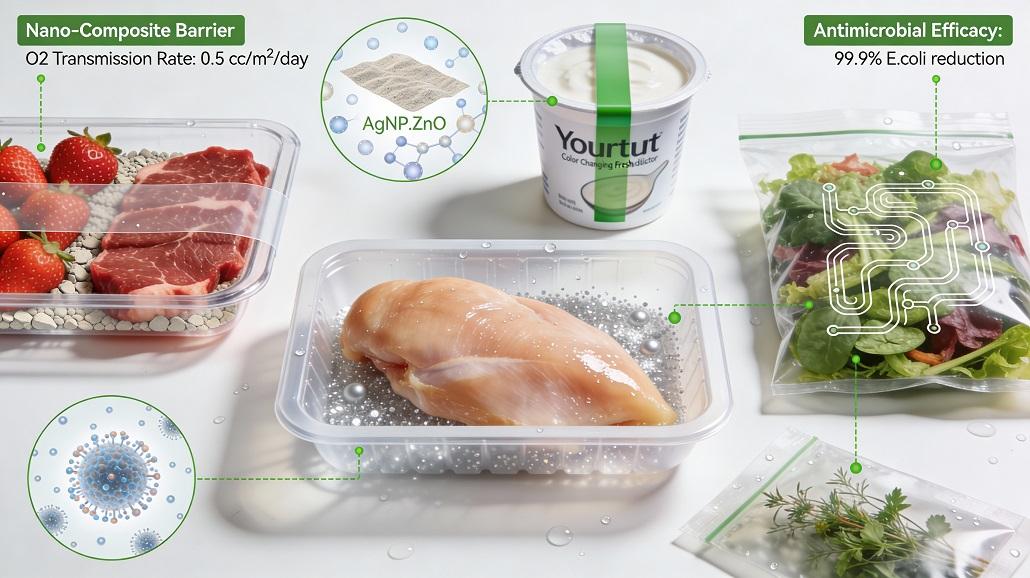
One of the primary and most persistent reasons for food spoilage is the ingress of environmental oxygen and moisture, which facilitates the rapid growth of aerobic bacteria and the oxidation of sensitive fats and oils. Traditional packaging materials, while effective to a point, often have microscopic pores or structural weaknesses that allow these gases to slowly pass through over time. Nanotechnology in food packaging solves this problem with surgical precision by incorporating nano-composites, such as specialized nano-clays, directly into the polymer matrix of the packaging film. These plate-like structures, which are only a few nanometers thick, create what scientists call a “tortuous path” for gas molecules, making it significantly more difficult and time-consuming for oxygen to reach the food. This dramatically enhanced barrier performance is a cornerstone of shelf life extension, allowing fresh produce, premium meats, and delicate dairy products to stay viable and nutritious for days or even weeks longer than before. This is especially essential for long-distance international transport, where time is the primary enemy of freshness.
The Rise of Active Antimicrobial Packaging Systems
Perhaps the most significant and safety-critical breakthrough in the field is the development of active antimicrobial packaging. By precisely embedding metal nano-particles such as silver (AgNP), zinc oxide (ZnO), or titanium dioxide (TiO2) directly into the packaging film or tray, manufacturers can create a surface that is naturally hostile to a wide range of bacteria, fungi, and viruses. These nano-particles work by disrupting the cell membranes of microorganisms or interfering with their metabolic processes, effectively neutralizing them upon contact. Unlike traditional chemical preservatives that must be added directly to the food, these antimicrobial agents remain safely within the structure of the packaging, providing a continuous, long-term protective shield without altering the food’s taste, texture, or chemical composition. This technology is particularly valuable for minimizing the risk of devastating foodborne illnesses like E. coli, Listeria, and Salmonella, which cost the global economy billions and claim thousands of lives each year.
Smart Nano-Sensors and Real-Time Freshness Monitoring
While enhanced barrier properties and antimicrobial effects are “active” features, nanotechnology in food packaging also enables “intelligent” functions through the integration of sophisticated nano-sensors. These sensors can be engineered to detect specific gases, such as ethylene (which triggers ripening) or carbon dioxide, or even subtle changes in pH levels that occur as food begins to break down or spoil. Instead of consumers and retailers relying on a static, often conservative “best before” date which is essentially an educated estimate they can now look at a color-changing indicator on the package that provides an accurate, real-time assessment of the product’s actual freshness and safety. This level of granular transparency not only enhances food packaging safety but also gives consumers the confidence to consume products that might otherwise be thrown away prematurely based on an arbitrary date label, directly addressing the heart of the food waste crisis.
Sustainability and the Global Reduction of Food Waste
The positive environmental impact of nanotechnology in food packaging is profound and two-fold. First, by significantly extending the shelf life of products, it directly and measurably reduces the amount of food that ends up in landfills, thereby significantly lowering the carbon footprint and methane emissions of the global food supply chain. Second, the use of high-performance nano-materials often allows for a process called “lightweighting” the ability to create thinner, stronger packaging that uses significantly less plastic or total material overall to achieve the same or better protection. Furthermore, researchers are currently pushing the boundaries of green science by exploring the use of bio-nanocomposites, which combine nano-particles with biodegradable and compostable polymers like polylactic acid (PLA). These advanced food packaging materials offer the high-performance benefits of nanotechnology while remaining fully compostable, addressing the urgent and growing need for sustainable packaging solutions in an increasingly plastic-conscious global society.
Addressing Safety Concerns and Rigorous Regulatory Frameworks
As with any powerful emerging technology that involves the manipulation of matter at such an incredibly small scale, the use of nanotechnology in food packaging is subject to rigorous and ongoing safety evaluations by international bodies. The primary and most frequently cited concern is the potential migration of nano-particles from the packaging material into the food itself. Regulatory bodies such as the FDA in the United States and the EFSA in Europe have established strict guidelines, safety thresholds, and testing protocols to ensure that these materials do not pose any risk to human health when used as intended. Current scientific research indicates that when nano-particles are properly “tethered” or chemically bonded within the polymer matrix of the packaging, the risk of significant migration is extremely low. Continuous, independent, and peer-reviewed monitoring is essential to maintaining public trust and ensuring that the vast benefits of nanotechnology are realized safely, ethically, and transparently.
The Future: From the Laboratory to the Supermarket Aisle
As we look toward the next decade of innovation, the integration of nanotechnology in food packaging will likely move from specialized, niche applications into the mainstream of the global grocery industry. We can expect to see the rise of “programmable” packaging that can intelligently release specific antioxidants, vitamins, or natural preservatives into the food over time based on the package’s internal environment. We may also see the development of “self-healing” materials that can automatically seal small punctures or scratches sustained during shipping, preserving the internal atmosphere and preventing contamination. The combination of integrated nano-sensors with blockchain technology will allow for a fully traceable, immutable “farm-to-fork” journey where the safety, origin, and quality of every single item are guaranteed to the consumer. By continuing to bridge the gap between advanced material science and biology, nanotechnology will ensure that the future of the global food supply is safer, more sustainable, and more resilient than it has ever been in human history.
The Role of Nano-Encapsulation in Flavor Preservation
Beyond safety and shelf life, nanotechnology is also being used to enhance the sensory experience of food. Nano-encapsulation allows for the protection of volatile flavor compounds and sensitive nutrients that would otherwise degrade during the high-heat processes often used in commercial packaging. By trapping these molecules in nano-sized “capsules,” they are protected from oxygen and light until the package is opened or the food is consumed. This ensures that the food retains its original, fresh-picked taste and full nutritional value, even after weeks in storage. This application of nanotechnology in food packaging is a major win for the “clean label” movement, as it allows manufacturers to deliver high-quality, flavorful products without the need for synthetic flavor enhancers or artificial stabilizers, further aligning modern technology with the consumer’s desire for natural, healthy food.
Conclusion: A Sustainable and Secure Food Future
In conclusion, nanotechnology is not just a scientific curiosity but a vital industrial tool that is solving some of the most pressing challenges of our time. By providing the means to keep food fresh for longer, detect spoilage before it becomes dangerous, and reduce our reliance on non-recyclable plastics, nanotechnology in food packaging is paving the way for a more secure and sustainable world. While the journey from the laboratory to global scale is filled with technical and regulatory hurdles, the progress made thus far is incredibly promising. As we continue to refine these molecular tools, the dream of a zero-waste, 100% safe food supply chain becomes not just a possibility, but an impending reality. The small scale of nanotechnology is, quite literally, making a massive difference in the lives of billions of people around the globe.