


















The packaging industry is standing at the threshold of a new industrial revolution, one where the physical machines on the factory floor are governed by an invisible, intelligent layer of software. Artificial intelligence is no longer a futuristic concept confined to the tech sector; it has become a practical, essential tool for modern manufacturers. By implementing AI in packaging printing, businesses are moving beyond simple automation and into the realm of “smart” production. These AI-driven workflows can learn from experience, predict future events, and make complex decisions in milliseconds, solving the most persistent challenges in color management, maintenance, and logistics.
The Power of Predictive Maintenance in Eliminating Downtime
In any high-volume printing operation, the most significant enemy of profitability is unplanned downtime. When a high-speed press breaks down, the costs ripple through the entire organization from missed delivery deadlines and wasted materials to the expensive rush fees for replacement parts. Traditionally, maintenance was either “reactive” (fixing things when they broke) or “preventative” (replacing parts on a fixed schedule, regardless of their actual condition).
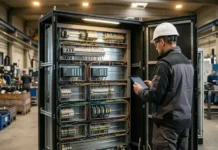
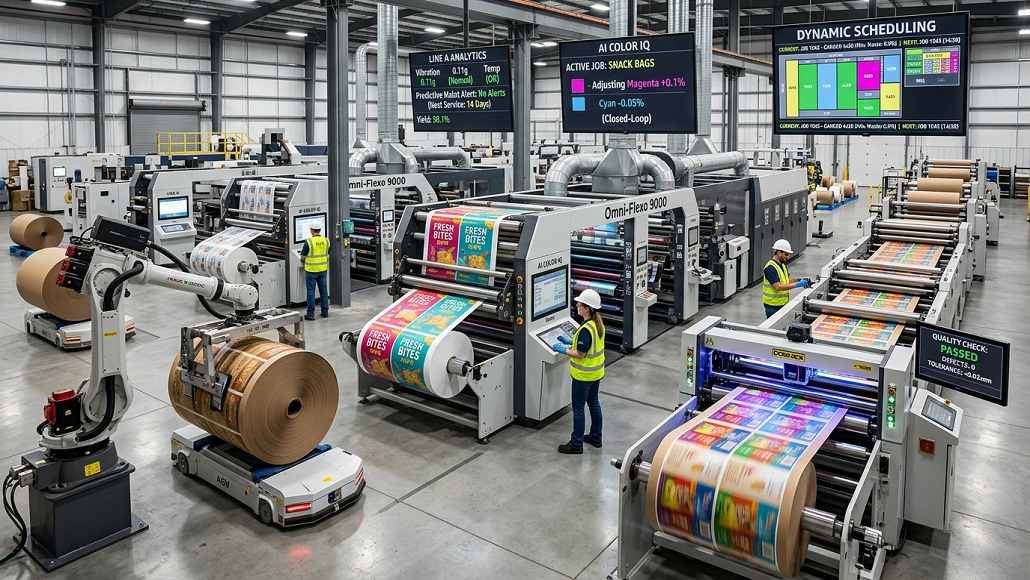
AI in packaging printing introduces a third, much more efficient model: predictive maintenance. By embedding hundreds of sensors throughout a printing press, manufacturers can collect real-time data on vibration, temperature, motor torque, and even the sound of the machine. An AI system analyzes this data, looking for the tiny, invisible patterns that precede a mechanical failure. For example, a slight increase in the heat generated by a bearing might indicate that it will fail in three days. The system can automatically alert the maintenance team and even order the necessary part, allowing the repair to be scheduled during a natural gap in production. This shift from “fixing” to “preventing” can increase machine uptime by over 20%, directly impacting the bottom line.
Revolutionizing Pre-Press with Intelligent File Optimization
The impact of AI is equally profound in the pre-press department, where the “digital printing workflow” begins. One of the most complex tasks in packaging is “ganging” or “nesting” the process of arranging different box designs on a single sheet of material to minimize waste. When you have dozens of different shapes and quantities to produce, the number of possible combinations is astronomical. While a human operator might find a “good” layout in thirty minutes, an AI algorithm can find the “perfect” layout in seconds, often saving 5% to 10% in material costs.
Furthermore, AI-driven systems are becoming incredibly adept at quality control. During the file preparation stage, AI can automatically detect and correct potential printing issues that a human eye might miss, such as hair-thin lines that are too small to print or colors that will be difficult to achieve on a specific substrate. This “right-first-time” approach ensures that the production floor never receives a file that is destined to fail, saving countless hours of rework and thousands of dollars in wasted ink and paper.
Achieving Perfection through AI-Enhanced Color Management
For a global brand, color consistency is non-negotiable. Whether a consumer sees a product in a supermarket in London or a boutique in Tokyo, the brand’s signature colors must match perfectly. Achieving this consistency is notoriously difficult because different materials (such as corrugated board, plastic film, or aluminum) absorb ink differently. Traditionally, “matching” these colors was a manual, artisanal process that required years of experience and a significant amount of trial and error.
AI in packaging printing is turning this art into a science. Intelligent color management systems use machine learning to build “profiles” of how different presses and materials behave under various environmental conditions. When a new job is started, the AI can predict exactly how the ink will react with the substrate and make the necessary adjustments to the color files automatically. These systems continue to learn from every job they run, becoming more accurate over time. By reducing the number of “test pulls” needed to achieve the correct color, AI not only ensures brand integrity but also significantly reduces the consumption of expensive inks and substrates.
Dynamic Scheduling and Resource Optimization
Managing the production schedule of a busy packaging plant is a logistical nightmare. Every day brings a new mix of urgent orders, long-term contracts, and varying material availability. A human scheduler must balance these factors while trying to minimize machine idle time and maximize efficiency. AI-driven scheduling systems can process these thousands of variables simultaneously to create the optimal production sequence.
These “smart” schedules do more than just put jobs in order. They can optimize for “color similarity” sequencing jobs with similar ink profiles to minimize the time and chemicals needed for wash-ups between runs. They can also factor in energy costs, scheduling the most power-hungry processes for times when utility rates are lower. Because the AI is connected to the real-time data from the shop floor, it can instantly reroute work if a machine goes down or if a customer places an emergency order, ensuring that the facility always operates at its theoretical maximum efficiency.
The Human-AI Partnership: Elevating the Role of the Printer
One of the most important aspects of the transition to AI in packaging printing is the evolving relationship between the technology and the workforce. There is often a fear that AI will replace human expertise, but the reality is quite the opposite. AI excels at processing vast amounts of data and performing repetitive, high-speed calculations tasks that are taxing and error-prone for humans. However, AI lacks the creativity, empathy, and strategic thinking that human professionals bring to the table.
By taking over the “heavy lifting” of data analysis and routine adjustments, AI allows print professionals to focus on higher-level tasks. A press operator becomes a “process manager,” overseeing an intelligent ecosystem and making strategic decisions based on the insights provided by the AI. This partnership leads to a more fulfilling work environment and a more robust business model. The most successful packaging companies will be those that view AI not as a replacement for their people, but as a powerful amplifier of their talent.
Looking Toward the Horizon: Generative AI in Packaging Design
As we look to the future, the next frontier for AI in packaging printing is generative design. We are already seeing the first stages of systems that can take a brand’s assets and create thousands of unique, print-ready packaging designs in seconds. This will enable a level of personalization that was previously unthinkable, allowing brands to create unique “limited edition” packaging for every individual customer.
Furthermore, AI will play a central role in the development of more sustainable packaging materials. By analyzing the molecular structure of different polymers and fibers, AI can help scientists discover new, compostable coatings and stronger, thinner materials that use less raw resource. The marriage of AI and material science will likely lead to the biggest sustainability breakthroughs of the next decade, ensuring that the packaging industry can meet its environmental obligations while continuing to grow.
A Vision for the Data-Driven Packaging Plant
The transformation of packaging printing operations through AI is not just a trend; it is a necessary evolution. In an industry defined by thin margins and high complexity, the ability to turn data into a competitive advantage is the ultimate differentiator. AI-driven workflows provide the visibility, precision, and agility needed to thrive in a global market that is moving faster every day.
For manufacturers, the message is clear: the transition to AI is no longer optional. The technology is here, it is proven, and it is delivering a massive return on investment. By embracing AI in packaging printing, companies are not just buying a piece of software; they are investing in a smarter, more resilient, and more sustainable future. The data-driven packaging plant is here, and it is redefining what is possible in the world of print.