






















Batch coding machines play a pivotal role in modern packaging compliance by automatically printing essential information such as batch numbers, production dates, and expiration dates on products and their packaging. These machines are critical enablers of traceability. Each batch code ties a group of items to specific production details, allowing manufacturers to track products through manufacturing, distribution, and even at point of sale. In fact, batch coding is critical for traceability, enabling a single item to be traced through all stages of production, processing, and distribution. Governments and industry bodies are increasingly mandating clear batch codes and labeling. For example, the EU’s General Product Safety Regulation requires type, batch or serial numbers on most consumer products, and the FDA’s upcoming FSMA traceability rule will require food packaging to carry accurate lot codes by 2028. By ensuring that every package bears a legible, standardized code, batch coding machines safeguard regulatory compliance and brand reputation.
Key roles of batch coding machines in packaging compliance include:
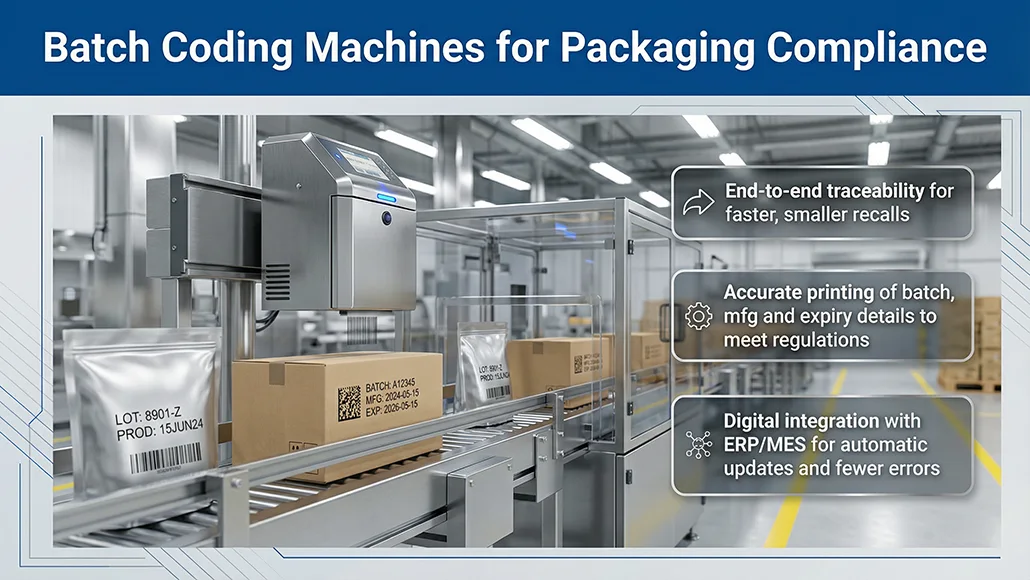
- Enhancing Traceability: Each batch code acts as a breadcrumb trail linking a product to its production records. When a defect or safety issue is discovered, the batch code lets you trace affected units fast, limit the scope of a recall, and show customers you’re in control. This means only the affected batches need to be removed, reducing costs and protecting consumers.
- Ensuring Regulatory Labeling: Automated coders ensure labels meet requirements (e.g. including lot numbers, expiry dates, country of origin). Industries from food to cosmetics are tightly regulated. For instance, cosmetic packaging must follow strict labeling regulations under BIS, FDA, and EU Cosmetics Regulation with batch codes and expiration dates mandatory for traceability. Similarly, food and beverage packaging must display batch numbers and allergen information in formats mandated by regulatory bodies like the FDA or EFSA. Batch coding machines reliably print all required data without error.
- Maintaining Quality and Safety: Clear, permanent codes prevent confusion on the line and at retail. Advanced printers can produce high-resolution, tamper-evident markings (such as barcodes and data matrices), which aids scanning and authentication. According to industry sources, modern batch coders deliver consistent print placement and uniform quality and can even print on irregular surfaces without smudging.
- Integrating with Digital Systems: Many machines now connect to enterprise systems. With Ethernet, wireless or cloud-enabled interfaces, batch coders fetch data from ERP and MES platforms in real time. This integration facilitates automated code updates, real-time monitoring, and compliance reporting, reducing human error and simplifying traceability. Batch information can flow seamlessly from production software to the printer and back to central records.
- Supporting Recalls and Accountability: By permanently marking each unit with its batch code, these machines protect brands. In case of a recall, products with the same batch code can then be withdrawn from sale at a reduced cost. Clear coding also deters counterfeiting and builds consumer trust, as shoppers can be confident a product is genuine and within its use period.
Regulatory and Industry Drivers
Global regulatory bodies are tightening packaging and labeling rules, making batch coding machines indispensable. In the pharmaceutical sector, strict serialization and traceability laws require precise, tamper-evident coding. For example, U.S. regulations (like FDA’s UDI) and the EU Falsified Medicines Directive (FMD) mandate unique codes on drug packages to combat counterfeit medicines. Coding machines in pharma must produce high-contrast, high-resolution identifiers that remain legible through distribution.
In the food industry, the FDA’s Food Traceability rule (FSMA Section 204) now requires certain foods to carry batch or lot codes linked to production records. The FDA extended the compliance date to July 2028, emphasizing that packaging must include accurate batch or lot codes to track products throughout the supply chain. In practice, this means every can, carton or pouch must bear a code that connects it to farm, ingredient, and processing data. The European Food Safety Authority (EFSA) and other bodies similarly enforce labeling (allergen info, expiration, etc.) on food packaging.
Cosmetics and personal care products are also highly regulated. Global guidelines (EU Cosmetics Regulation, FDA rules, India’s BIS standards, etc.) require cosmetic packages to display batch numbers, manufacturing and expiry dates. These codes ensure recall readiness and reassure consumers about product safety. In fact, cosmetics is one of the most counterfeited sectors; unique batch and QR codes printed by coding machines help verify authenticity.
Across industries, non-compliance can be costly. Automated batch coding helps companies fulfill requirements without manual checks. As one expert notes, failure to comply on labeling can lead to costly recalls, legal penalties, and reputational damage. Ensuring each package is coded correctly is thus not just operational detail, but a regulatory imperative.
Batch Coding Technologies in Packaging
Modern production lines use various batch coding machines tailored to the application. At the simplest level are manual coders (hand stamps or rollers) for small runs, but most factories deploy semi-automatic or automatic systems on conveyor lines. Coding methods are broadly split into contact and non-contact systems. Contact coders (like thermal transfer printers) require the print head to touch the package surface; they are common for labels, shrink sleeves and some film packaging. Non-contact coders (inkjet and laser) spray or etch codes without touching the item, which is ideal for fast-moving lines and diverse materials.
Among the technologies:
- Thermal Transfer Overprinters (TTO): Often used in food and flexible packaging, TTO machines use a heated ribbon to print high-quality text and barcodes on films or pouches. They are valued for clear, smudge-resistant codes and are built into sealing machines and wrappers.
- Continuous Inkjet (CIJ): CIJ coders use fast-drying liquid inks to mark on most surfaces, even curved or glossy ones. These are workhorses in beverage bottling and F&V lines. CIJ printers excel at high speeds and can run 24/7 with minimal intervention. Manufacturers highlight their industrial design (e.g. metal housing) and ability to print on plastics, glass or metals.
- Thermal Inkjet (TIJ): TIJ printers eject ink droplets in high resolution, producing razor-sharp text, barcodes and 2D codes. They have no bulky moving parts and are often chosen for carton lines, labels, or anywhere crisp printing is needed. For example, TIJ systems suit medical and electronics sectors where code clarity is crucial.
- Laser Marking: Laser coders engrave or etch the surface with beams of light, producing permanent, high-contrast marks. They are ideal for premium or difficult materials (glass bottles, metal packaging, etc.) where ink might fade or smear. Laser markings are tamper-proof and ink-free (aligning with sustainability goals), although initial costs are higher.
Choosing the right technology depends on the production speed, packaging material and required code quality. High-speed lines (e.g. bottling) often favor non-contact coders to avoid any line interference. Small or detailed packaging (like cosmetics bottles or small pharmaceuticals) may need TIJ for its fine print.
As packaging moves toward digital and automated solutions, coding machines evolve too. Today’s printers feature touchscreens, smart diagnostics and modular designs. They can dynamically fetch printing information (batch codes, dates, graphics) from connected databases or ERP systems, so that each product is coded with the latest data. This smart automation reduces errors: once the correct code is set, products feed through and are marked automatically until settings change.
Integration with Digital Systems
In the era of Industry 4.0, batch coding machines are increasingly integrated into the production IT environment. Modern coders come with built-in network connectivity (Ethernet, Wi-Fi, cloud links), making them part of the digital factory. This connectivity allows two-way communication: the machine can automatically update its code templates from an ERP or MES, and send status or code data back for tracking.
For instance, many batch printers now support OPC-UA or proprietary Industry 4.0 protocols. As one expert notes, they offer Industry 4.0-ready coding automation software, allowing you to integrate your batch coding machine into existing systems, and fully automate the batch coding process across multiple printers and lines. In practical terms, this means if a production supervisor changes a product SKU in the ERP, the new batch code sequence instantly updates on all relevant coders on the line.
This tight integration brings important compliance benefits. Automated code updates eliminate the risk of human entry errors in batch numbers or dates. Real-time monitoring ensures that if a coder goes offline or prints an unreadable code, alerts can be generated immediately. Data such as time, date and code printed can be logged in central systems, creating an audit trail. Indeed, seamless integration with conveyor systems, MES and quality control equipment reduces human error and simplifies traceability.
Cloud platforms further advance these capabilities. Some manufacturers offer software where line managers can design and distribute print layouts across all sites, monitor machine health remotely, and track production metrics in dashboards. In effect, batch coding becomes part of a broader digital transformation: codes aren’t just printed on packages, they feed into an end-to-end traceability chain. In highly regulated industries, this integration is invaluable. It means that at any point, a compliance officer could scan a code on a shipped product and immediately retrieve the full batch record from the ERP or cloud database.
Industry Applications and Benefits
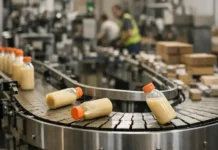
Every day, batch coding machines run in thousands of plants worldwide. In the food and beverage sector, they mark cartons of milk, cans of soup, and condiment pouches with best-by dates and lot numbers. This is essential for food safety: if contamination is detected in one day’s production, only that specific coded batch is recalled. The printers also often add barcodes or GS1 data matrix codes that carry batch data, linking physical goods to digital records.
In pharmaceuticals, coding machines are part of compliance lines that also perform serialization. They print clear lot codes and expiration dates on blister packs, vials, and labels. Given the stakes, these machines must achieve high print precision and durability. Laser or high-resolution inkjet coders are common in pharma, as they resist solvents and sterilization processes. Moreover, the need for secure record-keeping in pharma means batch coders are often combined with code validation scanners that verify print quality in real time.
The cosmetics and personal care industry also relies on coding for compliance and brand protection. A cosmetics maker’s packaging, from lipstick tubes to shampoo bottles, must include batch codes per regulations (and often an expiry or PAO indicator). Batch coders for cosmetics must handle a variety of substrate shapes and materials (metal compacts, glass jars, plastic tubes). As one industry guide explains, marking solutions like CIJ, TIJ or laser can all find a place for instance, using high-speed CIJ for moving bottles and laser for engraving batch info on premium glass perfume bottles. These machines help ensure that exported cosmetics meet the labeling standards of every market they enter, maintaining global compliance.
Across all these industries, the operational benefits of batch coding machines are significant. Automated coders boost efficiency by eliminating slow, error-prone manual marking. They maintain consistent code quality under high throughput, which is critical for products scanned at checkout or scanned for verification. By delivering consistent, accurate information without hindering overall production, the right coding equipment enhances productivity.
Equally important is brand trust. Clear, professional batch codes signal to regulators and consumers that a company takes safety seriously. Research indicates that properly coded packaging enhances brand credibility and can even translate into higher retailer trust. In tight supply chains, a single unreadable code can block shipments. Modern coders come with vision systems to verify every code immediately after printing, flagging any issues before products leave the plant.
Ensuring Compliance with Modern Solutions
The bottom line is that batch coding machines are no longer a nice-to-have convenience; they are a core element of quality systems. The right equipment not only adds value through clear, consistent coding but also supports your business’s reputation, compliance efforts, and adaptability to changing market demands. As regulators worldwide push for greater transparency and traceability, manufacturers must upgrade their marking solutions.
For businesses planning or refreshing packaging lines, that means choosing coding technology that meets current standards and is future-proof. Key considerations include compatibility with packaging materials, ease of code changeover (for frequent batch variations), and connectivity for data integration. Maintenance and consumable costs (inks, ribbons) are also factors for instance, lasers trade higher upfront cost for no ink consumption. Ultimately, a robust coding strategy includes operator training, validation of print quality, and scheduled audits of coding data against production records.
In conclusion, batch coding machines have evolved into intelligent, networked devices that underpin modern packaging compliance. They tie physical products to digital data, streamline recalls, and ensure that every box or bottle leaving the plant meets regulatory requirements. With technologies ranging from inkjet to laser and with built-in Industry 4.0 connectivity, these machines help companies keep pace with evolving standards and consumer demands. Investing in effective batch coding solutions is essential for any manufacturer who needs to guarantee product safety and regulatory alignment while maintaining efficient, automated operations.