










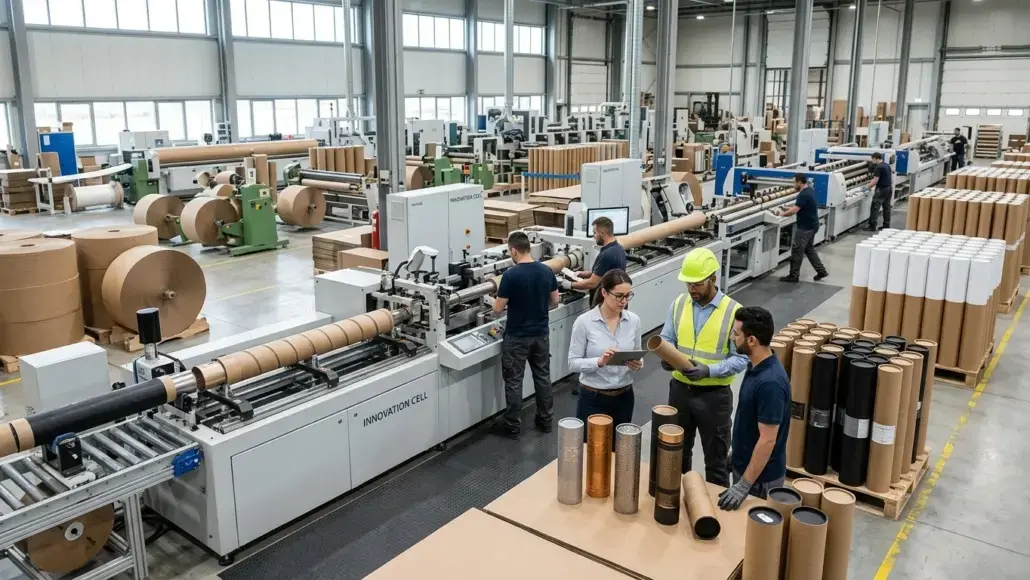

Innovation in packaging rarely happens in R&D departments. It happens when a brand comes to a manufacturer with a problem nobody has solved yet, and the manufacturer decides to say yes instead of defaulting to standard specifications.
The cardboard tube packaging industry has undergone quiet but significant evolution over the past five years. Not through revolutionary material science breakthroughs, but through manufacturers willing to invest in customer-specific solutions that later become industry standard offerings. This is how innovation actually works in B2B packaging.
When Standard Tubes Stop Working
Cardboard tubes have remained functionally unchanged for decades: cylindrical shapes, push-fit caps, standard diameters, basic printing. For commodity products, this works fine. But brands competing on differentiation, premium positioning, or specialized applications repeatedly hit the same wall: the tube they need doesn’t exist yet.
A supplement brand positioning as premium finds that standard round buttons on push-lock mechanisms don’t match their minimalist geometric aesthetic. A cosmetics company targeting arthritis-prone consumers needs better ergonomics than a standard push-to-open design provides. A luxury brand wants their tube to transform under LED backlighting. None of these are unreasonable requests. They just weren’t standard offerings.
Until someone decided to make them standard.
The Innovation Projects Reshaping the Industry
Several manufacturers have begun systematically documenting customer requests that require tooling redesigns or material innovations. What emerges is a clearer picture of where the market is actually moving:
| Innovation Type | Customer Driver | Industry Impact | Current Status |
| Custom locking mechanisms | Supplement brands needing child-resistant compliance without standard round buttons | Square, hexagonal, and custom-geometry lock buttons now available | Becoming standard offering |
| Translucent tube materials | Luxury brands wanting visual product showcase inside tube | Premium segment moving toward visibility as brand feature | Lab testing phase |
| Mono-material construction | Regulatory pressure and brand commitment to 100% recyclability | Elimination of mixed materials, single-stream recyclability | Partial commercial availability |
| Temperature-adaptive barriers | Cold-fill and hot-fill applications requiring dynamic protection | Barrier performance adjusts to product temperature | Development phase |
| Light-responsive finishes | Premium supplement and beauty brands creating unboxing moments | Tubes that change appearance under different lighting conditions | Custom orders, not yet standardized |
What’s notable about this table is that none of these innovations came from packaging theorists. They came from brands saying, “Here’s what we need to succeed,” and manufacturers investing the capital to deliver it.
The Economics of Custom Innovation
There’s a misconception that custom tube solutions require massive order volumes to justify the tooling investment. Manufacturers operating at traditional scales (50,000+ unit minimums) have built their business model around spreading setup costs across huge production runs. This made custom solutions economically inaccessible for emerging brands.
But the economics change when minimum order quantities drop. A manufacturer setting a 1,000-unit MOQ can invest in custom tooling because even smaller orders justify the upfront engineering cost when the client is committed to reorders. This structural change has opened the innovation pipeline.
Brands that previously had to compromise on packaging design accepting standard tubes that didn’t quite fit their brand vision can now design tubes specifically for their market position. A small supplement brand can test premium custom tubes at 1,000 units, prove the market, and scale to 10,000 units knowing the packaging works.
Real-World Examples From Recent Projects
One contemporary example: a cosmetics brand targeting older consumers and arthritis-affected users needed better grip on their push-lock mechanism. Standard round buttons provided minimal tactile feedback. The solution was a square lock button with textured surface simple conceptually, but required complete tooling redesign.
Another: a luxury supplement brand wanted their tube to visually represent their brand story. The tube needed to look like an urban skyscraper when backlit. This required experimentation with translucent paper composites, internal light-diffusion structure, and custom printing placement. The resulting tube became a premium unboxing moment the packaging itself was part of the product experience.
A third involved a food brand needing oil-resistant barrier properties but insisting on 100% mono-material construction for recyclability. The challenge: traditional barrier coatings require multiple material layers. The solution involved developing water-based barrier treatments that maintained food-safety certification while using only paper and plant-based compounds.
None of these were innovations in the abstract. They were direct responses to market problems that brands brought to their manufacturing partners.
How Brands Are Now Approaching Packaging Design
The shift in how premium brands approach paper tube packaging has changed expectations across the industry. Instead of asking “What tubes do you have available?” brands now ask “What tube do we need, and can you build it?”
This inversion of the question changes everything. Manufacturers responding to this demand are forced to develop faster prototyping, maintain flexible tooling, and invest in materials research beyond what traditional commodity manufacturing required.
Earthycores, operating across multiple markets from coffee to supplements to cosmetics, has systematized this approach. Their development model treats customer-specific requests as the primary innovation pipeline. When a customer brings a problem, it goes through lab evaluation, prototype testing, and commercial production. Problems solved for one brand often become offered services for others.
What This Means for Industry Standards
As individual innovations move from custom solutions to standard offerings, the baseline for “acceptable tube packaging” has shifted. Five years ago, a premium brand accepted standard round tubes because alternatives didn’t exist. Today, they expect design options that reflect their brand positioning.
This compression of innovation cycles from custom problem to standard offering in 12-24 months—is reshaping how manufacturers think about product development. The question isn’t “What should we build?” but “What problems are brands actually trying to solve, and can we build solutions faster than our competitors?”
Table showing innovation timeline compression:
| Timeline Period | Innovation Velocity | MOQ Requirements | Custom Solution Cost |
| 2018-2020 | Very slow (2-3 years from concept to availability) | 50,000+ units typically required | High engineering investment relative to order size |
| 2020-2023 | Moderate (12-18 months) | 10,000-20,000 units more common | Engineering investment justified by mid-market orders |
| 2023-present | Fast (6-12 months) | 1,000-5,000 unit commitments viable | Lower engineering cost-per-unit enables smaller order viability |
The compression matters because it fundamentally changes who can access premium packaging solutions. Startups and emerging brands no longer have to compromise on packaging to manage capital constraints. They can design packaging appropriate to their brand positioning and validate it at reasonable volumes.
The Certification Challenge in Custom Innovation
One often-overlooked aspect of packaging innovation is certification complexity. A brand creating a new tube design needs to ensure it meets:
– Food-grade safety standards (BRCGS if food contact required)- Compostability certifications (BPI for North America, EN 13432 for EU)- Responsible sourcing (FSC for forest products)- Manufacturing standards (ISO 14001 for environmental practice)- Regional import requirements (different for US, EU, Australia, etc.)
Custom innovation without certification infrastructure becomes a liability. Manufacturers managing multiple markets must maintain certifications across all these categories to support customer innovation. This creates a barrier to entry for smaller manufacturers trying to move into custom solutions.
The brands able to innovate successfully are those whose manufacturing partners have already solved the certification puzzle across multiple geographies.
Where Packaging Innovation is Actually Heading
Based on current development projects and market feedback, several innovation directions are clear:
Interactive packaging: Tubes that function as part of the user experience, not just containment. Light-reactive finishes, temperature-sensitive color changes, scannable sustainability verification.
Material alternatives: Less reliance on traditional petroleum-derived barriers. Algae-based coatings, mycelium composites, enzymatic decomposition systems materials that maintain barrier performance while improving end-of-life sustainability.
Modularity: Tubes designed for disassembly and component reuse. Lids that become storage solutions, tubes that nest for space efficiency, components that separate for targeted recycling.
Customized formulation: Barrier properties, stiffness, and finish tailored to specific product requirements rather than generic specifications.
None of these are theoretical. All are in active development at manufacturers willing to invest in customer-specific solutions. The constraint isn’t technology it’s manufacturer willingness to operate differently than traditional commodity models allow.
The Economics Will Eventually Follow
Currently, custom solutions require higher price premiums and minimum order volumes that limit market penetration. As innovation becomes systematic rather than exceptional, and as custom paper tube packaging solutions for every brand become more competitive offerings, price compression will follow.
The brands leading their categories won’t be the ones accepting standard packaging. They’ll be the ones solving actual market problems through packaging innovation and choosing manufacturing partners willing to invest in making those solutions possible.
The innovation cycle in tube packaging has fundamentally shifted. It’s no longer about what manufacturers want to build. It’s about what brands need to succeed.