


















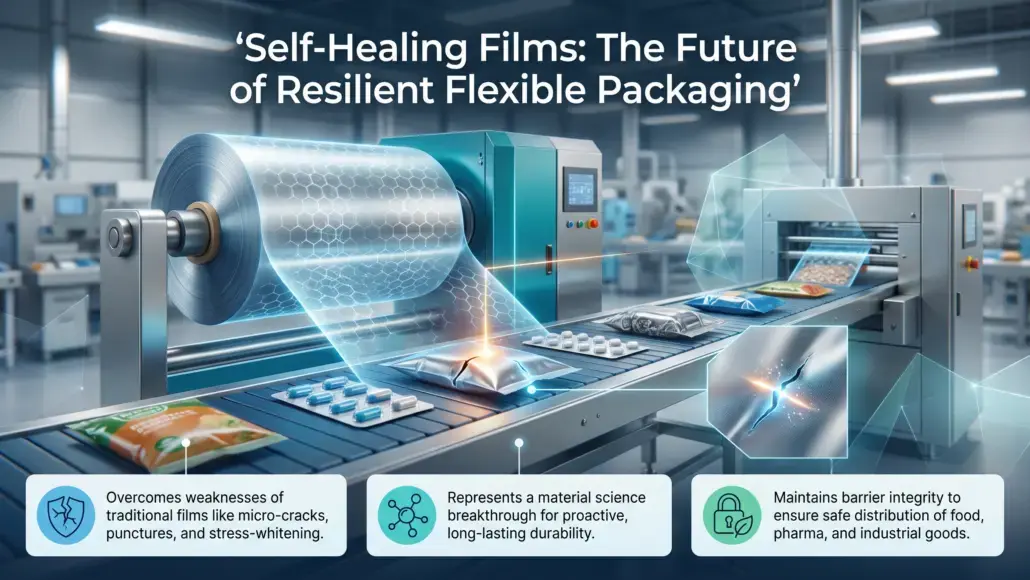
The resilience of flexible packaging is a fundamental requirement for the safe distribution of food, pharmaceuticals, and industrial products. Traditional films, while efficient, are susceptible to micro-cracks, punctures, and stress-whitening that can compromise the integrity of the barrier layer. The emergence of self-healing polymer films improving flexible packaging durability represents a paradigm shift in material science, offering a proactive approach to maintaining package performance. By incorporating molecular mechanisms that allow for the autonomous repair of structural damage, these advanced films extend the life of the packaging and protect the contents from environmental degradation. This development is particularly significant in sectors where even the smallest breach can lead to product spoilage or contamination.
Molecular Mechanisms of Autonomous Repair in Packaging Films
The technology behind self-healing polymer films improving flexible packaging durability generally falls into two categories: intrinsic and extrinsic healing systems. Intrinsic systems rely on the reversible nature of chemical bonds within the polymer matrix itself. When the film is damaged, the polymer chains can re-associate through mechanisms such as hydrogen bonding, metal-ligand coordination, or Diels-Alder reactions. This ability to reform molecular connections at the site of a rupture allows the film to regain its mechanical strength and barrier properties without external intervention. These systems are highly desirable for flexible packaging because they can often undergo multiple healing cycles, ensuring long-term durability even in high-stress environments.
Extrinsic systems, on the other hand, utilize sequestered healing agents within the polymer structure. These agents are typically contained within microcapsules or vascular networks that rupture upon impact or cracking. Once the capsule is breached, the healing liquid flows into the damage site and polymerizes, effectively sealing the crack. The application of these extrinsic self-healing polymer films improving flexible packaging durability is particularly effective for larger punctures or deep abrasions that might exceed the capacity of intrinsic systems. By carefully selecting the type and concentration of these healing agents, manufacturers can tailor the response of the film to the specific types of damage most commonly encountered during a particular product’s life cycle.
The choice between intrinsic and extrinsic systems depends largely on the intended application and the environmental conditions the packaging will face. For instance, films intended for low-temperature environments may require different molecular triggers than those used in ambient or high-temperature settings. The ongoing refinement of these technologies focuses on increasing the speed of the healing process and ensuring that the repaired area maintains the same level of clarity and flexibility as the original material. As these systems mature, they are becoming increasingly integrated into standard multi-layer film structures, providing an additional layer of security for high-value goods.
Enhancing Barrier Integrity and Extending Product Shelf Life
One of the most critical functions of flexible packaging is to act as a barrier against oxygen, moisture, and light. Any physical damage to the film, no matter how small, creates a pathway for these elements to enter the package, which can drastically reduce the shelf life of the enclosed product. The use of self-healing polymer films improving flexible packaging durability is a direct response to this vulnerability. By automatically sealing micro-cracks before they can expand, these films ensure that the barrier remains intact throughout the entire supply chain. This is especially vital for modified atmosphere packaging, where the maintenance of a specific gas composition is essential for preserving the freshness of perishables.
The economic implications of reduced spoilage are substantial for both retailers and producers. Food waste is a major global challenge, and a significant portion of this waste occurs due to packaging failures during transport and handling. By adopting advanced repairable materials, companies can significantly decrease the rate of “leakers” and damaged units that must be discarded. This leads to higher yield, reduced logistics costs associated with returns, and improved consumer trust. The ability to maintain a pristine barrier also allows for the potential use of thinner films, as the self-healing properties provide a safety margin that was previously achieved through over-engineering and thicker material layers.
The integration of self-healing properties can improve the performance of functional coatings and laminations. Many flexible packages use thin layers of aluminum or specialized polymers to achieve high barrier performance. These layers are often brittle and prone to cracking when the package is flexed or folded. When incorporated into a system utilizing advanced films, the base film can help mitigate the effects of these cracks by providing a secondary seal or by facilitating the repair of the functional layer itself. This synergistic approach ensures that the high-performance characteristics of the packaging are preserved even under the most demanding physical conditions.
Durability in High-Stress Distribution and E-Commerce Environments
The rise of e-commerce has placed unprecedented stress on packaging systems. Unlike traditional retail supply chains, the e-commerce journey involves a higher frequency of handling, more diverse transportation modes, and a greater risk of impact and abrasion. In this context, advanced films offer a vital solution for maintaining package integrity. The ability of the material to “heal” itself after being subjected to the rough handling typical of parcel delivery services ensures that the product arrives in the same condition it left the warehouse. This reduces the number of customer complaints and the high costs associated with replacing damaged goods.
Flexible pouches and bags are particularly popular in e-commerce due to their lightweight nature and space efficiency. However, their large surface area makes them more susceptible to punctures from other items in the same shipment. The application of durable films provides these formats with a level of toughness that rivals more rigid alternatives. This allows brands to continue using efficient flexible formats without worrying about the increased risk of failure. The psychological impact on the consumer is also important: a package that arrives intact and appears undamaged reinforces the perception of brand quality and reliability.
In addition to physical toughness, the resistance of these films to environmental stressors such as UV exposure and humidity is also being improved. Some self-healing mechanisms are triggered by specific environmental cues, such as moisture or light, which can be used to provide targeted repair in certain climates. The versatility of these systems means they can be optimized for global supply chains where a single package may travel through multiple different climate zones. This adaptability is a key advantage for multinational corporations looking to standardize their packaging solutions while ensuring peak performance across all markets.
Advanced Testing Protocols and Quality Assurance for Repairable Films
To ensure the reliability of these new materials, the packaging industry is developing specialized testing protocols that go beyond standard tensile and puncture tests. These new methods involve inducing controlled damage (such as a specific micro-crack or a precisely sized pinhole) and then monitoring the recovery of the film’s barrier properties over time. Oxygen transmission rate and water vapor transmission rate measurements are conducted before damage, immediately after damage, and after the healing period. This quantitative data allows engineers to determine the exact efficiency of the self-healing mechanism and how it performs under different atmospheric conditions.
Quality assurance in the production of self-healing films also requires a higher level of monitoring. During the extrusion process, the distribution of healing agents or the uniformity of the reversible bond network must be verified to ensure that the entire surface of the film possesses the intended repair capabilities. Advanced imaging techniques, such as infrared spectroscopy and scanning electron microscopy, are used to inspect the morphology of the film at a microscopic level. These tools help manufacturers identify any inconsistencies in the material that could lead to weak spots or failure to heal. By maintaining a rigorous quality control process, producers can guarantee that their films provide the long-term durability required for high-stakes packaging applications.
Future Perspectives on Smart and Responsive Packaging Systems
The development of self-healing films is closely linked to the broader trend toward smart and responsive packaging. As the industry moves toward more interactive systems, the role of these materials will likely expand to include diagnostic functions. For example, some healing agents can be formulated with indicators that change color when a repair has occurred, providing a visible signal that the package has been compromised and subsequently fixed. This type of functionality adds a layer of transparency to the supply chain, allowing quality control teams to identify areas where handling processes might need improvement.
There is also significant research into the combination of self-healing properties with antimicrobial or oxygen-scavenging functions. By embedding these active agents within a self-healing matrix, manufacturers can create a multi-functional film that not only repairs physical damage but also actively works to preserve the product inside. The synergy between these different technologies represents the next generation of packaging materials. The successful implementation of advanced films is a foundational step toward this more complex and capable future. As processing techniques become more refined and material costs decrease, the widespread adoption of these advanced films will become increasingly feasible for a broad range of consumer goods.

