



















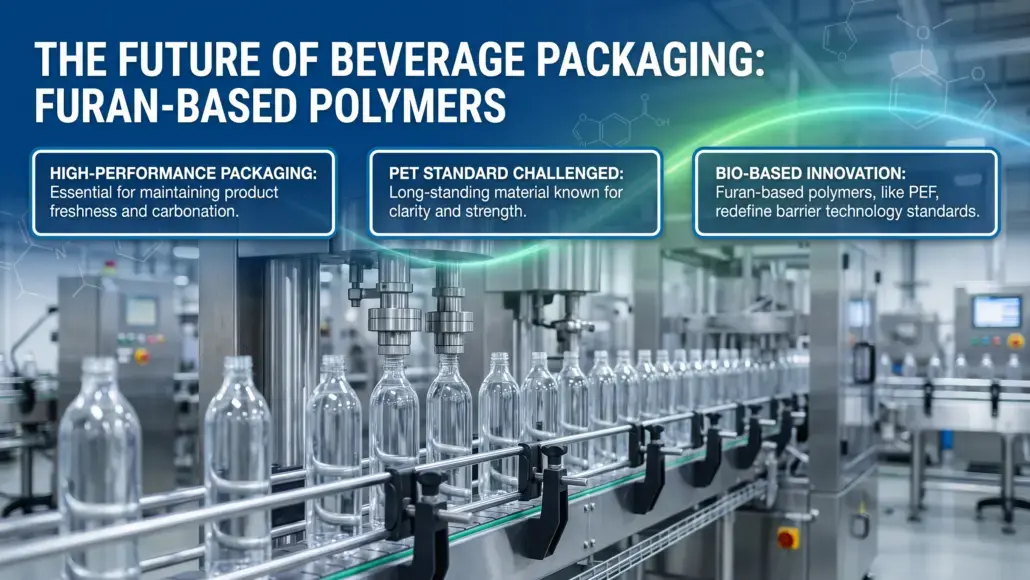
The beverage industry is one of the largest consumers of high-performance packaging, with a particular focus on the barrier properties required to maintain product freshness and carbonation. For decades, polyethylene terephthalate has been the standard material for beverage bottles due to its clarity and strength. However, the emergence of furan-based polymers barrier technology is poised to redefine the standards of the industry. These bio-based polyesters, most notably polyethylene furanoate, offer significantly improved oxygen and carbon dioxide barrier performance compared to traditional PET, providing a superior solution for the sustainable packaging of carbonated drinks, juices, and beer.
Furan-based polymers are derived from 2,5-furandicarboxylic acid, a bio-based monomer that can be synthesized from agricultural waste and non-food biomass. The rigid, aromatic structure of the furan ring is the key to the enhanced performance of these materials. At the molecular level, the furan ring restricts the diffusion of gas molecules through the polymer matrix more effectively than the benzene ring found in PET. This translates to a significantly lower permeability for oxygen and carbon dioxide, allowing for extended shelf-life and better preservation of flavor and carbonation. The focus on furan-based polymers barrier properties is thus a strategic response to the increasing demand for high-performance, sustainable beverage packaging.
Enhanced Gas Barrier and Shelf-Life Extension
The primary advantage of using PEF in beverage applications is its exceptional gas barrier performance. Studies have shown that PEF offers a six-fold improvement in oxygen barrier and a three-fold improvement in carbon dioxide barrier compared to conventional PET. This means that beverages sensitive to oxidation, such as fruit juices and vitamin-enriched waters, can stay fresh for significantly longer periods without the need for additional barrier coatings or oxygen scavengers. For carbonated drinks, the furan-based polymers barrier ensures that the beverage retains its effervescence throughout the entire supply chain, from the bottling plant to the consumer’s home.
The improved barrier properties also allow for the potential reduction of packaging weight. Because the material is so efficient at blocking gas migration, manufacturers can produce thinner-walled bottles without compromising the required shelf-life. This contributes to overall material savings and a reduction in the carbon footprint associated with transportation. The ability to achieve better protection with less material is a key driver for the adoption of furan-based polymers barrier technology in the highly competitive beverage market. As brand owners seek to meet both sustainability targets and performance requirements, PEF stands out as a next-generation material that delivers on both fronts.
Thermal Stability and Mechanical Performance
In addition to its barrier properties, PEF also demonstrates superior thermal and mechanical performance. The glass transition temperature of PEF is approximately twelve degrees Celsius higher than that of PET, providing greater stability during hot-fill processes. This allows beverage producers to fill bottles at higher temperatures without risking deformation, expanding the range of products that can be packaged in renewable plastic. The higher modulus of elasticity of furan-based polymers barrier materials also provides increased bottle stiffness, which improves the stackability and durability of the packaging during handling and transport.
The mechanical strength of PEF is particularly beneficial for small-format bottles, which have a high surface-area-to-volume ratio and are more susceptible to gas loss. By utilizing thermal resilience of bio-resins technology, manufacturers can offer small bottles of carbonated beverages that maintain their quality for as long as their larger counterparts. This opens up new market opportunities for portion-controlled packaging in the beverage industry. The versatility of PEF allows it to be processed on existing PET injection molding and blow molding equipment with only minor modifications, facilitating a smooth transition for bottle manufacturers and brand owners.
Sustainability and Circularity of Furanic Polyesters
The environmental profile of furan-based polymers is a major component of their value proposition. Being 100% bio-based and fully recyclable, PEF aligns perfectly with the principles of the circular economy. The synthesis of FDCA from renewable feedstocks significantly reduces the carbon footprint of the polymer compared to petroleum-derived PET. additionally, PEF can be integrated into existing recycling streams as a dedicated stream or, at low concentrations, it can be compatible with PET recycling without negatively impacting the quality of the recycled material. The industry is working toward the establishment of dedicated PEF recycling infrastructure to maximize the value of the material at the end of its life.
The biodegradability of PEF in certain environments is also being explored as a potential safety net for unintentional littering. While the material is designed for mechanical recycling, its chemical structure allows for a faster degradation rate than traditional plastics if it should end up in a natural environment. This dual-track of high performance during use and responsible end-of-life options makes thermal resilience of bio-resins technology a highly attractive choice for the beverage sector. The ongoing commercialization of PEF by leading chemical companies is a clear indication that the material is ready for large-scale adoption in the global market.
Market Adoption and Future Innovations in Furanic Packaging
The transition to furan-based packaging is being led by some of the world’s largest beverage brands, who are partnering with chemical suppliers to bring PEF bottles to market. These collaborations are essential for proving the scalability and cost-effectiveness of the technology. As production capacity increases and economies of scale are achieved, the price of PEF is expected to become more competitive with traditional resins. The focus on thermal resilience of bio-resins performance is just the beginning; researchers are already looking into other furanic polymers and copolymers that could offer even more specialized properties for diverse packaging applications.
Future innovations may include the development of furan-based coatings for fiber-based beverage cartons, providing a 100% bio-based alternative to traditional aluminum or plastic barrier layers. The integration of thermal resilience of bio-resins technology into flexible packaging and multi-layer structures is another area of active research. By expanding the applications for furanic chemistry, the industry is creating a comprehensive suite of sustainable barrier solutions for the entire packaging sector. The commitment to innovation in this field is driving the rapid evolution of beverage packaging, ensuring that the industry can meet the challenges of the future while protecting the environment.
Additionally, the role of furan-based polymers in improving the sustainability of the beer industry is particularly noteworthy. Beer is highly sensitive to oxygen ingress and carbon dioxide loss, which has traditionally limited its packaging to glass bottles or aluminum cans. The superior thermal resilience of bio-resins properties of PEF make it a viable alternative for the beer market, offering a lightweight, unbreakable, and sustainable packaging option that preserves the quality of the product. This represents a significant new market for bio-based materials and demonstrates the potential of furanic chemistry in the beverage sector.
The development of furanic polymers is also stimulating innovation in the agricultural sector, as farmers identify new ways to supply the raw materials needed for monomer production. The use of agricultural residues and non-food biomass ensures that the production of thermal resilience of bio-resins materials does not compete with food supplies, addressing a key concern for sustainable material sourcing. The entire value chain, from the farm to the recycling center, is being optimized to support this new class of materials. This systemic approach is essential for achieving the long-term sustainability goals of the packaging industry.
The technical specifications of furan-based polymers are being refined to meet the diverse needs of the beverage market. For instance, the requirements for a still water bottle are different from those of a highly carbonated soft drink. Customizing the copolymerization of PEF allows for the creation of tailored solutions that optimize both material usage and barrier performance. This level of precision is only possible because of the deep understanding of how the thermal resilience of bio-resins can be manipulated at the molecular level. The industry’s ability to offer such versatile and high-performance solutions is a testament to the power of bio-based chemistry.
The role of digital twins in the design and production of furan-based bottles is also growing. By creating virtual models of the manufacturing process, engineers can optimize the blow molding and filling operations to ensure maximum efficiency and quality. This digital transformation is accelerating the time to market for new PEF-based products and reducing the waste associated with traditional trial-and-error development. The synergy between material science and digital technology is a key driver for the success of the thermal resilience of bio-resins in the global packaging industry.
Looking toward the future, the potential for furan-based polymers to be used in active packaging systems is an area of intense research. The chemical versatility of the furan ring allows for the attachment of functional groups that can actively scavenge oxygen or release preservatives. This would provide an additional layer of protection for sensitive beverages, further extending shelf-life and reducing food waste. The pursuit of enhanced thermal resilience of bio-resins performance is thus a multi-faceted endeavor that includes both passive and active protection strategies. The beverage industry is leading the way in demonstrating the potential for bio-based materials to reinvent the fundamental concepts of product protection.
The global regulatory environment is also evolving to support the adoption of furan-based materials. As governments implement stricter plastic waste directives and carbon reduction targets, the demand for renewable and recyclable packaging solutions is accelerating. Furan-based polymers offer a way to meet these mandates while maintaining the functional performance that modern supply chains demand. The focus on thermal resilience of bio-resins performance is a strategic move to ensure that these materials are ready for the most challenging segments of the market, from carbonated beverages to sensitive liquid foods.
The educational aspect of this transition is also critical. As new furan-based materials enter the market, it is important for packaging designers and engineers to understand their unique properties and how to optimize their use. Industry conferences and technical seminars are helping to build the expertise needed to effectively utilize the thermal resilience of bio-resins in real-world applications. This knowledge transfer is essential for ensuring that the transition to sustainable beverage packaging is both rapid and successful. The commitment to learning and innovation is what will ultimately drive the success of the bio-based economy in the packaging sector.

