


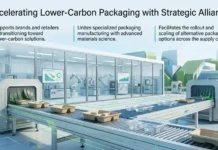











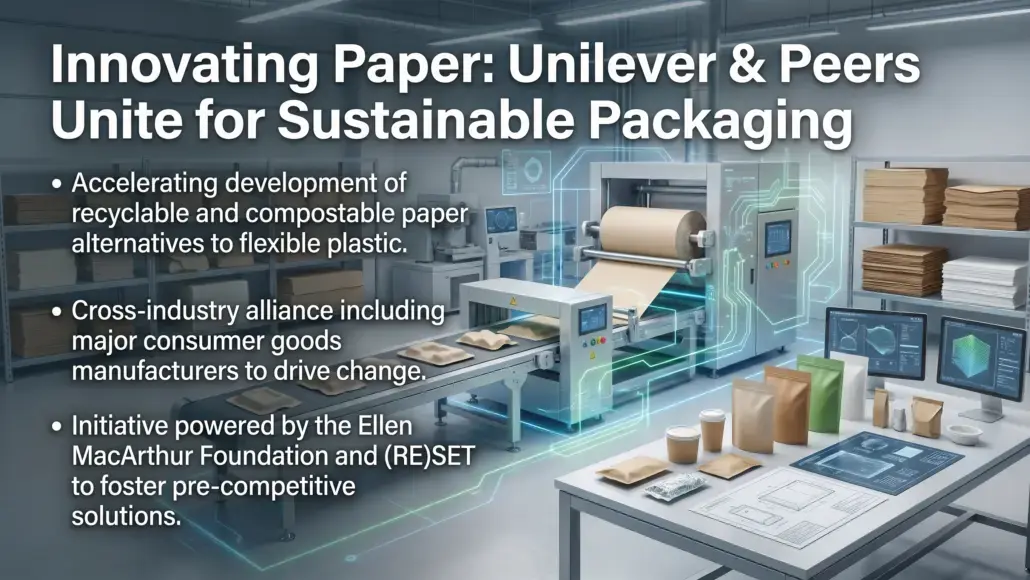

Unilever has joined the PaperFlex Consortium as a founding member to accelerate the creation and deployment of recyclable and compostable paper-based alternatives to flexible plastic packaging formats. Convened by the Ellen MacArthur Foundation and powered by (RE)SET, the cross-industry initiative brings Unilever together with other prominent consumer goods manufacturers, including Nestlé, PepsiCo, Procter & Gamble, Colgate-Palmolive, and Mars. Through this pre-competitive alliance, the participating companies will jointly fund and test advanced paper-based packaging technologies to address critical performance requirements across global supply chains.
Collaborative Funding and Technical Testing
The consortium establishes a unified platform for major consumer goods companies to share the financial investment and technical hurdles inherent in replacing conventional flexible plastic. The joint program focuses on rigorous testing to enhance essential performance criteria, including high-level product protection, extended shelf life, consumer usability, and seamless compatibility with existing high-speed manufacturing lines. These testing parameters are designated to support regional markets where flexible plastic collection systems and local recycling infrastructure remain notably limited. By combining resources, the initiative seeks to expedite the commercial scale-up of viable paper-based packaging for diverse fast-moving consumer products, specifically personal care goods and shampoo formulations.
Unilever Expands Packaging R&D Investments
Alongside its participation in the PaperFlex Consortium, Unilever confirmed that it has more than doubled its corporate investment in packaging R&D in recent years to support sustainable material transitions. The ramped-up packaging R&D commitments are powered by a dedicated team of more than 60 materials scientists focused on engineering next-generation paper materials and high-performance barrier coatings. To date, these internal specialists have evaluated and assessed more than 3,000 distinct technologies to identify solutions capable of safeguarding product integrity while meeting circularity goals.
The shared framework enables members to pool knowledge on complex barrier coatings and processing techniques, reducing the individual risks associated with early-stage material testing. As consumer goods manufacturers pursue scalable solutions for demanding categories like shampoo and broader personal care lines, the shared testing regime provides a structured pathway to validate paper substrates on high-speed equipment. This combined industry focus is designed to fast-track technical breakthroughs and establish resilient paper-based alternatives across manufacturing networks where flexible plastic recycling continues to encounter substantial operational bottlenecks.
Word Count: 366 words