













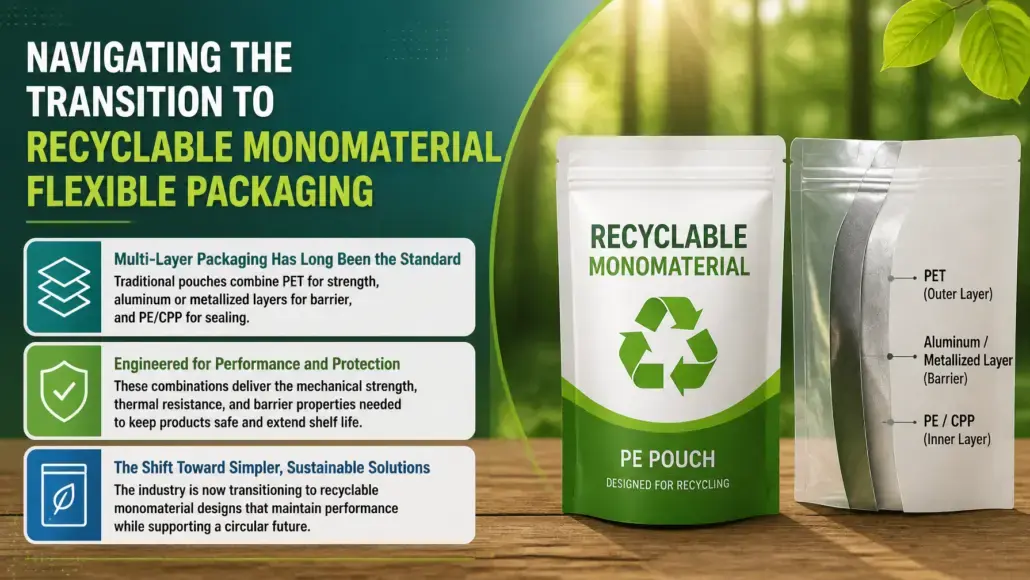
For decades, the flexible packaging sector relied on a singular engineering philosophy: combine disparate materials to achieve optimal performance at minimal weight. A standard dry-food or liquid pouch historically paired an outer layer of polyethylene terephthalate (PET) for mechanical stiffness and thermal resistance during sealing, an intermediate aluminum foil or metallized layer for gas and light barriers, and an inner polyethylene (PE) or cast polypropylene (CPP) web for hermetic sealing.
While chemically effective and resource-efficient in terms of raw material consumption, these multi-material laminates presented an insurmountable barrier to mechanical recycling. The thermodynamic incompatibility of combining polar polymers like PET with non-polar polyolefins causes catastrophic phase separation during reprocessing, yielding brittle, degraded recyclate that has little commercial utility.
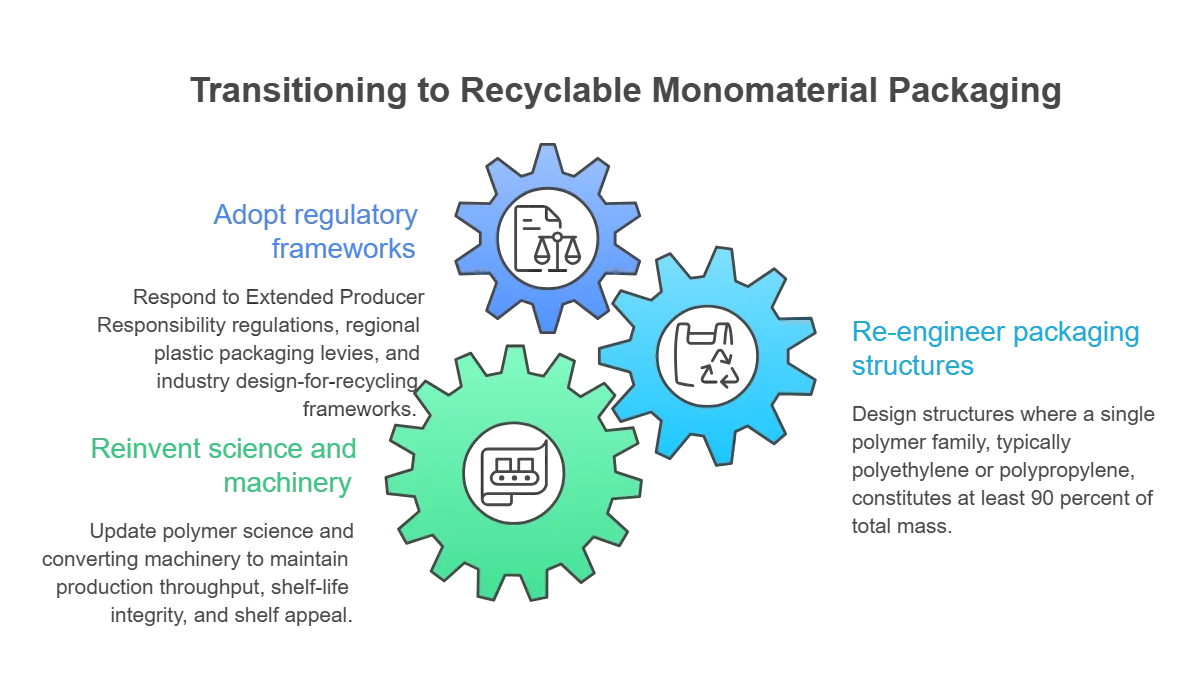
Driven by Extended Producer Responsibility (EPR) regulations, regional plastic packaging levies, and design-for-recycling frameworks established by industry consortia, the packaging sector is executing a fundamental pivot. Packaging World Insights observes that the shift toward recyclable monomaterial flexible packaging requires re-engineering structures so that a single polymer family, typically polyethylene or polypropylene, constitutes the vast majority of the total packaging mass, generally targeted at or above 90 percent. Achieving this threshold without sacrificing production throughput, shelf-life integrity, or shelf appeal demands a rigorous reinvention of both polymer science and converting machinery.
The Thermodynamic Reality of Pure Polyolefins
The primary hurdle converters encounter when replacing PET-based laminates is thermal stability. Polyethylene possesses a relatively low melting point, typically ranging between 105°C and 135°C depending on density and molecular branching. In a conventional form-fill-seal (FFS) line running PET/PE, the outer PET layer withstands temperatures well above 200°C without melting or distorting. This wide thermal differential allows sealing jaws to apply intense, rapid heat through the structural layer to activate the sealant layer underneath without damaging the package exterior.
When transitioning to an all-PE structure, this protective thermal differential largely vanishes. If the outer layer melts near 130°C and the inner sealant initiates at 105°C, the operating window narrows dramatically. Exceeding this narrow margin causes heat from the sealing jaws to conduct instantly through the thin web, resulting in severe film shrinkage, burn-through, jaw sticking, and compromised seam aesthetics. Packaging engineers must widen this differential mechanically and chemically to maintain commercial line speeds.
Engineering the Outer Web: Overcoming Thermal and Mechanical Limits
To recreate the rigidity, flatness, and heat resistance of polyester within a single polymer stream, converters rely heavily on orientation technologies, particularly Machine Direction Orientation (MDO). By heating an extruded polyethylene film and stretching it between rollers operating at differential speeds, polymer chains align parallel to the direction of flow. This molecular alignment alters the physical characteristics of the film, enhancing tensile strength, optical transparency, and critical thermal resistance.
Machine Direction Orientation (MDO-PE) Integration
MDO-PE films exhibit elevated melting behavior, often gaining valuable thermal headroom due to higher crystal orientation, while significantly reducing thermal elongation under tension. Unoriented blown PE films tend to stretch unpredictably under web tension inside packaging lines, leading to misregistration and uneven seal distribution. MDO processing delivers the structural modulus necessary to pull films through complex web paths at high commercial velocities.
High-Density Outer Layers and Thermal Topcoats
Beyond orientation, resin formulation plays an indispensable role. Converters increasingly deploy high-density polyethylene (HDPE) resins within the outer structural ply. By selecting resins with high crystallinity, the melting peak of the exterior skin can be pushed toward the upper physical limit of the polymer. When paired with cross-linked heat-resistant overprint varnishes (OPVs), the film resists jaw adhesion, effectively insulating the polyolefin from direct thermal degradation during the sealing dwell time.
Advanced Sealant Webs and Low Seal-Initiation Temperatures
Widening the operating window from the bottom requires driving the seal initiation temperature (SIT) of the inner layer as low as technically feasible. Metallocene-catalyzed linear low-density polyethylene (mLLDPE) and polyolefin plastomers have emerged as essential building blocks for sealant layers. These specialty resins initiate robust fusion seals at temperatures significantly lower than standard grades while maintaining hot tack strength, the mechanical integrity of the seal while still in a molten state.
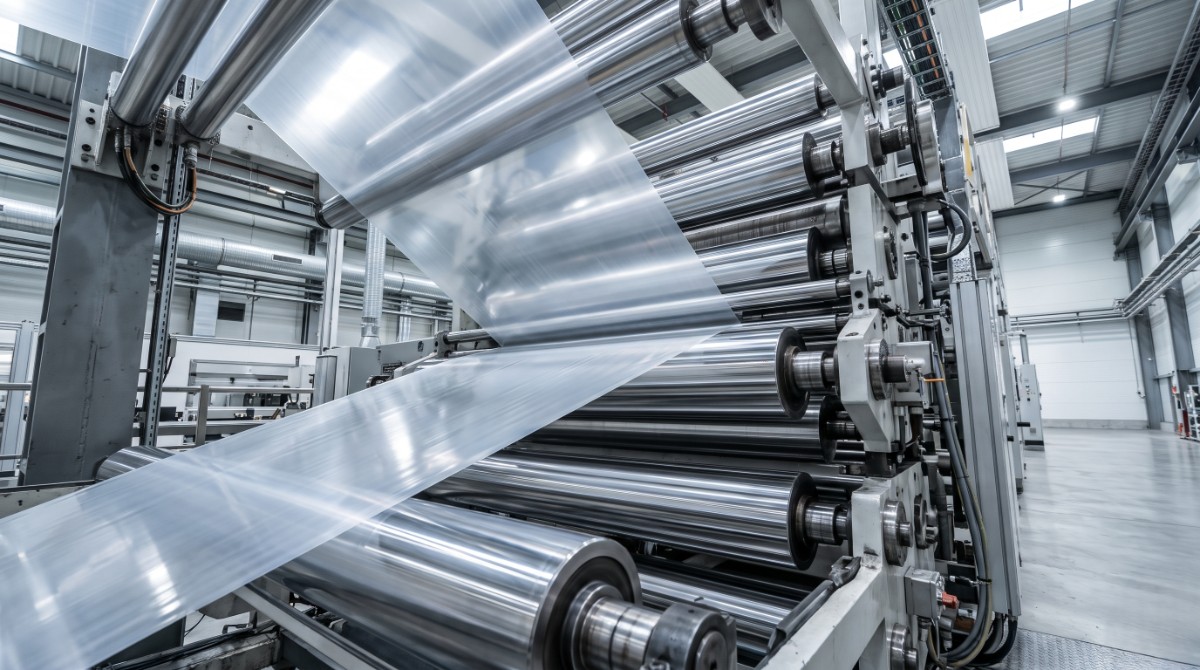
By coupling an MDO-HDPE exterior layer with an advanced plastomer sealant, converters restore an operational window of roughly 40°C to 50°C. This separation prevents jaw sticking and enables legacy vertical form-fill-seal (VFFS) and horizontal flow-wrapping equipment to operate without drastic reductions in cycle rates.
Bridging the Barrier Deficit: Preserving Shelf Life in Monomaterial Formats
Thermal stability resolves machinability, but shelf-life performance hinges on barrier integrity. Multi-layer laminates commonly integrated solid aluminum foil or thick coextruded EVOH cores. Pure polyolefins are intrinsically permeable to atmospheric gases and moisture vapor, rendering them inadequate in their basic state for oxygen-sensitive foods such as coffee, nuts, dry milk powders, and cured meats.
While high-barrier solutions focus on blocking ambient gases for shelf-stable goods, developing compatible active packaging systems, such as ethylene scavengers and moisture-regulating mono-PE films, proves equally critical for extending the shelf life of fresh produce without compromising circularity.
Vacuum-Deposited Coatings and Ultra-Thin EVOH
To achieve high-barrier performance within monomaterial packaging, converters utilize two main processing routes: inorganic vacuum deposition and micro-layer coextrusion. Vacuum deposition applies sub-micron coatings of aluminum oxide (AlOx) or silicon oxide (SiOx) to oriented films. Because these ceramic-like or metallic layers are measured in nanometers, their total percentage of the overall packaging mass remains well below 0.1 percent, preserving compatibility with mechanical recycling streams while lowering oxygen transmission rates (OTR) and water vapor transmission rates (WVTR).
Alternatively, ethylene vinyl alcohol (EVOH) can be embedded within the structure, provided its presence remains within established design guidelines, typically kept below 5 percent of total package weight. When coextruded as a central core protected by adjoining PE tie layers, a micro-layer of EVOH provides gas barrier protection without blinding near-infrared (NIR) sorting systems at recycling facilities or generating unmanageable carbonization during mechanical re-extrusion.
Mono-PE Versus Mono-PP: Selecting the Appropriate Pathway
When engineering recyclable flexible packaging, the choice between an all-polyethylene (mono-PE) or all-polypropylene (mono-PP) system depends on regional recycling infrastructure and packaging performance demands.
The Polyethylene (PE) Advantage
- Recycling Dominance: Accounts for the vast majority of flexible film recovery infrastructure, serving as the primary target for front-of-store drop-offs and municipal collection streams.
- Mechanical Performance: Delivers superior puncture resistance, robust low-temperature drop-impact strength essential for frozen logistics, and broad, forgiving sealing kinetics.
- Processing Requirement: Demands heavy reliance on Machine Direction Orientation (MDO) technology to match the dimensional stability and optical clarity of polyester.
The Polypropylene (PP) Advantage
- Thermal & Mechanical Properties: Built from BOPP outer webs and CPP inner sealants, mono-PP provides greater structural stiffness and a higher melting point (160°C–165°C) than PE, enabling wider operating windows on standard packaging machinery.
- Barrier & Optical Quality: Inherently delivers exceptional clarity alongside strong moisture barrier performance.
- Thermal Processing Capability: Acts as the primary polyolefin candidate for high-heat applications like pasteurization and retort sterilization, resisting pouch deformation and delamination under autoclave conditions.
The Role of Adhesives, Primers, and Inks in Recyclability
-
Contaminants in Recycled Resin: Non-polyolefin components, including cross-linked polyurethane adhesives, heavy ink coverage, and functional primers, directly degrade recycled resin quality.Traditional two-component, solvent-based adhesives fail to melt during extrusion reprocessing, causing gels, char, and structural defects in second-generation films.
-
Adhesive Innovations: Converters are transitioning to single-component, solvent-free adhesives formulated for polyolefin recycling streams. These new formulations either plasticize predictably within the polyolefin melt or detach cleanly during the washing phase.
-
De-Inking & Resin Value Retention: Manufacturers are developing de-inkable inks that can be stripped during early recycling stages. Effective ink removal prevents discoloration and polymer degradation, allowing recycled monomaterial resin to be reused in film extrusion rather than downcycled into thicker molded goods.
Scaling the Industrial Transition
Transitioning to recyclable monomaterial flexible packaging is an operational transformation requiring shared engineering between resin suppliers, film extruders, converters, equipment manufacturers, and brand technical teams. Success depends on abandoning drop-in replacement mindsets in favor of holistic system design. Packaging World Insights believes that by intentionally pairing high-performance MDO outer plies, low-initiation plastomers, targeted barrier chemistries, and optimized thermal machinery, the industry is establishing that environmental circularity and high-speed industrial performance can successfully coexist.

