



















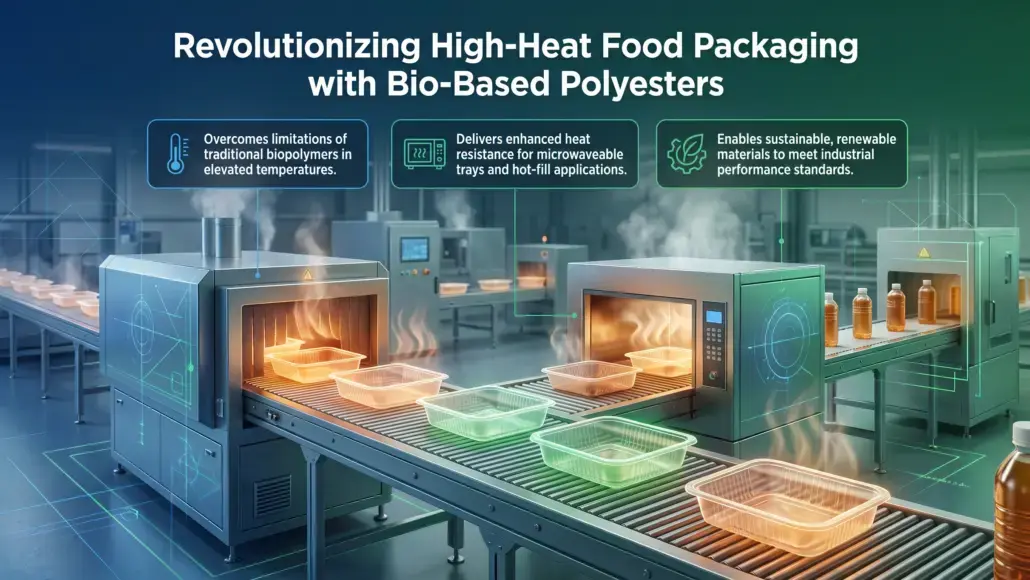
Industrial food packaging has long grappled with the limitations of sustainable materials when exposed to elevated temperatures. The adoption of biopolymers in high-heat applications, such as microwaveable trays and hot-fill beverage containers, requires specific mechanical and thermal properties that traditional bio-resins often lack. Recent advancements in polymer engineering have focused on developing bio-based polyesters heat resistance to bridge this gap, ensuring that renewable materials can withstand the rigors of commercial food service.
The thermal stability of packaging materials is determined by the glass transition temperature and the melting point of the polymer matrix. For years, standard polylactic acid remained restricted to cold-fill applications due to its low thermal threshold. However, the introduction of stereocomplex technology and the integration of nucleating agents have significantly improved the performance of these materials. By manipulating the crystalline structure of the polymer, manufacturers can now achieve a level of bio-based polyesters heat resistance that rivals conventional petroleum-derived plastics like polypropylene.
Thermal Dynamics of Crystalline Bio-Polyesters
The structural integrity of packaging during thermal processing is a primary concern for manufacturers. When food products are filled at high temperatures, the packaging material must maintain its shape and barrier properties without deformation. Crystalline bio-polyesters provide the necessary rigidity to endure these conditions. The crystallization process involves the alignment of polymer chains into a tightly packed lattice, which restricts molecular movement and increases the temperature at which the material begins to soften. This crystalline growth is often accelerated through the use of organic or inorganic nucleating agents that provide sites for crystal formation.
Advanced processing techniques, such as biaxial orientation and controlled cooling, further enhance the thermal performance of these materials. In applications where heat exposure is prolonged, such as in retort packaging, the material must also resist hydrolytic degradation. The chemical composition of next-generation bio-polyesters is tailored to minimize moisture absorption, which preserves the mechanical strength of the package throughout its lifecycle. This focus on durability ensures that thermal stability is not merely a temporary attribute but a consistent feature of the material.
Engineering High-Temperature Food Contact Materials
Safety regulations regarding food contact materials necessitate a thorough understanding of migration patterns at elevated temperatures. As packaging is exposed to heat, the risk of chemical constituents leaching into the food product increases. Modern bio-polyesters are synthesized using catalysts and additives that are compliant with global safety standards. The inherent purity of renewable feedstocks often results in lower levels of volatile organic compounds compared to traditional resins. This safety profile is particularly important for microwaveable packaging, where internal pressures and high temperatures can exacerbate migration risks.
The development of high-heat bio-polyesters also involves the optimization of melt strength and viscosity. During injection molding or thermoforming, the polymer must flow efficiently while retaining enough structural cohesion to form complex shapes. Enhancing bio-based polyesters heat resistance requires a delicate balance between these processing characteristics and the final thermal properties. Engineers utilize molecular weight distribution and branching strategies to create resins that are both processable and thermally stable, allowing for the high-speed production of durable food containers.
Applications in Hot-Fill and Microwaveable Packaging
The commercial viability of sustainable packaging depends on its ability to perform in demanding environments. Hot-fill technology, widely used for juices and sauces, requires containers that can resist temperatures exceeding eighty degrees Celsius. Traditional biopolymers would often collapse under these conditions, but new formulations incorporating bio-based polyesters heat resistance have made these applications feasible. These materials provide the necessary vacuum resistance as the product cools, preventing bottle distortion and maintaining seal integrity.
Microwaveable packaging represents another significant opportunity for high-heat bio-polyesters. Consumers increasingly demand convenience without compromising environmental values. Trays and lids made from heat-stable biopolymers allow for the safe heating of meals while remaining fully compostable or recyclable within existing streams. The low thermal conductivity of these materials also provides a safety benefit, as the packaging remains comfortable to handle even after heating. This combination of functionality and sustainability is driving the rapid adoption of bio-polyesters in the convenience food sector.
Lifecycle Considerations and End-of-Life Performance
Integrating heat-resistant biopolymers into a circular economy requires careful consideration of their end-of-life processing. While enhancing thermal stability is crucial for performance, the material must also remain compatible with waste management infrastructure. Most high-heat bio-polyesters are designed to be industrially compostable, breaking down into carbon dioxide and water under specific conditions. The increased crystallinity that provides heat resistance does not necessarily impede the biodegradation process, provided the environment maintains the required moisture and microbial activity.
Recycling represents another pathway for these materials. As the volume of bio-based polyesters in the market grows, the development of dedicated recycling streams becomes more economically viable. The thermal stability of these resins allows them to undergo multiple processing cycles without significant loss of properties, supporting the transition toward a more sustainable packaging industry. By focusing on bio-based polyesters heat resistance, the sector is moving beyond the limitations of early bioplastics and creating a new generation of high-performance materials that align with both functional requirements and environmental goals.
The evolution of bio-based materials has reached a critical juncture where performance must match the established benchmarks of the petroleum industry. The pursuit of thermal resilience of bio-resins is a clear indication that the packaging sector is no longer satisfied with niche applications for sustainable resins. Instead, there is a concerted effort to replace mainstream plastics in every category, including those defined by high thermal stress. The technical challenges involved in this transition are significant, requiring a deep understanding of polymer physics and chemical engineering.
One of the primary areas of research involves the use of furan-based monomers to create polyesters with inherently higher glass transition temperatures. These monomers, derived from agricultural waste, offer a rigid molecular structure that translates into superior thermal and barrier properties. When compared to traditional bio-based materials, furanic polyesters demonstrate a marked improvement in their ability to withstand heat without losing structural integrity. This innovation is particularly relevant for the beverage industry, where carbonated drinks and hot-fill products require specific performance profiles that were previously unattainable with renewable resources.
The economic sector of bio-based polyesters is also shifting as production scales and technology matures. While early iterations of heat-stable biopolymers carried a significant price premium, the optimization of manufacturing processes has begun to narrow this gap. The integration of bio-refineries, where multiple value streams are derived from a single feedstock, has improved the cost-efficiency of polymer production. This progress is essential for the widespread adoption of thermal resilience of bio-resins, as brand owners seek to meet sustainability targets without drastically increasing their packaging costs.
Additionally, the role of additives cannot be overlooked in the quest for thermal excellence. Bio-based nucleating agents, derived from natural waxes or minerals, are being used to fine-tune the crystallization kinetics of polyesters. These additives not only improve heat resistance but also enhance the optical clarity of the material, a key requirement for many food packaging applications. The synergy between high-purity resins and specialized bio-additives is creating a new class of materials that are as versatile as they are sustainable.
The regulatory environment continues to shape the development of these materials. As governments around the world implement stricter plastic waste directives and carbon reduction targets, the demand for renewable packaging solutions is accelerating. Bio-based polyesters offer a way to meet these mandates while maintaining the functional performance that modern supply chains demand. The focus on heat resistance is a strategic move to ensure that these materials are ready for the most challenging segments of the market, from industrial food service to retail convenience.
In terms of material characterization, the industry is adopting more sophisticated testing methods to validate the performance of bio-polyesters under heat. Differential scanning calorimetry and dynamic mechanical analysis are standard tools used to map the thermal transitions and mechanical responses of these polymers. These data points are crucial for design engineers who must ensure that a package will perform predictably throughout its entire lifecycle, from the filling line to the consumer’s microwave. The precision afforded by these analytical techniques allows for the rapid iteration and improvement of new formulations.
The collaboration between academia and industry is another driving force behind the success of bio-based polyesters. Research projects focused on the synthesis of new bio-monomers are quickly transitioning into pilot-scale production, shortening the time to market for innovative materials. This ecosystem of innovation is fostering a rapid exchange of ideas and technologies, ensuring that the packaging industry remains at the forefront of the bio-economy. The focus remains steadfast on delivering materials that do not require brands to compromise on performance for the sake of sustainability.
Looking ahead, the potential for bio-based polyesters extends into smart packaging and active systems. The thermal stability of these materials provides a reliable substrate for printed electronics or oxygen scavengers that might be sensitive to the processing temperatures of other biopolymers. This opens up new possibilities for enhancing food safety and shelf-life while maintaining a low environmental footprint. The integration of functionality and sustainability is the ultimate goal, and heat-resistant bio-polyesters are a foundational component of this vision.
The transition to bio-based materials is an essential step in reducing the environmental impact of the packaging sector. By overcoming the hurdle of heat resistance, bio-polyesters are proving that renewable materials can meet the highest standards of industrial performance. The ongoing investment in research, processing technology, and waste management infrastructure will ensure that these materials play a central role in the future of global packaging. The industry is witnessing a fundamental shift in material science, where the origin of the carbon is just as important as the properties of the final product.
The resilience of bio-based polyesters under thermal stress is a testament to the progress made in polymer science over the past decade. What was once a specialized material for niche products has become a viable alternative for high-volume, high-performance applications. The packaging industry is leading the way in demonstrating that sustainability and performance are not mutually exclusive. As more companies adopt these materials, the collective knowledge and infrastructure will continue to grow, further solidifying the position of bio-based polyesters as a cornerstone of modern packaging.
The technical specifications of these materials are also being refined to meet the needs of specific food categories. For instance, the requirements for a coffee pod are very different from those of a microwaveable soup container. Customizing the thermal properties of bio-polyesters allows for the creation of tailored solutions that optimize both material usage and energy efficiency. This level of customization is only possible because of the deep understanding of how thermal resilience of bio-resins can be manipulated at the molecular level.
Finally, the consumer perception of bio-based packaging is evolving. As people become more aware of the environmental consequences of their choices, they are increasingly looking for packaging that is both functional and responsible. High-heat bio-polyesters provide a clear signal to consumers that a brand is invested in the future of the planet. The ability to offer a product that can be safely heated and then responsibly disposed of is a powerful value proposition in today’s market. This consumer-driven demand is accelerating the pace of innovation and ensuring a bright future for bio-based materials in the packaging industry.

