

























Industry 4.0 is a huge talking point at the moment. On one hand, we see companies embracing the technological changes and seeing huge benefits, but there are still others who are afraid to take the step.
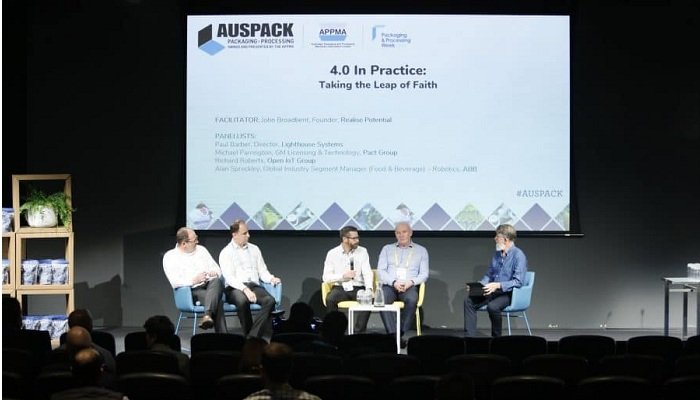
John Broadbent, founder of Realise Potential, led a panel at the 2019 AUSPACK Business and Industry Conference about the risks of falling behind and the rewards of adopting new technologies as they become available.
John was joined in discussion by:
- Paul Barber, director at Lighthouse Systems
- Michael Parrington, GM licensing and technology at Pact Group
- Richard Robert, MES operations manager and senior consultant at ZI-ARGUS
- Alan Spreckley, global industry segment manager (food & beverage) at Robotics ABB
Why are some manufacturers seemingly stuck at industry 3.0?
For people enjoying the benefits of industry 4.0, it may seem strange that other organisations are failing to make the move.
There are many opinions on why some companies are lagging behind — lack of understanding, return on investment and a general resistance to change being high on the list.
Richard said, “I think the biggest thing is that a lot of the customers don’t understand what it is right now. They might already be doing it; they might not know how to get there. Understanding what it is and then understanding what sort of costs that implies to get there is helping them get through that.”
Alan added, “I think one of the major problems is people in general have a resistance to change. People sometimes feel too comfortable with where they are at the moment and what they have. I think many people are entering the fourth industrial revolution without actually realising it. And I think if you can explain things simply, they start to understand, but you have to show the value to them in financial terms in most cases.”
What are the impacts for these businesses when industry 5.0 comes around?
Change is constant and while some manufacturers are still refusing to move into an industry 4.0 model, others are already beginning to transition into industry 5.0.
The panel agreed that this refusal to adopt the latest technology is a poor business decision at best and a fatal one at work.
Alan had the bleakest outlook for the laggard companies. He warned, “I think one of the key things to remember here is that recent history is littered with many major global companies who don’t exist anymore because they wouldn’t change or didn’t see the need to change. I think It’s a continuous process, it’s advancement — it’s technological advancement, it’s social advancement — if you don’t change with the times you stagnate and die.”.
Paul backed that up by saying, “The world is more demanding than it’s ever been before. All of us have got higher expectations on everything we do, on the quality of products we receive, on the quality of service we receive. Our customers are more demanding and if businesses don’t keep up with the demands of the customers then those customers will go elsewhere.”
Richard said, “At the end of the day it’s growth, so the company’s going to miss out on growth but how quickly that happens is up to you. There’s a lot of statistics for industry 4.0, by 2022, IOT applications reaching 23 billion. That’s the growth that we’re seeing and predicting. You want to be a part of that.”
Michael added to that thought by saying that even if you don’t fail completely, you will be moving behind your competition. He said, “The bullnose of the innovation curve is constantly moving through time. The start line stays fixed, the finish line is moving and the longer you stand still the longer the race becomes and the more catch up you play.”
Final thoughts
Asked to give one final piece of advice to their audience, the consensus from the panel was to take the leap of faith.
Alan said, “I think it’s just a case of remembering. It’s not going away, industry 4.0 is going to stay and I think people have to adopt it. One key take away I always have is the early adopter very often becomes the market leader.”
Michael added, “If you’re not sure, find someone to support you.”
Robert said, “Try and understand the big picture and then put the stepping-stones in place to get there.”
And Paul finished the session by saying, “It’s not actually as daunting as people think. Industry 4.0 has a lot of fluff around it, but if you peel back the layers of the onion it’s not that complicated. It’s something that’s done step by step, it’s not done overnight. It’s a journey, it’s a transition, and it may take several years but certainly don’t be daunted by it.”
Three key takeaways
- Industry 4.0 is here now and companies are already benefiting from it.
- Businesses that refuse to adopt industry 4.0 run a risk of being left behind or becoming irrelevant.
- If you’re not sure where to start with your transitions, there’s plenty of help out there.