














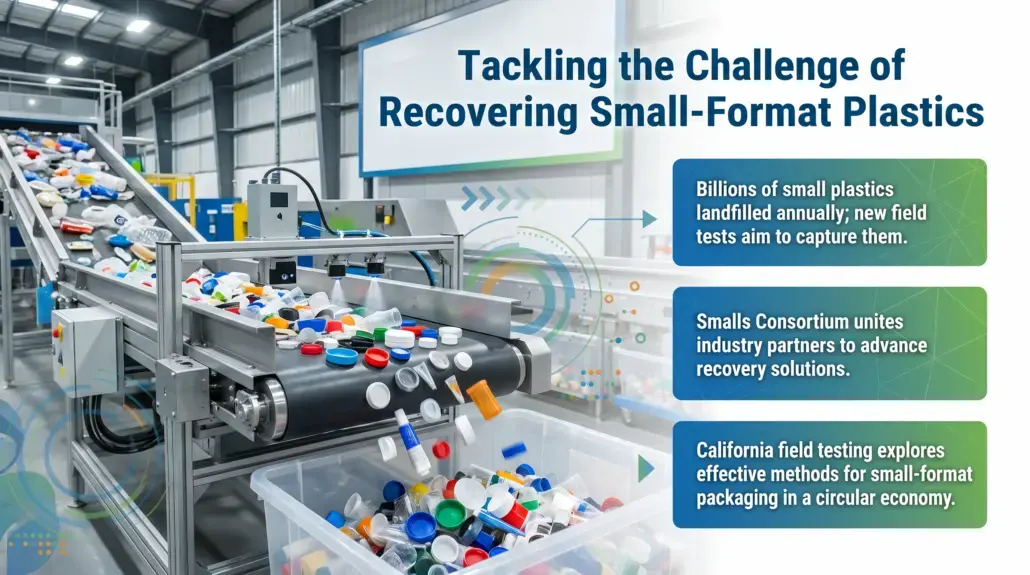

Closed Loop Partners’ Center for the Circular Economy has launched the next phase of its Smalls Consortium: Advancing the Recovery of Small-Format Packaging, bringing together founding partner L’Oréal, supporting partners Kraft Heinz and CVS Health, and strategic advisor Circular Action Alliance (CAA). The initiative aims to address a long-standing recycling challenge in which billions of small-format plastic items, including cosmetic packaging, caps, lids, coffee pods and pill bottles, are not captured effectively by existing recycling systems and often end up in landfills. With California preparing to implement SB 54, its Extended Producer Responsibility (EPR) law on January 1, 2027, the consortium is using the state as a testing ground to develop scalable solutions for recovering these materials. Smalls Consortium participants will focus on creating practical approaches that can support brands, recyclers and end markets while improving material recovery rates.
“L’Oréal is helping to build the systems needed to recover, sort, process and ensure market demand for small format materials,” says Marissa McGowan, Chief Sustainability Officer, North America at L’Oréal. “As a founding member of the Smalls Consortium, we’re motivated to continue our work with Closed Loop Partners. This is both an environmental priority and a business imperative. Advancing solutions for small-format packaging is a credible path to reduce supply chain risk, strengthen EPR readiness and secure future material supply. We encourage other companies to join us in scaling solutions that no company can solve alone.”
To conduct field testing, the consortium is working with Potential Industries, a recycling operator with more than 50 years of experience and multiple facilities across Southern California. The project will apply methodologies that include site assessments, material characterization studies, equipment evaluations, financial analysis, recovery trials and engagement with end markets. The objective is to generate data and operational insights that can guide broader recovery efforts across California and in other states where EPR programs are expanding. “As one of the longest-standing MRF operators in Southern California, we know firsthand that sortation is necessary, but without consistent viable end markets paying reasonable scrap pricing to sell to, the system is not sustainable,” says Dan Domonoske, VP of Potential Industries, Inc. “That is why Closed Loop Partners’ approach, that includes demand pull from end markets, is so valuable. Together, we are looking at how to improve sortation while simultaneously supporting the reprocessing and end markets that pull these materials through the supply chain. For Potential Industries, this initiative is both a practical business opportunity and an important step toward building a more resilient recycling system in California and the U.S.”
The consortium is also collaborating with CAA, the Producer Responsibility Organization selected by California, Colorado, Maryland, Minnesota, Oregon and Washington to develop EPR program plans for paper and packaging. Through this cooperation, learnings from field trials will help inform policy implementation and investment decisions. Key priorities include developing a data-backed roadmap, strengthening recycling infrastructure, ensuring recovered materials are incorporated into new products and improving packaging design alongside brands and retailers. Building on four years of research and testing, including a 2025 report examining recovery opportunities in New York, the Smalls Consortium is now extending its framework to California. “Small-format packaging has long fallen through the cracks of the recycling system not because it lacks value, but because recovery requires coordination across the full system,” says Kate Daly, Managing Partner at Closed Loop Partners. “When these materials go to landfill, it represents both an environmental loss and a missed economic opportunity. Over the past four years, our Smalls Consortium has built a deep understanding of the small-format packaging material stream from infrastructure needs to end markets and is now bringing stakeholders together in California to help build a system designed for long-term, real-world impact.”