















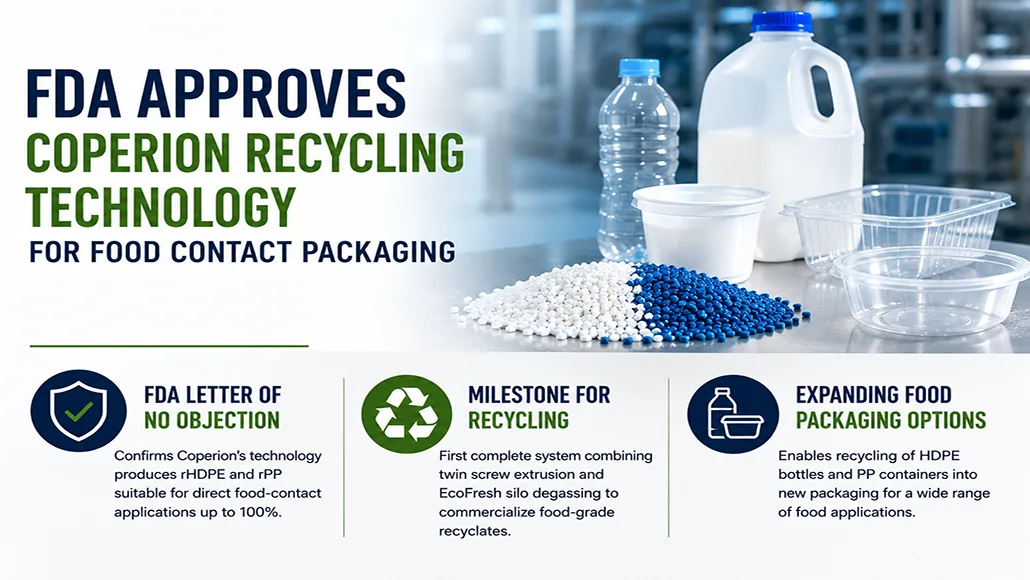

The US Food and Drug Administration (FDA) has issued a letter of no objection (LNO) confirming that high-density PE (HDPE) and PP recycled through Coperion’s twin screw extruders and EcoFresh silo degassing technology are suitable for direct food-contact applications. The approval allows recycled HDPE (rHDPE) and recycled PP (rPP) produced with the company’s process to be used in new packaging at concentrations of up to 100%. According to Coperion, the decision marks a milestone for the production of food contact packaging from mechanically recycled materials and supports applications involving high-temperature, heat-sterilized, pasteurized and frozen products. The Stuttgart, Germany-based company stated that it is the first supplier of complete decontamination systems combining twin screw extrusion and EcoFresh silo degassing to commercialize a solution for food-grade recyclates.
Commenting on the development, Stefan Lachenmayer, global commercial director of recycling at Coperion, said: “The FDA’s letter of no objection (LNO) means that recycled HDPE (rHDPE) and recycled PP (rPP) manufactured with our technologies can be used for new food packaging in proportions up to 100%.” He added: “As a result, we provide recyclers the assurance that our energy-efficient mechanical recycling process manufactures high-quality recyclate for use cases A–H. These include, for example, packaging for high-temperature, heat-sterilized, pasteurized, or frozen products.” The company said the approval opens opportunities to recycle HDPE milk jugs and fruit juice bottles into new bottles and related products, while PP containers such as food cups, bowls and trays can also be processed into packaging intended for direct food contact.
Coperion noted that producing food-safe recyclates remains one of the most demanding aspects of plastics recycling because materials must meet strict purity and safety requirements before being approved for food-contact use. The company attributes its decontamination performance to the high-degassing capability of its co-rotating twin screw extruders and the EcoFresh silo degassing system, which removes low-volatility migratory substances within short residence times. For food-safe rHDPE production, the process uses beverage bottles and caps as feedstock, while rPP compounds are produced from materials including vegetable trays and yogurt containers. The material is melted, mixed, homogenized and degassed before filtration, pelletizing and a second decontamination stage in the EcoFresh unit.
Lachenmayer said Coperion’s role as a complete system provider contributes to the environmental performance of its recycling solutions. “We look at the entire process and apply our decontamination technologies at specific points in the process chain. It is their optimal interplay that makes the efficient achievement of the necessary level of decontamination possible.” The company also highlighted that recyclers can evaluate decontamination performance using original material streams at its Recycling Innovation Center. The FDA decision further strengthens the pathway for recycled plastics in Food Contact Packaging, alongside recent developments involving food-safe rPP and HDPE recycling initiatives in Europe.