














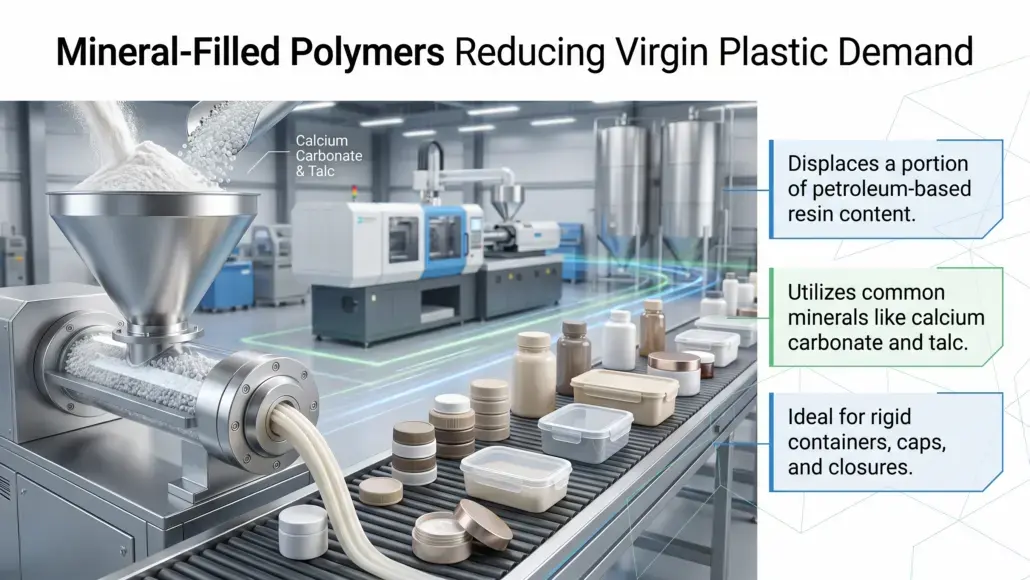
The integration of inorganic minerals into polymer matrices is a well-established technique that is gaining renewed importance as the packaging industry seeks to reduce its reliance on virgin petroleum-based resins. Mineral-filled polymers utilize substances such as calcium carbonate, talc, mica, and wollastonite to displace a portion of the plastic content in rigid containers, caps, and closures. Calcium carbonate is the most widely used filler due to its abundance, low cost, and neutral color. When incorporated into polymers like polypropylene or high-density polyethylene, it acts as a functional extender, providing a range of benefits beyond simple volume replacement. Talc is also highly valued for its plate-like particle structure, which significantly enhances the stiffness and heat resistance of the final product.
The performance of mineral-filled polymers depends heavily on the particle size, shape, and surface treatment of the minerals. Ultra-fine particles with a narrow size distribution ensure better dispersion within the polymer melt, preventing the formation of aggregates that could act as stress concentrators. Surface treatments, such as stearic acid coatings, are often applied to the minerals to improve their compatibility with the hydrophobic polymer chains. This enhances the interfacial bonding, allowing for higher filler loadings without a significant loss of mechanical properties. By optimizing these factors, manufacturers can create packaging materials that contain up to 40 percent mineral content, drastically reducing the volume of virgin plastic required for production.
Enhancing thermal stability and rigidity in rigid containers
One of the primary technical advantages of using mineral-filled polymers is the significant improvement in the thermal and mechanical stability of the packaging. Minerals have much higher heat resistance and lower thermal expansion coefficients than plastics. When added to a polymer, they increase the heat deflection temperature, allowing the packaging to maintain its structural integrity at higher temperatures. This is particularly important for applications such as hot-fill food containers or microwavable packaging, where the material must resist deformation under thermal stress. The presence of mineral fillers also reduces the shrinkage and warpage that can occur during the cooling phase of the injection molding or blow molding process, leading to better dimensional accuracy.
Rigidity is another critical factor for rigid packaging, as it determines the stackability and top-load strength of containers. Mineral-filled polymers exhibit increased flexural modulus, meaning they are stiffer and less prone to bending under load. This allows designers to reduce the wall thickness of containers while maintaining the same level of performance, a process known as down-gauging. The combination of mineral loading and down-gauging leads to a double reduction in plastic usage: first by replacing plastic with mineral, and second by using less total material. This efficiency is vital for high-volume packaging production where even small reductions in material use can lead to significant environmental and economic benefits.
Processing efficiency and energy reduction in extrusion
The use of mineral-filled polymers can also lead to improvements in manufacturing efficiency and energy consumption. Minerals typically have higher thermal conductivity than polymers, which means that mineral-filled melts heat up and cool down faster than unfilled resins. In extrusion and molding processes, this can translate into shorter cycle times and increased throughput. The faster cooling rate allows parts to be ejected from the mold sooner, maximizing the utilization of the production equipment. Furthermore, the presence of mineral fillers can reduce the viscosity of the polymer melt under certain conditions, lowering the energy required for the extrusion process.
In addition to thermal benefits, mineral-filled polymers can improve the printability and surface finish of the packaging. The minerals create a slightly more textured surface that enhances ink adhesion, reducing the need for expensive surface treatments like corona discharge. This is particularly beneficial for high-speed printing lines where consistent surface quality is essential for maintaining production speeds. The overall impact on the manufacturing environment is a more streamlined process with lower energy requirements per unit of production. As energy costs continue to rise, these operational efficiencies provide a strong incentive for packaging converters to adopt mineral-filled solutions.
Recyclability impacts on post-consumer resin streams
The impact of mineral fillers on the recyclability of plastic packaging is a subject of careful consideration within the industry. Generally, mineral-filled polymers are compatible with existing mechanical recycling streams, provided the filler loading is kept within certain limits. During the sorting process, near-infrared sensors can still identify the base polymer, ensuring that the material is directed to the correct recycling channel. Once the material is reground and reprocessed, the mineral fillers remain within the polymer, continuing to provide their functional benefits in the next generation of products. This supports the creation of high-quality post-consumer resins that can be used in demanding applications.
However, high concentrations of certain minerals can increase the density of the plastic, which may affect the float-sink separation process used in some recycling facilities. To address this, industry guidelines recommend keeping filler levels at a point where the overall density of the material remains below that of water for polyolefins. Innovation in mineral technology is also leading to the development of “lightweight” fillers that provide reinforcement without a significant increase in density. By aligning material formulations with recycling infrastructure capabilities, the packaging industry can ensure that mineral-filled polymers contribute to a truly circular economy. The use of these fillers actually enhances the value of recycled plastics by providing the stiffness and thermal stability that can sometimes be lost during the recycling process.
Cost management strategies amidst volatile virgin resin pricing
The economic rationale for using mineral-filled polymers is deeply linked to the volatility of the global oil market, which directly influences the price of virgin plastic resins. By replacing a significant portion of the resin with a more price-stable mineral filler, manufacturers can insulate themselves from sudden price spikes in the raw material market. This stability is essential for maintaining predictable margins in the highly competitive packaging sector. Mineral fillers are generally much less expensive than polymers, meaning that a mineral-filled formulation has a lower overall material cost per kilogram. When combined with the operational efficiencies mentioned earlier, the total cost of production is significantly reduced.
Strategic sourcing of minerals can further enhance these cost advantages. Many of the minerals used in packaging are abundant and can be sourced locally, reducing transportation costs and the associated carbon footprint. Furthermore, the use of mineral-filled polymers allows brands to meet their sustainability goals without the high premiums often associated with bio-based or chemically recycled plastics. This makes it a highly accessible technology for a wide range of packaging applications, from mass-market consumer goods to specialized industrial containers. The long-term trend toward higher plastic taxes and stricter environmental regulations will only increase the financial attractiveness of mineral-filled polymers as a key strategy for reducing virgin plastic demand.

