












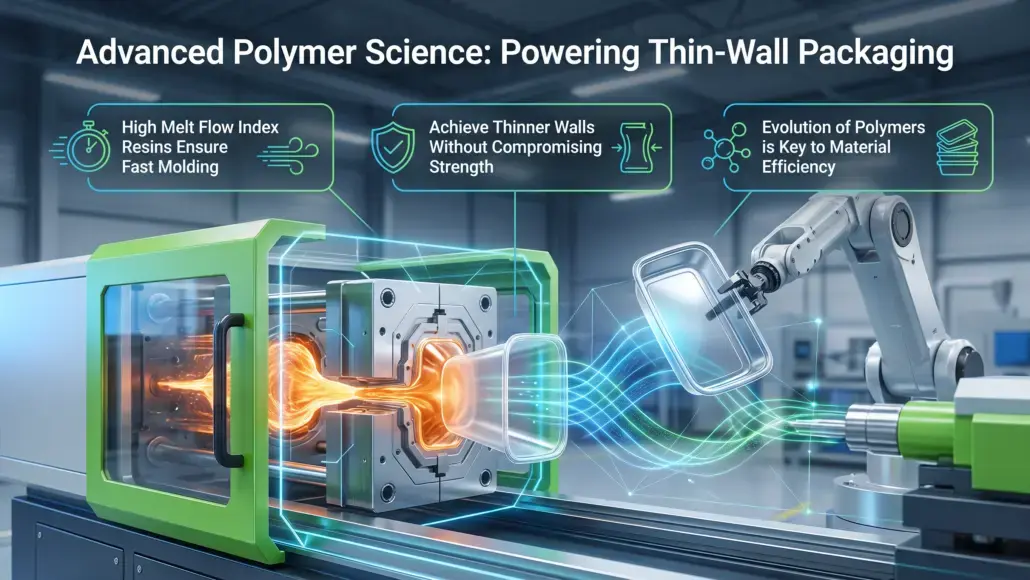

The evolution of polymer science has been central to the success of reduced gauge containers. For manufacturers to achieve thinner walls without compromising the mechanical performance of a container, the resin must possess specific rheological properties. High melt flow index (MFI) resins are now the standard for these applications, allowing the polymer to travel through narrow mold cavities at extremely high speeds. This capability is critical because as wall thickness decreases, the window for successful cavity filling narrows significantly. Traditional resins often face issues with premature solidification, known as freeze-off, which leads to incomplete parts or structural weaknesses. Modern polypropylene and polyethylene grades designed for thin-wall applications feature narrow molecular weight distributions that facilitate easier flow while maintaining the stiffness required for stacking and transport.
Chemical additives play a supporting role in this material optimization. Nucleating agents are frequently incorporated into the resin to accelerate the crystallization process. By increasing the rate at which the polymer solidifies, manufacturers can reduce the overall cycle time, which directly impacts the economic viability of thin-wall production. These agents also refine the crystalline structure of the plastic, resulting in improved clarity and enhanced physical properties such as impact resistance and flexural modulus. This balance between flowability and structural strength is the cornerstone of thin-wall plastic packaging advancing material efficiency across the global supply chain. Without these specialized resin formulations, the move toward ultra-thin containers would be limited by the physical constraints of conventional thermoplastic behavior.
Additionally, the introduction of metallocene-catalyzed resins has provided a new level of control over polymer architecture. These materials offer superior puncture resistance and tensile strength compared to traditional Ziegler-Natta polymers. In the context of thin-wall containers used for food service or dairy products, this means that even as the wall thickness is reduced by 20 or 30 percent, the container remains capable of withstanding the rigors of automated filling and palletization. The precision offered by these advanced resins ensures that every gram of plastic is utilized to its maximum potential, eliminating unnecessary bulk that does not contribute to the functional performance of the package.
Precision Engineering in Mold Design and Cooling Systems
The transition to thinner walls places immense pressure on the mechanical components of the injection molding process. High-pressure injection is a fundamental requirement, often exceeding 2,000 bar to ensure the melt reaches the furthest extremities of the mold before cooling begins. Consequently, the molds themselves must be engineered from high-grade tool steels that can withstand these repetitive stresses without deforming. Precision alignment between the core and the cavity is paramount: even a minor deviation can result in uneven wall thickness, which creates weak points and potential failure during the top-load testing phase. Centering systems and sturdy clamping mechanisms are essential features of modern thin-wall molding cells, ensuring that the integrity of the thin-wall plastic packaging advancing material efficiency is maintained across millions of production cycles.
Cooling is perhaps the most critical factor in the production of thin-wall containers. Because the cycle times are often as low as three to five seconds, the heat must be extracted from the mold with incredible speed and uniformity. Conventional cooling channels are frequently insufficient for these demands. Instead, manufacturers utilize conformal cooling techniques, where the cooling paths are designed to follow the exact geometry of the part. This ensures that the base, the sidewalls, and the rim of the container cool at the same rate, preventing the warping or internal stresses that commonly plague thinner parts. Beryllium copper inserts are also used in areas of high heat concentration due to their superior thermal conductivity compared to standard steel.
Advancements in hot runner technology have also facilitated the push toward material efficiency. Valve gating systems provide precise control over the volume of plastic entering the cavity, reducing the amount of waste generated by traditional cold runner systems. By eliminating the sprue and runner, manufacturers not only save material but also reduce the energy required to reprocess scrap. These systems also allow for better control over the gate vestige, ensuring a clean finish that is aesthetically pleasing for consumer-facing products. The integration of high-precision molds with advanced cooling and runner systems creates a production environment where material waste is minimized and throughput is maximized.
Structural Integrity and Barrier Performance at Reduced Gauges
Reducing the amount of material in a package naturally raises concerns about its ability to protect the contents and survive the logistical journey from factory to consumer. To address this, engineers employ advanced computer-aided design (CAD) and finite element analysis (FEA) to optimize the geometry of the container. Ribbing and structural contours are strategically placed to provide maximum rigidity with minimum plastic. For example, a slightly flared rim or a reinforced base can significantly increase the top-load strength of a tub, allowing it to be stacked several layers high in a warehouse without collapsing. These design features are vital for thin-wall plastic packaging advancing material efficiency, as they compensate for the lack of mass through superior mechanical architecture.
Barrier performance is another critical consideration, particularly for perishable food products. As the plastic wall becomes thinner, the rate of oxygen and moisture transmission can increase, potentially shortening the shelf life of the product. To counteract this, manufacturers often turn to multi-layer co-injection or in-mold labeling (IML). IML is especially effective in thin-wall applications because the label itself can act as a structural reinforcement and a barrier layer. High-quality labels made from specialized barrier films can be fused to the container during the molding process, providing excellent protection against environmental factors while allowing the primary container walls to remain thin.
Additionally, the choice of material blends can enhance the barrier properties of thin-walled parts. Incorporating small percentages of barrier resins or nano-composites into the polymer matrix can significantly reduce gas permeability. These technical solutions ensure that the drive for material efficiency does not come at the expense of food safety or product quality. The ability to maintain high barrier performance at reduced gauges is a major factor in the widespread adoption of thin-wall formats in the dairy, margarine, and ready-meal sectors.
Economic and Environmental Implications of Reduced Material Input
The primary driver for the adoption of thin-wall technology is the reduction of unit costs. In high-volume packaging production, the cost of the raw resin can account for up to 70 percent of the total manufacturing expense. By reducing the weight of a container by even a fraction of a gram, a manufacturer can realize significant savings over a year of production. These savings are often reinvested into further technological upgrades, creating a cycle of continuous improvement. Additionally, lighter containers result in lower shipping costs. Because freight charges are often determined by weight, the cumulative reduction in mass across thousands of pallets can lead to substantial logistics savings and a lower carbon footprint for the transportation phase.
From an environmental perspective, the reduction in material usage is a key component of sustainable packaging strategies. By using less plastic to perform the same function, manufacturers are effectively reducing the demand for virgin resin. This aligns with the principles of source reduction, which is prioritized in many waste management hierarchies. Additionally, thinner containers require less energy to manufacture per unit because the cooling times are shorter and the material volume to be melted is lower. While the initial investment in high-speed machinery and precision molds is significant, the long-term environmental benefits of reduced energy and material consumption are clear.
However, the environmental impact is not solely about the production phase. The recyclability of thin-walled containers is also a focus of current research. Most thin-wall containers are made from polypropylene, which is widely accepted in recycling streams. The challenge lies in the sorting and processing of very light items at material recovery facilities. Advancements in infrared sorting technology and mechanical processing are helping to ensure that these efficient containers can be effectively reclaimed and converted into secondary raw materials. This closed-loop potential further solidifies the role of thin-wall plastic packaging advancing material efficiency as a sustainable choice for the modern packaging industry.
Future Integration of Bio-based Polymers in Thin-Wall Applications
As the industry looks toward the future, the integration of bio-based and compostable polymers into thin-wall formats is an area of intense activity. Materials like polylactic acid (PLA) and polyhydroxyalkanoates (PHA) offer the potential to decouple packaging from fossil-fuel feedstocks. However, these materials often present different processing challenges compared to traditional polyolefins. They typically have lower thermal stability and different flow characteristics, requiring modifications to the molding process. Ongoing research is focused on developing bio-based grades that can match the high-speed processing capabilities of traditional resins, ensuring that the benefits of thin-wall plastic packaging advancing material efficiency can be applied to renewable materials.
Blending bio-resins with traditional polymers is one approach being explored to bridge the performance gap. This allows for a gradual transition to more sustainable feedstocks while maintaining the high mechanical standards required for thin-wall containers. Additionally, the development of bio-based additives, such as natural fibers or mineral fillers, can help to increase the stiffness of bio-polymers, making them more suitable for ultra-thin applications. These innovations are paving the way for a new generation of containers that are both material-efficient and derived from renewable sources.
The regulatory environment is also playing a role in shaping the future of this sector. Governments around the world are implementing increasingly strict requirements for packaging waste reduction and recycled content. Thin-wall technology provides a viable pathway for meeting these targets without compromising the functionality or safety of the package. As the industry continues to refine its processes and materials, the synergy between thin-wall design and sustainable polymer chemistry will remain a central theme in the evolution of packaging. The commitment to technical excellence and material optimization ensures that plastic packaging continues to provide essential protection for goods while minimizing its overall environmental footprint.