













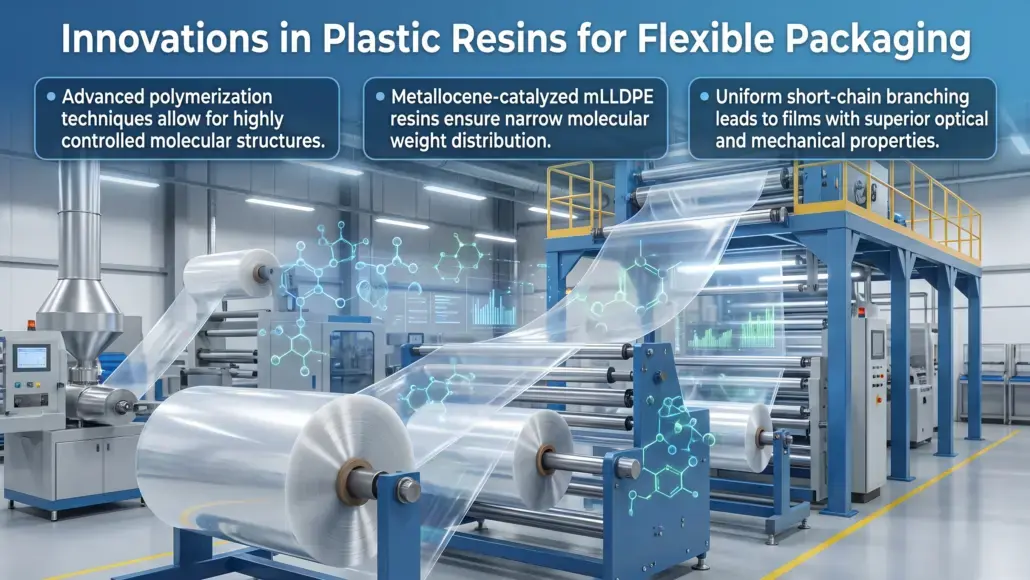

The flexible packaging sector relies heavily on the optical and mechanical properties of polyolefin films. Recent breakthroughs in polymerization techniques have allowed for the creation of resins with highly controlled molecular structures. Metallocene-catalyzed linear low-density polyethylene (mLLDPE) is a prime example of these developments. By providing a narrow molecular weight distribution and uniform distribution of short-chain branching, these resins allow for the production of films with exceptional clarity and gloss. This visual appeal is crucial for consumer goods where product visibility is a primary marketing requirement. Beyond aesthetics, the precise control over the polymer chain architecture results in significantly improved impact strength and puncture resistance, which are essential for maintaining package integrity throughout the retail cycle.
The development of high-density polyethylene (HDPE) grades with enhanced processability has also contributed to the evolution of flexible formats. Traditional HDPE was often difficult to process into thin films due to its high crystallinity and tendency toward brittleness. However, modern bimodal resins combine two different molecular weight fractions to offer a balance of stiffness and toughness. This allows manufacturers to downgauge their films without losing the structural rigidity needed for stand-up pouches. The ability to use less material while maintaining or improving performance is a central theme in plastic resin innovations optimizing flexible packaging design across various industrial applications.
In addition to traditional polyolefins, the industry is seeing increased usage of cyclic olefin copolymers (COC). These specialized resins offer glass-like transparency and excellent moisture barrier properties. When blended with standard polyethylene, COC can improve the heat resistance and stiffness of the film, making it suitable for hot-fill applications. The synergistic effects of combining different resin grades allow engineers to tailor the film properties to meet the specific demands of the product, whether it requires high breathability for fresh produce or absolute moisture exclusion for dry goods.
Multilayer Coextrusion and the Role of Specialty Barrier Resins
The complexity of modern flexible packaging often necessitates the use of multiple layers to achieve the required protection. Coextrusion technology allows for the simultaneous processing of different resins into a single, unified film structure. Within these structures, specialty barrier resins like ethylene vinyl alcohol (EVOH) and polyamide (PA) play a vital role. EVOH is prized for its exceptional gas barrier properties, effectively preventing oxygen from entering the package and causing oxidation of the contents. Because EVOH is sensitive to moisture, it is typically sandwiched between layers of hydrophobic polyolefins, which protect the barrier layer and maintain its effectiveness over the product life.
Polyamides, commonly known as nylon, provide excellent mechanical strength and thermoformability. In vacuum packaging or deep-draw applications, the toughness of the PA layer ensures that the film does not tear or pinhole during the forming process. The integration of tie-resins or compatibilizers is essential for ensuring adhesion between these dissimilar materials. These functionalized polymers act as a bridge, preventing delamination and ensuring that the final structure behaves as a single unit. The precision with which these layers can now be managed allows for the creation of ultra-thin barrier films that offer superior protection with minimal material usage.
Recent innovations have also focused on the development of nanotechnology-enhanced barrier resins. By incorporating nanoclay particles into the polymer matrix, manufacturers can create a tortuous path for gas molecules, significantly reducing permeability. This technology holds great promise for further reducing the thickness of barrier layers without compromising the shelf life of the product. The continuous refinement of coextrusion processes and the introduction of novel barrier chemistries are fundamental to plastic resin innovations optimizing flexible packaging design for the global food and medical industries.
Enhancing Seal Integrity and Mechanical Durability in Flexible Formats
The reliability of a flexible package is often defined by the quality of its seals. If a seal fails during transport or storage, the entire package becomes compromised, leading to product waste and potential safety issues. Advancements in sealant resins have focused on broadening the sealing window and improving hot-tack strength. Hot-tack refers to the ability of the molten seal to hold together immediately after the sealing bars have released, which is critical for high-speed vertical form-fill-seal (VFFS) operations. Resins like plastomers and ionomers offer excellent low-temperature initiation, allowing for faster production speeds and reduced energy consumption.
Ionomers are particularly notable for their ability to seal through contaminants like oils or powders. In the packaging of fatty meats or powdered detergents, the presence of product residue in the seal area can often lead to leaks. Ionomers can absorb these contaminants and maintain a hermetic seal, providing a level of security that traditional polyethylene cannot match. This mechanical durability extends to the overall film structure as well. The ability to resist environmental stress cracking and repeated flexing is essential for large-format bags used in industrial or agricultural settings.
To further improve durability, manufacturers are exploring the use of oriented films. By stretching the film in one or both directions during production, the polymer chains become aligned, leading to a significant increase in tensile strength and stiffness. Biaxially oriented polypropylene (BOPP) and biaxially oriented polyethylene terephthalate (BOPET) are widely used for their excellent mechanical properties and printability. These oriented layers are often combined with sealant resins through lamination or extrusion coating to create high-performance laminates that can withstand the most demanding shipping conditions.
Sustainable Resin Alternatives and the Push for Mono-Material Structures
The environmental impact of packaging is a primary concern for the industry, leading to a significant push for more sustainable material choices. One of the major challenges in recycling flexible packaging is the complexity of multilayer structures, which often combine different types of plastic that cannot be easily separated. To address this, there is a growing trend toward the development of mono-material structures. By using different grades of the same polymer, such as combinations of HDPE and LLDPE, manufacturers can create a recyclable package that still offers the necessary barrier and mechanical properties.
The development of machine-direction oriented (MDO) polyethylene films is a key enabler for mono-material designs. MDO films offer the stiffness and heat resistance traditionally provided by PET or PP, allowing them to replace these non-recyclable layers in a PE-based structure. This shift toward circularity is supported by plastic resin innovations optimizing flexible packaging design that focus on maintaining performance while simplifying the material composition. Additionally, the inclusion of post-consumer recycled (PCR) content into flexible films is becoming more common. While processing PCR resins presents challenges such as impurities and variability in flow, new filtration and stabilization technologies are making it possible to produce high-quality films with significant recycled content.
Bio-based resins are also gaining traction as a sustainable alternative to fossil-fuel-derived plastics. Materials like bio-polyethylene and bio-polypropylene offer the same performance as their conventional counterparts but are derived from renewable feedstocks such as sugarcane or waste oils. For applications where composting is a viable end-of-life option, compostable resins like PLA or PBAT are being utilized. These materials are engineered to break down in industrial composting facilities, providing an alternative pathway for organic waste management. The integration of these sustainable materials requires careful consideration of the entire life cycle, ensuring that the environmental benefits are not offset by increased material usage or reduced protection.
Performance Optimization in High-Speed Converting and Filling Operations
The efficiency of the packaging process is heavily influenced by the interaction between the film and the machinery. Factors such as coefficient of friction (COF), static buildup, and thermal stability are critical for smooth operation. Additives such as slip agents and anti-blocking agents are incorporated into the resin to control the COF, ensuring that the film can slide easily over metal rollers and forming collars without sticking or dragging. Precision control over the concentration and migration of these additives is essential for maintaining consistent performance over time, especially in varying humidity and temperature conditions.
Thermal stability is another crucial factor, particularly during the extrusion and sealing phases. Resins must be able to withstand high temperatures without degrading or losing their mechanical properties. The use of advanced antioxidant packages helps to protect the polymer chains during processing, ensuring that the final film maintains its integrity and appearance. In the filling phase, the ability of the film to handle the weight and impact of the product is paramount. High-speed filling lines place significant stress on the package, requiring films with high modulus and excellent puncture resistance to prevent bursts and leaks.
The integration of smart packaging features is also beginning to influence resin selection. For example, materials that can change color in response to temperature or the presence of certain gases can provide valuable information about the condition of the product. While these technologies are still in the early stages of adoption, they represent a new frontier for plastic resin innovations optimizing flexible packaging design. By combining advanced material science with digital technologies, the packaging industry is creating solutions that are not only protective and efficient but also informative and interactive. The continued focus on performance optimization ensures that flexible packaging remains a versatile and cost-effective choice for a wide range of global industries.