















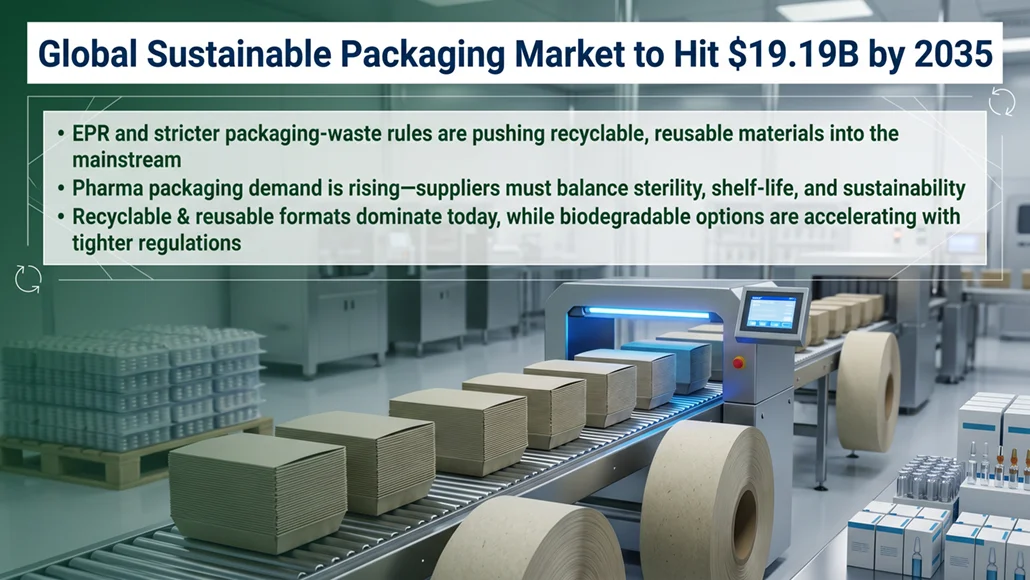

The global sustainable packaging market is projected to grow from USD 10.29 billion in 2025 to USD 19.19 billion by 2035, registering a compound annual growth rate (CAGR) of 6.4% over the forecast period. The market is expected to reach USD 10.95 billion in 2026 as regulatory enforcement, pharmaceutical sector sustainability targets, and investment in eco-friendly materials continue to reshape packaging procurement strategies worldwide.
Sustainable packaging solutions are increasingly replacing conventional materials such as non-degradable plastics, glass, and metal with recyclable, reusable, and biodegradable alternatives. Within the pharmaceutical industry, packaging remains a critical component for ensuring sterility, contamination prevention, and product shelf-life stability. The integration of environmental compliance with functional packaging performance is emerging as a key driver of long-term market demand.
Governments across major economies are strengthening regulations related to packaging waste and recyclability. The United Kingdom has allocated substantial public funding to accelerate sustainable plastic packaging innovation, while the United States introduced Extended Producer Responsibility (EPR) laws in July 2025 that require packaging producers to finance recycling systems based on packaging volume and recyclability standards. These regulatory developments are increasing the commercial viability of sustainable materials across the packaging value chain.
Investor activity and manufacturing expansion are also supporting market momentum. Over the last five years, sustainable packaging companies collectively secured more than USD 13 billion in funding activity. In March 2026, a major packaging manufacturer announced plans to establish a 468,000-square-foot sustainable packaging facility in Mississippi to address rising long-term demand for environmentally compliant packaging formats.
Key Market Drivers
- Regulatory enforcement and EPR frameworks are accelerating adoption of recyclable and reusable packaging materials across pharmaceutical and consumer industries.
- Sustainability commitments from pharmaceutical and biotechnology companies are increasing pressure on suppliers to provide eco-friendly packaging formats.
- Expansion of pharmaceutical drug pipelines is driving additional demand for primary and secondary packaging solutions.
- Strategic partnerships and material innovation initiatives are improving recyclability, fiber-based packaging adoption, and sustainable closure technologies.
- Advancements in material science are helping reduce performance limitations traditionally associated with biodegradable and sustainable packaging materials.
Market Segmentation Analysis
Recyclable and reusable packaging currently accounts for approximately 90% of the total sustainable packaging market due to established manufacturing infrastructure, availability of recyclable raw materials, and extended product shelf life. However, biodegradable packaging is projected to expand at a faster pace, with an estimated CAGR of around 7% through 2035 as environmental regulations become stricter.
Primary packaging, including bottles, syringes, cartridges, ampoules, and vials, represents the largest segment by packaging type and is expected to maintain market leadership throughout the forecast period. In secondary packaging, boxes and cartons continue to dominate due to their scalability and compatibility with diverse product sizes and shipping requirements.
Pharmaceutical and biotechnology companies remain the largest end-user segment, driven by high-volume packaging demand and sustainability compliance mandates linked to greenhouse gas reduction initiatives.
Regional Outlook
Asia-Pacific currently holds nearly 50% of the global sustainable packaging market and is expected to maintain its leading position through 2035. The region’s growth is supported by population expansion, rising healthcare consumption, and increasingly strict regulations targeting plastic pollution. Countries including Japan, South Korea, and Thailand have implemented restrictions on conventional plastics while encouraging adoption of sustainable packaging alternatives.
Europe and North America continue to represent major market centers due to established regulatory frameworks and high concentration of packaging solution providers. Europe remains a key innovation hub supported by advanced environmental policies and packaging regulations, while the United States market is benefiting from new EPR legislation introduced in 2025.
Latin America is forecast to be the fastest-growing regional market, with a projected CAGR of 6.9% through 2035. Growth in the region is being supported by rising consumer preference for environmentally responsible products, stricter plastic waste regulations, and expanding retail and e-commerce sectors requiring scalable sustainable packaging solutions.