















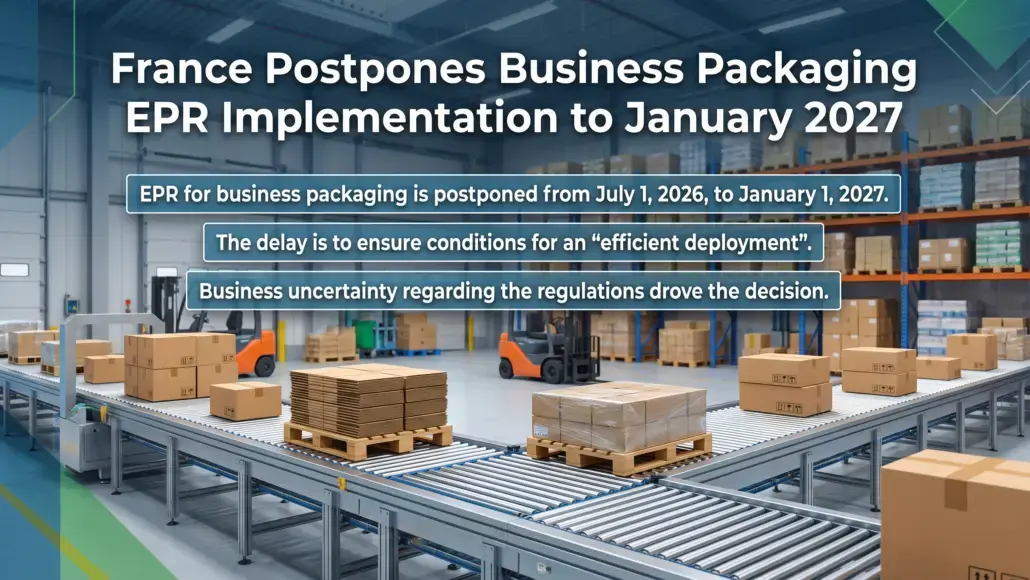

France has postponed the implementation of its Extended Producer Responsibility (EPR) for packaging of goods used by businesses, shifting the effective date from July 1, 2026, to January 1, 2027. The Ministries of Ecological Transition, Spatial Planning, Transport, Urban Development, and Housing indicated that the delay is necessary due to the absence of conditions required for an “efficient deployment.” A primary driver for this decision is the uncertainty among many businesses regarding their legal obligation to join one of the three state-approved producer responsibility organizations (PROs): Citeo Pro, Leko Pro, and Twiice. The transition to the business packaging EPR requires high levels of organizational clarity to ensure that all economic stakeholders are properly integrated into the new waste management framework.
Mathieu Lefèvre, Minister Delegate for Ecological Transition, stated that the January 2027 launch date will provide the necessary conditions for a successful start. The postponement also addresses the delayed publication of EPR fee rates from the approved PROs, which had previously prevented businesses from adapting their financial models to include these new costs. By moving the deadline, the government enables PROs to define and communicate their pricing schedules for 2027 by September, offering the visibility required for long-term operational planning.
Finalizing Technical Standards and Global Context
The global SURGE in packaging EPR schemes is driven by the polluter-pays principle, which encourages producers to take responsibility for the entire lifecycle of their waste. This regulatory shift is accelerating the development of monomaterials, refillable systems, and reusable packaging innovations. During the extended implementation period, French authorities will finalize technical work concerning traceability and the development of standards with the downstream sector. Minister Lefèvre has emphasized that he will monitor these developments to ensure that new fee schedules remain aligned with the initial financial projections provided by the PROs during their accreditation process.
The objective for the remainder of the year is for every affected operator to have officially joined an eco-organization, ensuring a fully operational business packaging EPR scheme by the new January deadline. This delay follows similar regulatory adjustments in other major markets; for example, the UK recently deferred its packaging EPR fees by one year and postponed the mandatory collection of flexible packaging until 2030. Within the European Union, the Packaging and Packaging Waste Regulation (PPWR) continues to mandate EPR for all member states, reinforcing the trend toward standardized, producer-funded waste management systems.
Regional Sustainability and Industrial Impact
While the national scheme undergoes technical refinements, environmental advocacy groups continue to urge municipalities to utilize their regional powers to address single-use plastic waste. Local authorities are considered well-positioned to drive progress through their proximity to residents and their ability to promote initiatives like Deposit Return Schemes (DRS). As the industrial sector prepares for the 2027 implementation, the focus will remain on building a resilient and transparent system that effectively manages commercial and industrial packaging waste across the country.