



























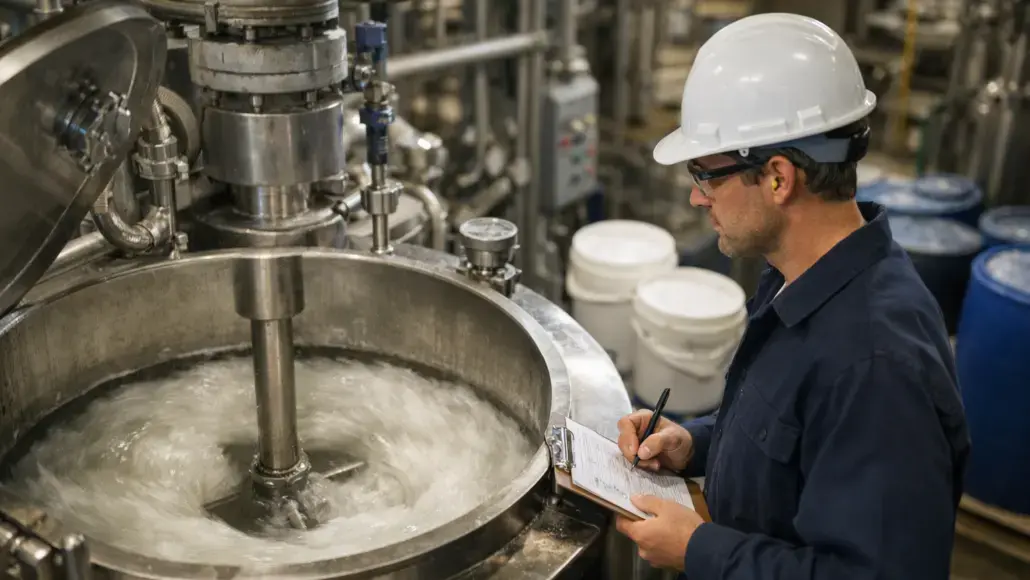
What Manufacturers Should Consider When Mixing Bulk Liquids Before PackagingThe mixing tank may be the last place you want to discover a batch problem. Once an inconsistent blend has been filled into thousands of bottles, pails or drums, correcting it becomes far more complicated and costly. Manufacturers need to pay close attention to mixing before packaging, since this stage can determine whether the finished product meets its required specifications.
Choosing suitable equipment, understanding the liquid’s properties and maintaining consistent operating conditions all play a role in achieving a reliable blend. This guide explores the key questions to consider before mixing bulk liquids, from material characteristics and equipment selection to operator safety and quality checks.
Why the Mixing Step Deserves More Attention
Mixing seems simple until it goes wrong. Ingredients that look blended can stratify, settle or foam. A mix that works in a lab beaker may behave differently in a 275-gallon tote. And a batch that is uneven at the start of filling can drift by the end of the run.
Because packaging locks in whatever you send it, small mixing problems become large quality problems. Treat mixing as a controlled process with defined inputs, settings and checks, not as an afternoon task for whoever is free. A short written procedure, even one page long, makes a surprising difference.
Know the Liquid Before Choosing the Method
Start with the material. Properties decide almost everything else:
- Viscosity: thin liquids and thick pastes need very different mixing energy
- Density differences: heavy components may sink while light ones float
- Solids content: powders and particles need to be suspended or dissolved
- Temperature sensitivity: heat from mixing can change some products
- Shear sensitivity: aggressive mixing can damage emulsions or foams
Foaming and air entrainment: trapped air can ruin fill accuracy
Write down these properties and your goal, such as blending, dissolving or keeping solids suspended. A mixer chosen for the wrong goal wastes energy and can make the product worse. If you run several products, group them by similar properties, since one setup rarely suits everything.
Safety Comes First
Mixing operations often involve flammable liquids, reactive chemicals, moving parts, and enclosed containers, making safety planning essential. Before starting any mixing process, review the relevant safety data sheets to understand chemical hazards, handling requirements, and emergency measures. Following established chemical safety guidelines can help workers understand potential workplace hazards and appropriate protective measures. Check hazardous area classifications, grounding practices, and lockout procedures to reduce the risk of fires, chemical exposure, and equipment-related accidents.
Ensure the mixer is suitable for the materials being processed and that all protective guards and safety controls are functioning correctly. Employees should receive appropriate training on operating procedures and potential hazards. Make sure everyone working near the mixer knows where the emergency stop is located and how to use it properly. Regular equipment inspections, clear operating instructions, and well-established emergency procedures help create a safer working environment and reduce the likelihood of preventable incidents.
Matching the Mixer to the Container
Intermediate bulk containers (IBCs), commonly known as IBC totes, are widely used to store and transport liquids, but their shape and narrow openings can limit mixer compatibility. Cedarstone Industry describes its IBC tote mixer options as compatible with standard 275- and 330-gallon totes, with top-mounted designs and electric or air-powered drives. The company also advises confirming tote dimensions before ordering.
For totes with narrow top openings, a folding impeller can simplify installation: the blades fold for insertion and expand during operation, allowing a larger effective mixing diameter than the opening alone would permit. Selection still depends on viscosity, solids content, desired mixing intensity and the tote’s mounting and structural limitations.
Regardless of the supplier, check the shaft length, impeller size, mounting method, drive type and, where required by the area classification, the equipment’s hazardous-location suitability against your actual container and operating environment. Consider whether the mixer can accommodate changes in viscosity and the range of products you process. It is also worth checking spare-part availability, maintenance access and how easily the unit can be transferred between totes. These details can help you determine whether the equipment suits your workflow and operating requirements.
Controlling the Process
Good equipment still needs good procedures. A reliable mixing routine usually includes:
- A defined order of addition, since sequence can affect dissolving and reactions
- Set speeds and run times, based on testing rather than guesses
- Steps to avoid vortexing and air entrainment
- Sampling at locations and frequencies established by a suitable sampling plan; top, middle and bottom samples may help assess uniformity
- Checks of viscosity, density, pH or other key properties
- Records of batch numbers, times and settings
Test new products on a small scale first, then confirm the results in the full container. Written steps and operator training make results repeatable from shift to shift. Short refreshers, checklists posted near the equipment and a clear way to report problems help the whole team catch issues early.
Cleaning, Compatibility and Cross-Contamination
What touches the liquid matters. Check that the materials of the shaft, impeller and seals are compatible with your chemistry, because corrosion and swelling can shorten equipment life and contaminate batches. Decide how equipment will be cleaned between products, and verify that the cleaning method actually works.
If you run allergens, regulated products or color-sensitive formulas, plan extra steps to avoid carryover. Dedicated tools, clear labeling and documented cleaning checks help protect quality and customers. Keep the cleaning records with the batch records, so you can answer questions quickly if a customer ever raises a concern.
Conclusion
Mixing bulk liquids before packaging is a quality decision, a safety decision and a cost decision all at once. Understand the properties of your product, match equipment to the container and environment, follow safe practices, write down a repeatable process and verify the results with sampling and records.
Check cleaning and material compatibility as carefully as the blend itself. When the mixing step is planned instead of improvised, every container that leaves the line is more likely to match the last one, and your team spends less time fixing problems after the fact.

