















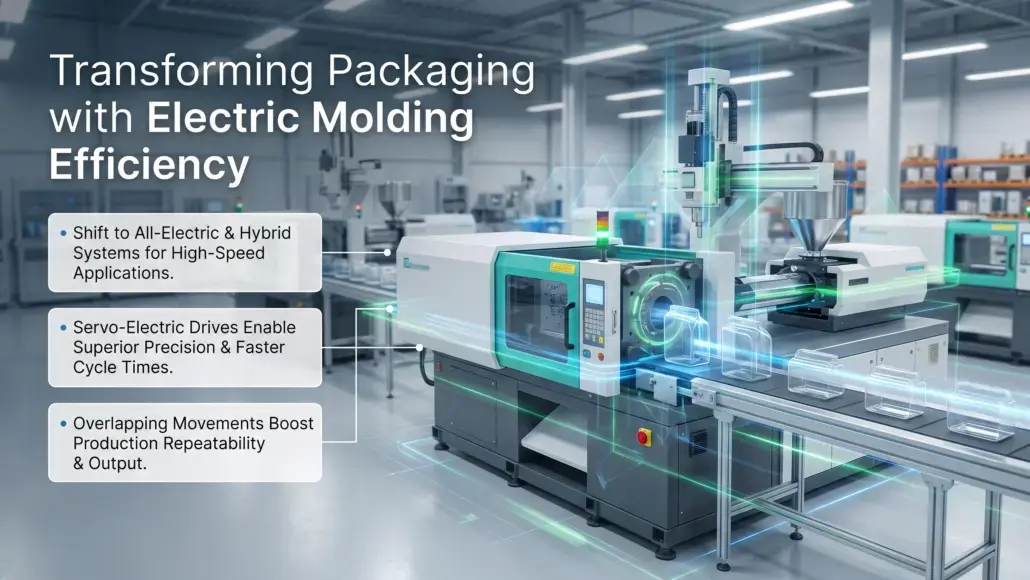

The drive for greater efficiency in the packaging industry has centered on the reduction of cycle times and the improvement of repeatability. Traditional hydraulic injection molding machines have largely been replaced in high-speed applications by all-electric or hybrid systems. Servo-electric drives provide a level of precision and speed that is unattainable with hydraulic power. These systems allow for the overlapping of movements, such as opening the mold while simultaneously starting the plasticization process for the next shot. This parallel operation is a critical factor in plastic injection molding advancing high-speed packaging production, as it can shave seconds off each cycle, leading to massive increases in annual output for high-volume items like caps, closures, and thin-wall containers.
The responsiveness of servo motors allows for incredibly accurate control over the injection profile. The transition from high-speed filling to the packing phase can be managed with millisecond precision, ensuring that every cavity is filled uniformly without flashing or short shots. This consistency is vital for maintaining the tight tolerances required for threaded closures or snap-fit lids. Additionally, all-electric machines are significantly more energy-efficient than their hydraulic counterparts. Because the motors only draw power when they are moving, energy consumption can be reduced by up to 50 percent. In a 24/7 manufacturing environment, these energy savings contribute directly to a lower total cost of ownership and a reduced environmental footprint.
Additionally, the cleanliness of all-electric machines makes them ideal for the production of food and medical packaging. The absence of hydraulic oil eliminates the risk of leaks and contamination in the cleanroom or production area. This operational cleanliness, combined with the quiet operation of the electric drives, creates a superior manufacturing environment. The integration of advanced motion control algorithms ensures that the mechanical components, such as the toggle clamp and the ejector system, operate smoothly and with minimal vibration, extending the life of the machine and the mold.
Multi-Cavity Tooling Strategies and Precision Hot Runners
To achieve the massive volumes required by the global packaging market, manufacturers rely on multi-cavity molds that can produce dozens or even hundreds of parts in a single cycle. Engineering these molds requires a deep understanding of fluid dynamics and thermal management. The challenge lies in ensuring that the polymer melt reaches every cavity at the same time and at the same pressure. Even a minor imbalance in the flow can lead to variations in part weight and dimensions, which are unacceptable in automated filling and capping lines. Balanced runner systems and precision-engineered gates are essential for achieving the required uniformity across a large mold plate.
Hot runner technology is a fundamental component of high-speed molding cells. By keeping the polymer in a molten state within the runner system, manufacturers can eliminate the waste and cycle-time penalty associated with traditional cold runners. Modern hot runners feature sophisticated heating zones and thermocouple controls that maintain a uniform temperature throughout the manifold. Valve gating systems provide the ultimate level of control, allowing for the precise timing of the opening and closing of each gate. This eliminates stringing and ensures a clean, aesthetic gate vestige on the final part. The use of plastic injection molding advancing high-speed packaging production through these advanced tooling strategies allows for the efficient mass production of complex, high-quality components.
Stack molds are another advanced tooling strategy used to increase output without increasing the footprint of the machine. By stacking two or more mold faces on top of each other, the machine can double its production capacity within the same clamping force. This is particularly effective for flat parts like lids and shallow containers. The coordination of the multiple parting lines and the ejector systems in a stack mold requires a high degree of engineering precision, but the gains in productivity are substantial. The continuous refinement of hot runner and stack mold technology remains a key driver of innovation in the high-volume packaging sector.
In-Mold Labeling and Integrated Secondary Processes
The integration of secondary processes into the injection molding cycle is a major trend in the pursuit of manufacturing efficiency. In-mold labeling (IML) is the most prominent example, where a pre-printed label is placed into the mold cavity by a robot before the plastic is injected. The molten polymer then fuses with the label, creating a finished, decorated product in a single step. This eliminates the need for post-molding labeling or printing, reducing labor costs and the risk of damage during handling. IML also provides superior aesthetics and durability, as the label becomes an integral part of the container wall.
High-speed robotics are essential for the success of IML operations. The robot must be able to pick up the labels, place them into the cavities with sub-millimeter precision, and then remove the finished parts, all within a cycle time of just a few seconds. Side-entry robots are commonly used for these applications because they can move in and out of the mold area much faster than traditional top-entry systems. The synchronization between the robot and the molding machine is managed by high-speed communication protocols, ensuring that the process remains stable and efficient even at peak production speeds.
Other integrated processes include in-mold assembly and multi-component molding (2K or 3K molding). Multi-component molding allows for the production of parts with different materials or colors in a single cycle. For example, a closure can be molded with a rigid body and a soft, integrated seal. This eliminates the need for a separate assembly step and ensures a perfect bond between the two materials. The ability to combine multiple functions into a single molding cell is a hallmark of plastic injection molding advancing high-speed packaging production in the modern industrial environment.
Advanced Cooling Techniques and Thermal Management in Fast Cycles
In any injection molding process, the cooling phase accounts for the majority of the cycle time. In high-speed packaging production, where every fraction of a second counts, the ability to extract heat quickly and uniformly is paramount. Traditional cooling channels, drilled into the mold base, are often insufficient for the demands of fast cycles. Instead, manufacturers utilize conformal cooling, where the channels are 3D-printed or laser-sintered to follow the exact contour of the part. This brings the cooling medium much closer to the polymer, significantly reducing the time required for the part to reach ejection temperature.
Beryllium copper and other high-conductivity alloys are also used in areas of the mold where heat tends to accumulate, such as the cores of deep containers. These materials can transfer heat much faster than standard tool steel, preventing hot spots that could lead to warping or long-term structural issues. The management of the cooling medium itself is also critical. High-flow cooling systems with precise temperature control ensure that the mold temperature remains stable throughout the production run. Even small fluctuations in mold temperature can affect the shrinkage and dimensions of the parts, leading to quality issues.
Additionally, the use of pulsing cooling systems systems or specialized heat-transfer fluids can further enhance the efficiency of the thermal management process. By optimizing the cooling phase, manufacturers can achieve significantly shorter cycle times while maintaining the structural integrity and aesthetic quality of the parts. This technical focus on thermal management is a core element of plastic injection molding advancing high-speed packaging production, enabling the industry to meet the ever-increasing demand for high-quality, cost-effective packaging solutions.
Data-Driven Quality Control and Predictive Maintenance Systems
The complexity and speed of modern molding cells require a sophisticated approach to quality control. Manual inspection is impossible at production speeds of thousands of parts per hour. Instead, manufacturers utilize high-speed vision systems that can inspect every part for defects like flashes, short shots, or color variations in real-time. These cameras are often integrated directly into the take-out robot or the conveyor system, allowing for the automatic rejection of any non-conforming parts. This 100 percent inspection capability ensures that only perfect products reach the customer, a critical requirement for food and pharmaceutical applications.
Data from the molding machine and the auxiliary equipment is also used for process monitoring and optimization. Every shot is recorded and analyzed to detect any trends or deviations that could indicate a potential issue. For example, a gradual increase in injection pressure might suggest that a gate is becoming blocked or that the material viscosity is changing. By identifying these issues early, operators can make the necessary adjustments before the process moves out of specification. This data-driven approach to quality control is a fundamental part of plastic injection molding advancing high-speed packaging production in the era of Industry 4.0.
Predictive maintenance is another significant benefit of digital integration. By monitoring the condition of critical components like the screw, the barrel, and the mold components, the system can predict when they are likely to require service. This allows for scheduled maintenance during planned downtime, preventing costly unplanned failures and ensuring the long-term reliability of the production cell. The ability to collect and analyze large volumes of data from multiple machines also provides valuable insights for continuous process improvement. The commitment to digital excellence and data-driven decision-making ensures that the injection molding industry remains at the forefront of high-speed manufacturing, providing essential solutions for the global packaging market.