















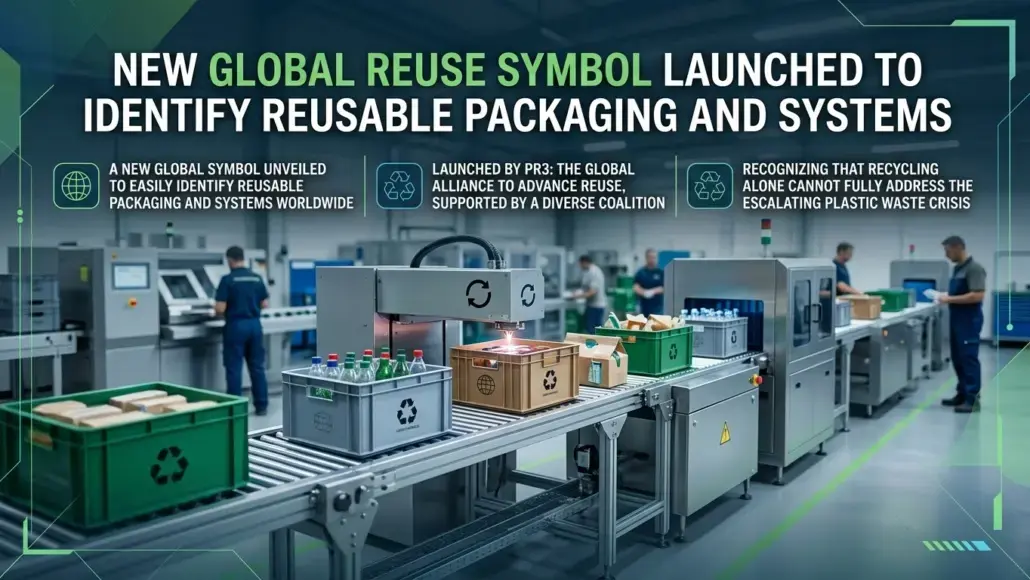

A coalition of businesses, governments, NGOs, and designers has unveiled a new global reuse symbol specifically created to identify reusable packaging and reuse systems worldwide. The symbol was launched by PR3: The Global Alliance to Advance Reuse, arriving at a time of growing recognition that recycling alone is insufficient to address the escalating plastic waste crisis.
The PR3 Global Standards Panel initiated the search for a universal reuse symbol in 2025. The call drew 236 submissions from 29 countries, reflecting broad international interest in addressing the challenge of plastic waste through standardized reusable packaging identification.
The winning design was created by Nicole Ascanio Rodriguez and Juan Navarrete, designers and co-founders of Epigrama Studios, based in Bogotá, Colombia. The selection process involved multiple rounds of jury review, global market testing, and evaluation against criteria including distinctiveness, memorability, actionability, cultural adaptability, and recognizability. The design was also specifically assessed to ensure it could be clearly distinguished from the existing recycling symbol.
The global reuse symbol is now being introduced across a diverse range of reusables and reuse infrastructure including cups, wine and beverage bottles, and collection bins. It is also intended to appear at collection points, wash facilities, digital interfaces, return systems, and reuse infrastructure built to support end-to-end circular systems.
Beyond the symbol itself, PR3 has developed global standards for reuse systems covering collection systems, container design, digital systems, labeling, operations, incentives, and washing infrastructure. These standards were developed through a consensus body representing more than 80 organizations and are already guiding the development of reuse systems including municipal and commercial reuse infrastructure across North America, Europe, and Asia. PR3 is additionally working on a certification system for reuse operations and wash infrastructure.
PR3 co-founder and director Amy Larkin stated that reuse is the most effective strategy for long-term plastic use reduction. Larkin noted that reusable packaging systems can cut the manufacturing of single-use plastic by 90% when compared to equivalent single-use products. She also pointed to the ongoing Strait of Hormuz crisis as a factor that has pushed the price of plastic packaging up by 40% in many areas in just three months, given that the Middle East is a major exporter of petrochemicals used in plastics production.
“There’s a pure financial incentive to reuse, which is not going away anytime soon,” Larkin said. “And the more people reuse, the more it will get picked up, with reuse entrepreneurs leading the way.”
Larkin cited PepsiCo Inc. expanding its reusable cup program inside Levi’s Stadium for February’s Super Bowl as an example of how reuse is gaining greater prominence. She also noted that in Indonesia, the government has identified reuse as an integral part of its strategy against plastic waste.
“We anticipate reuse is going to be very desirable, and this new symbol is going to be seen around the world. Culture changes everything and I hope it comes to be a beacon for thinking ‘there are solutions out there’ and ‘we can fix stuff’,” Larkin added.
Juan Navarrete, co-founder and designer at Epigrama Studios, explained the thinking behind the winning design. “We wanted to create a symbol that communicates return, continuity and circulation,” Navarrete said in a statement, adding that it had to be simple enough to travel globally, yet meaningful enough to represent a new relationship with materials and waste.
“The symbol understands time not as a straight line, but as a spiral: returning, restoring and beginning again,” he said.
Professor Cressida Bowyer, deputy director of the Revolution Plastics Institute at Portsmouth University and a member of the judging panel, described reuse as a critical part of tackling plastic pollution. She noted that reuse systems are capable of delivering environmental, economic, and social benefits.
“As well as consumers, our research shows that business, NGOs, academia and governments have a vital role to play in creating the conditions for reuse systems to succeed,” Professor Bowyer said. “The development of a new universal logo for reuse shows there is clear momentum, to scale up reuse. Continued research and international collaboration will be essential to accelerate this progress.”
The launch of this global reuse symbol represents a coordinated international effort to bring greater visibility and standardization to reusable packaging systems at a time when both environmental pressures and economic factors are driving demand for viable alternatives to single-use plastics.