












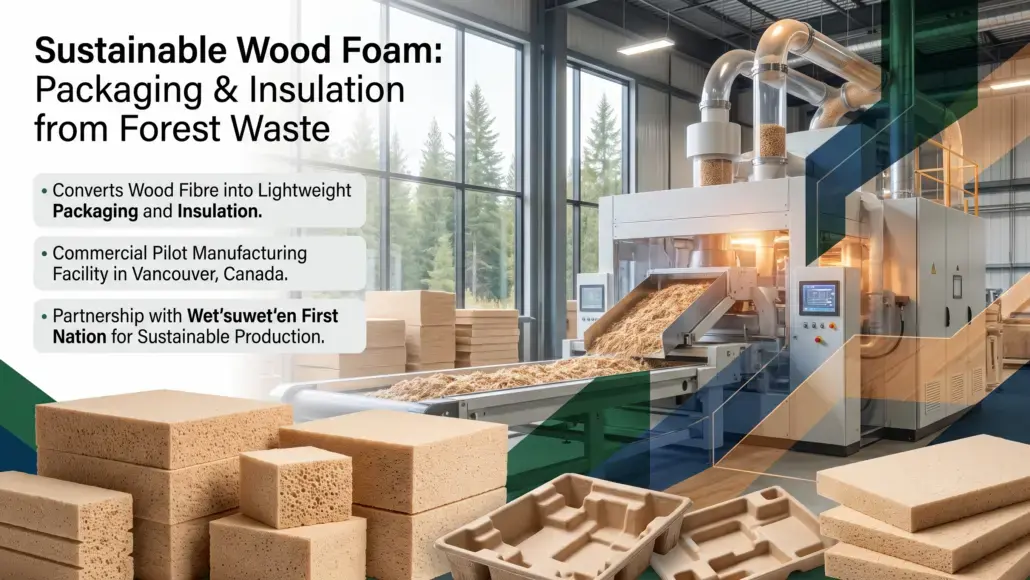

A pilot manufacturing site in Vancouver, Canada, has begun producing wood foam, a material developed at the University of British Columbia (UBC) and brought into commercial production through a partnership with the Wet’suwet’en First Nation. The facility converts wood fibre into lightweight blocks designed for packaging and insulation applications, marking a tangible step from laboratory research to real-world manufacturing.
From Forest Waste to Biodegradable Packaging
The project is led by Feng Jiang of UBC’s faculty of forestry and environmental stewardship, working alongside DicinFoam, a majority-owned subsidiary of YLP — the business arm of the Wet’suwet’en First Nation. The intellectual property underpinning the technology is jointly held by UBC and YLP.
At the core of the process is a commitment to using wood waste sourced from logging activity and forest fires — material that would otherwise be burned or discarded. This waste is transformed into biodegradable packaging and insulation products, offering a meaningful alternative to conventional plastic packaging.
The Manufacturing Process
At the Vancouver plant, softwood species including spruce, pine, and fir are processed using heat, mechanical methods, and limited chemical additives to produce the foam material. In packaging applications, the wood foam packaging is designed to decompose in soil within months, presenting a clear environmental advantage over petroleum-based plastics.
The site is also manufacturing insulation panels treated to meet building performance standards — a segment of the market that currently relies heavily on imported wood-based products.
Scaling from Research to Production
A pivotal figure in translating this research into production is Yeling Zhu, chief technology officer of DicinFoam. Zhu completed postdoctoral work in Dr. Jiang’s laboratory, subsequently worked at another company, and later returned to lead the scale-up process. Jiang’s lab continues to be involved in the next phase of development, including testing different feedstock combinations and broadening potential end uses.
The Vancouver facility is currently producing between 150 kg and 200 kg of wood foam per day.
Expansion Plans and Economic Opportunity
The growth roadmap for the venture is well defined. The next planned stage involves a larger facility in Burns Lake, situated within Wet’suwet’en territory, with a targeted annual capacity of 1,000 tonnes of biodegradable packaging foam. This expansion is expected to generate as many as 15 jobs in the surrounding area.
Following that phase, the company intends to scale further with a 15,000-tonne facility on Vancouver Island, where an additional 35 to 60 jobs are anticipated. The progression reflects a structured, staged approach to bringing this plastic packaging alternative to greater commercial scale while supporting regional economic development.
Jiang’s lab remains actively engaged in refining the technology, exploring new feedstock mixes, and identifying additional applications — ensuring that the research foundation continues to evolve alongside the growing manufacturing operation.