




















When Brent crude oil hit $138 per barrel in April 2026, flexible packaging converters faced a familiar pressure through an unfamiliar lens. Raw material costs surged, film prices followed within weeks, and the cost of every wasted meter on the production floor jumped with them. But the underlying vulnerability runs deeper than oil alone. Covid-era supply chain disruptions, geopolitical trade route closures, and the EU’s new PPWR regulation have all amplified the same question converters are asking with increasing urgency: what can we actually control?
We sat down with AVT’s CEO Roy Porat and VP Product and Marketing Guy Yogev to discuss how external cost shocks are reshaping the way flexible packaging converters think about waste, margins, and the role of inline print inspection in an industry that can no longer absorb volatility the way it used to.
THE MARKET REALITY
Q: Roy, when Brent crude oil hit $138 per barrel in April 2026, what did you hear from your customers in the weeks that followed?
Roy Porat:
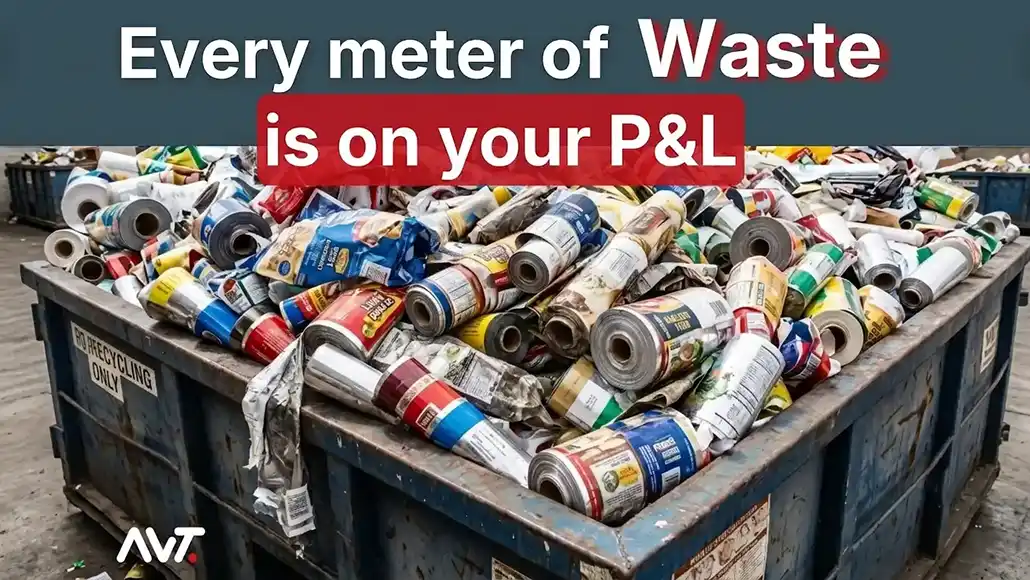
The first calls we got were not about quality. They were about money. Take a converter running at 5% scrap, which most production managers would consider reasonable. At $2,500 per ton, that 5% costs roughly $225,000 a year in lost substrate. When film prices jumped to $3,750 per ton in a single quarter, that same 5% became $337,500. The converter didn’t get worse at their job. The price of their existing waste rate went up by over $100,000 overnight.
What struck me was how fast the conversation shifted. For years, the inspection conversation started with quality and customer complaints. In April and May of 2026, it started with “how much substrate can we stop losing.” That’s a fundamentally different entry point, and it tells you how much pressure converters were under.
Q: Guy, AVT works with converters across flexible packaging globally. Was the pressure concentrated in one region, or did you see it across the board?
Guy Yogev:
It hit everywhere, but it hit differently depending on where you operate. European converters were already running under elevated energy costs when the oil spike landed in April 2026. It didn’t arrive in isolation. It landed on top of an industry that was already fighting to protect its margins.
In North America, converters felt it just as clearly. Raw material costs climbed fast, and the pressure on substrate pricing was immediate. The end result for the converter buying the film was the same regardless of region: your material costs went up, and your scrap rate didn’t go down.
We also heard from converters in Asia and Latin America facing the same dynamic through different triggers. The supply chain is too connected for any region to be fully insulated. Covid proved that through shipping disruptions. April 2026 proved it through oil. The mechanism changes. The impact on the production floor is the same.
Q: Roy, oil is the headline, but your recent report argues that the real vulnerability is broader than oil alone. Can you explain that?
Roy Porat:
Oil is the clearest illustration because the cost chain is so direct. Crude to naphtha to resin to film. Every converter can follow that logic. But what we’ve learned over the past five years is that the underlying vulnerability is to any external event that raises your input costs without changing your output.
Covid shut ports. Container costs multiplied overnight. Import restrictions cut off backup suppliers. Geopolitical events disrupted major trade routes. None of those were oil events, but they all produced the same result for converters: the material on your floor got more expensive or harder to get, and every wasted meter hurt more.
The converters who came through each of those disruptions in the best shape were not the ones who reacted fastest after the event. They were the ones who had already built a lower waste rate into their operations before the event happened. That’s the argument we make in the report. Your waste rate is the one variable you control. Everything else, oil, logistics, regulation, trade policy, is outside your hands.
THE WASTE EQUATION
Q: The report puts specific dollar figures behind scrap rates at different film price levels. When you present those numbers to converters, what is the typical reaction?
Guy Yogev:
Converters track their scrap costs closely. They know their percentages, they benchmark, and they budget accordingly. What catches people off guard is the timeline. An oil price spike hits their production floor cost within four to six weeks. That’s not enough time to renegotiate a customer contract, restructure a supplier agreement, or make any meaningful operational change.
So the scrap rate that was fully accounted for in last quarter’s budget is suddenly costing significantly more, and it happened faster than any normal planning cycle can respond to. That’s the moment converters start looking at their waste rate not just as a quality metric but as an unhedged exposure to external shocks they can’t predict and can’t react to fast enough.
Q: Does the scrap rate need to be high for this math to matter?
Roy Porat:
Not at all. That’s the point. Every converter runs some level of waste. Makeready, color corrections, run-time defects, splice losses, converting-stage rejects. These are built into the process and every production team manages them.
The issue isn’t the percentage. It’s what that percentage costs when the inputs behind it get more expensive. A well-run converter with a modest scrap rate still sees the dollar value of that waste climb every time film prices move. The losses come from many small categories across a shift, and no single one looks alarming on its own. But when the raw material behind all of them gets repriced upward in four to six weeks, the total adds up fast.
That’s why we focus on the waste rate as a controllable variable. You don’t need to be running a bad operation for this to matter. You just need to be running during a volatile material market, and that’s where most converters find themselves today.
TECHNOLOGY AND MARGIN PROTECTION
Q: Guy, when a converter asks you “how does inspection protect my margins,” what does that answer actually look like on the production floor?
Guy Yogev:
It comes down to four categories of loss that converters carry on every job, and inspection acts on all four simultaneously.
The first is preventing reprints before they start. The system compares each job against the customer-approved PDF at setup. Wrong version, wrong language, misplaced graphic, outdated artwork, or a defect in the plate — it gets flagged and can be fixed before the first meter runs. In addition, the system will track the required good target and will ensure enough good material is produced before the job ends.
The second is catching process drift while it is still recoverable. A registration shift starts small. A streak begins as a faint line. Ink density changes gradually. The system detects these developing patterns as soon as they start and gives the operator the chance to correct in-process rather than discovering a problem at the rewinder.
The third is protecting your material, ink, energy, and press time simultaneously. Every out-of-spec meter that gets discarded carries the combined cost of all four. Reducing the defect rate cuts all four at once.
And the fourth is reducing makeready waste on every job change. Automated registration control and inline color measurement shorten the trial-and-error cycle at setup, reducing the meters consumed before the first good unit ships.
Color gets the most attention in quality conversations, and for good reason. But it is one signal among many. The financial case for inspection gets strongest when you account for all four loss categories together, not just the ones that show up in a quality complaint.
Q: Roy, you have been AVT’s general manager in the past and came back as an owner and CEO when AVT got back to operate independently in early 2025. How has the conversation with customers changed over that time? Are converters evaluating inspection differently now than they were in the past?
Roy Porat:
The entry point has changed. Before Covid-19, most conversations started with quality. A converter had a customer complaint, a brand-owner audit, a defect that reached the market. The motivation was protecting the relationship.
That motivation hasn’t gone away. But two new pillars have been added alongside it. The first is cost. When your raw materials represent 75% of your total spend and those prices can jump 50% in a quarter, every percentage point of scrap you eliminate is worth materially more than it was two years ago. The ROI on inspection has improved substantially, and we didn’t change the technology. The market changed the math.
The second is regulation. PPWR is real, the deadlines are binding, and brand owners are already translating those requirements into supplier scorecards. A converter who can document a measurable waste reduction has a commercial advantage. One who can’t is at risk.
So today, when a converter evaluates inspection, they’re evaluating it across three dimensions at once: quality, cost, and compliance. And all three point toward the same investment.
Q: Guy, can you give a tangible example of what inline inspection changes in a real production scenario, without naming a specific customer?
Guy Yogev:
Picture a wide-web flexo press running at 400 meters per minute on BOPP film. Midway through a long run, the ink density on one color station starts drifting. It’s gradual. The eye doesn’t catch it at that speed. Without inline measurement, the operator notices something looks off 10 or 15 minutes later, stops the press, pulls a sample, measures it offline. By that point, 750 to 1,500 meters of film have printed out of spec.
With inline color measurement, the system detects the drift within meters of onset. The operator gets an alert, makes the correction, and the press continues. The difference between those two scenarios is 750 to 1,500 meters of film, plus the ink, plus the energy, plus the press time. Price that film at $3,750 per ton and multiply by the number of times that scenario plays out per shift, across multiple presses, over a full year. The saving compounds fast.
And that’s just color. The same logic applies to registration, spots, streaks, missing print, dirty print, and varnish defects. At modern production speeds, the human eye simply cannot monitor every meter reliably. The system can.
REGULATION AND BRAND-OWNER PRESSURE
Q: Roy, the EU’s PPWR regulation is now in effect. How are you seeing that change the conversation with European converters?
Roy Porat:
PPWR added a dimension to production waste that didn’t exist two years ago. Converters have always known that scrap costs money. That’s not new. What’s new is that scrap now carries regulatory weight.
A converter catches a defect before it reaches a customer. That’s the job, and good converters do it well. But the substrate, ink, and energy behind that scrapped roll still enter the waste stream. Under PPWR, that volume matters. The regulation sets binding recyclability targets and waste reduction mandates with deadlines running from 2030 through 2040. Brand owners are not waiting for those deadlines. They are already building supplier scorecards around measurable waste reduction today.
For converters, this means your scrap rate is no longer just a cost line. It is a compliance metric and a commercial qualification factor. The converters who can document their waste reduction with real production data are the ones winning new business. The ones who can’t are increasingly at risk of losing business to competitors who can.
Q: Guy, is sustainability a real driver of purchasing decisions for inspection systems, or does it still come down to cost and quality?
Guy Yogev:
Two years ago I would have said sustainability was a supporting argument. It made the business case look better, but it rarely drove the decision on its own. That has changed.
What changed it was not environmental conviction alone. It was binding regulation combined with procurement teams at major CPG companies translating those regulations into hard supplier requirements. When a brand owner tells a converter “We need documented evidence of your waste reduction as a condition of our next contract renewal,” sustainability stops being a nice-to-have and becomes a qualification requirement.
Inspection data is the most direct way to provide that evidence. Our systems generate documented production quality records for every job. A converter can show exactly what their defect rate is, how it has improved over time, and how much substrate they have kept out of the waste stream as a result. That data used to be a bonus. Today it is what gets you through the door.
THE FUTURE AND AI
Q: Roy, looking at the flexible packaging market over the next two to three years, what do you expect converters will face?
Roy Porat:
More of the same, but with less room to absorb it. Material cost volatility is structural. The forces driving it, geopolitical instability, concentrated supply chains, energy cost disparities between regions, are not going away. PPWR deadlines tighten progressively through 2030. Brand owners will continue consolidating their supplier base around converters who can demonstrate quality, efficiency, and sustainability documentation.
The converters who invest in visibility across their production process now are the ones who will still be winning business in 2028 and beyond. Those who wait will face a higher barrier to entry with fewer options and less time. Every year of delay means catching up in a more competitive and more regulated environment.
I don’t say this to create urgency for the sake of it. I say it because we see the data from more than 8,300 installations worldwide, and the converters who invested early in disciplined quality control consistently outperform those who didn’t, especially in volatile periods. The evidence is very clear at this point.
Q: Guy, AVT has been in print inspection for over 30 years. How is the technology itself evolving to meet these new pressures?
Guy Yogev:
For 30 years, the core of what we do has been detection. See the defect, flag it, let the operator correct it. That capability continues to get sharper, faster, and more precise with every generation of our systems.
But the most significant evolution happening right now is in what we do with the data those systems generate. An AVT inspection system on a modern press generates an enormous volume of production data every shift. Every defect, every color measurement, every process parameter across every meter of every job. Until recently, most of that data was used reactively: something went wrong, you look at the data to understand what happened.
The direction we are moving, and I’ll say this carefully because we have some significant developments coming that I’m not ready to fully detail today, is toward using that data predictively. Not just detecting what went wrong, but anticipating what is about to go wrong. Identifying patterns that precede a defect event before waste accumulates. Recommending process adjustments before the operator even sees a symptom.
AI and machine learning are at the center of that evolution. The converters we work with are generating exactly the kind of production data that makes machine learning powerful, and we are building the intelligence layer that turns that data into actionable, real-time decisions on the press floor. The goal is to move our customers from reactive quality control to proactive process optimization. That is where the industry is heading, and AVT intends to lead it.
Q: Roy, final question. If a converter reads this and recognizes their own situation, what is the one thing you would want them to take away?
Roy Porat:
The waste rate is the one variable you control.
Oil prices, shipping costs, trade policy, regulation, brand-owner demands — none of those are in your hands. Your scrap rate is. Every point you reduce protects your margin today, strengthens your compliance position for the deadlines ahead, and builds the documented production data that keeps brand-owner relationships intact.
The technology to do this exists today. The evidence from converters who have done it is clear and consistent. The financial case improves every time external conditions tighten, which, as we have seen, happens more often than any of us would like.
The question is not whether a print quality control system makes financial sense. It is how much each month of delay is costing you in substrate, in margin, and in the confidence of the customers you serve.