

















The global packaging industry is undergoing a structural paradigm shift driven by changing consumer behaviors, e-commerce growth, and a demand for deeply personalized brand experiences. Traditional packaging production, dominated by flexographic and gravure printing methods, was built for mass production: high-speed, long runs, and static designs. However, today’s market thrives on agility, customization, and rapid product iterations. At the intersection of these forces lies a vital technological advancement: specialized digital print papers. By examining how digital print papers advancing custom packaging production, we see how engineered print substrates, innovative surface coatings, and digital press compatibility are enabling brands to achieve unmatched speed-to-market, zero-waste operations, and highly targeted customer engagement.
The Disruption of Traditional Packaging Workflows
To appreciate the significance of digital print papers advancing custom packaging production, it is essential to contrast digital workflows with traditional printing methods. Flexography and lithographic lamination require the fabrication of physical printing plates or gravure cylinders. Flexographic plates are made of photopolymer materials that are exposed to UV light through a film negative or laser-ablated, followed by chemical washing or thermal processing to create the raised relief image. Gravure cylinders are heavy steel rolls copper-plated and laser-engraved with millions of microscopic cells. This prepress phase is not only expensive, with plate and cylinder costs reaching thousands of dollars per design, but also time-consuming, requiring days or weeks from artwork approval to the first production run. Furthermore, the physical storage, handling, and maintenance of thousands of fragile printing plates and heavy steel cylinders represent a massive logisitical and financial burden for traditional print shops, requiring large climate-controlled warehouses. The cleaning process also involves hazardous organic solvents, adding an environmental and regulatory overhead. Consequently, brands were forced to order tens of thousands of identical packages to amortize these high setup and maintenance costs, leading to high minimum order quantities (MOQs) and massive warehousing requirements.
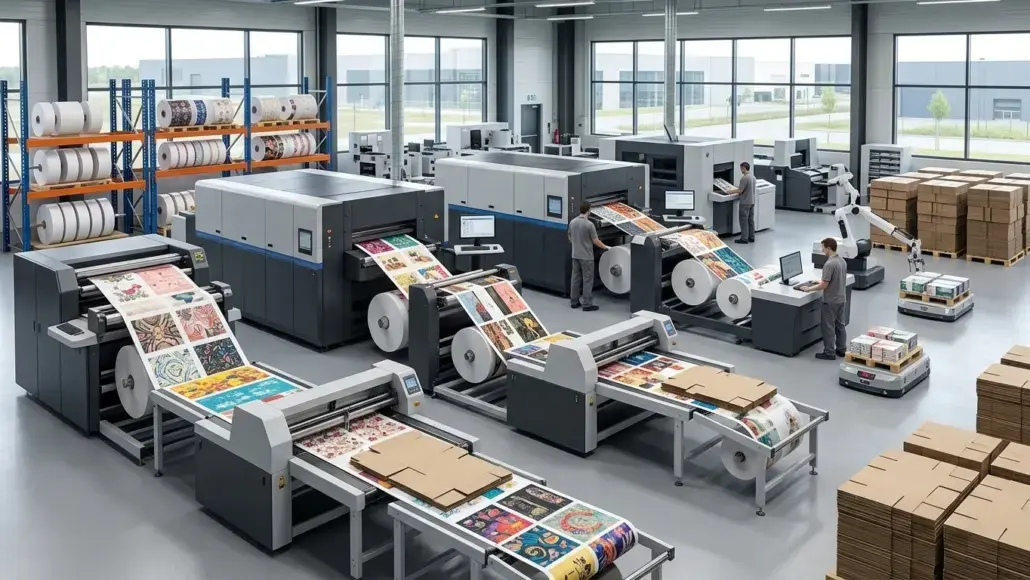
Digital packaging printing eliminates these mechanical bottlenecks. Because digital presses accept artwork files directly from design software, there are no printing plates to manufacture, mount, or clean. The setup time is virtually instantaneous, allowing a press to switch from one packaging design to another mid-run with zero downtime. However, running a high-speed digital press without the correct paper substrate is impossible.
Standard paper stocks are not designed to handle the unique physics of digital inks and toners. If a raw, untreated paper sheet is fed into an industrial digital press, the ink will bleed along the paper fibers, drying slowly and resulting in blurry images, dull colors, and poor barcode readability. Digital print papers solve this challenge by acting as highly engineered chemical platforms, designed to interact dynamically with digital inks to deliver vibrant, photo-realistic imagery on high-speed production lines.
Substrate Engineering for Digital Inkjet Chemistry
The formulation of digital print papers depends heavily on the specific digital press technology being utilized, which is broadly split into inkjet and electrophotography. High-speed inkjet systems, utilizing water-based, solvent, or ultraviolet (UV) curable inks, have become the workhorses of the digital packaging sector. Engineering papers for these systems is a complex exercise in surface energy management and capillary physics.
For water-based (aqueous) inkjet inks, the paper must absorb the liquid carrier (water) rapidly while keeping the pigment colorants locked on the very surface of the sheet. If the pigments sink too deeply into the paper fiber matrix, the print will appear washed out and lose its color brilliance. To prevent this, specialty digital print papers feature micro-porous, silica-based or alumina-based surface coatings, combined with binders like polyvinyl alcohol (PVA) and cationic coagulants. These cationic coagulants carry a positive electrical charge, which instantly attracts and bonds with the negatively charged (anionic) pigment particles in the ink. This ionic attraction acts as a chemical “freeze,” pinning the ink droplets instantly as they hit the paper surface. At the same time, the porous mineral structures of silica or precipitated calcium carbonate (PCC) use capillary action to quickly draw the water carrier away, allowing the ink to dry almost instantly. This rapid physical separation of carrier and colorant prevents the ink droplets from spreading laterally a phenomenon known as feathering or bleeding ensuring sharp text, fine lines, and high-density barcodes.
For UV-curable inkjet inks, which dry through instant exposure to ultraviolet light, the challenge is different. UV inks are highly viscous and do not dry through absorption but through polymerization. Therefore, the digital print papers must possess optimized surface tension (measured in dynes per centimeter) to ensure that the wet ink droplets spread evenly and adhere strongly to the paper surface before the UV curing lamps freeze them in place. The paper’s surface must resist chemical degradation from the reactive monomers in the UV inks, ensuring that the cured ink layer does not flake or peel when the paper is subsequently folded, creased, or die-cut into boxes.
Electrophotography and Toner Adhesion Mechanics
The other dominant digital printing technology is electrophotography, which utilizes dry or liquid toners. This technology, exemplified by HP Indigo and Xeikon presses, is highly favored for folding cartons and premium cosmetic packaging due to its exceptional print quality and ability to match Pantone spot colors with extreme accuracy.
In dry-toner electrophotography, the press uses electrostatic charges to transfer fine plastic resin particles onto the paper, which are then fused to the substrate using high-temperature rollers. The process relies on a photoreceptor drum that is charged using a corona wire, with lasers discharging specific areas to create an electrostatic latent image. The charged toner particles are attracted to these discharged areas before being transferred to the paper. Digital print papers designed for dry toner must possess precise electrical conductivity and surface resistivity (typically measured in ohms/square). If the paper is too dry, it will build up excessive static electricity, leading to toner scattering and ghost images. Conversely, if the paper is too damp, the electrical charge will dissipate too quickly, resulting in incomplete toner transfer. The paper must also withstand the high heat of the fusing roll without curling, blistering, or losing its structural moisture balance.
Liquid toner systems, on the other hand, utilize microscopic pigment particles suspended in a volatile carrier oil. To achieve excellent print quality on these presses, digital print papers are treated with specialized primers or surface sizings, such as polyethyleneimine or ethylene acrylic acid copolymers. These primers act as molecular bridges, creating a strong chemical bond between the synthetic liquid toner and the natural wood fibers of the paper. Without these custom-primed surfaces, the liquid toner would fail to adhere properly, scratching or rubbing off during the aggressive mechanical stresses of folding, scoring, and glueing on the post-print converting lines.
Operational Agility, Inventory Reduction, and Sustainability
The business benefits of digital print papers advancing custom packaging production are profound, completely restructuring the economics of packaging logistics. By enabling short-run production and removing plate fees, digital printing allows brands to adopt “just-in-time” packaging strategies.
Instead of ordering a year’s supply of packaging and storing it in a warehouse where it is vulnerable to damage, moisture, and design obsolescence brands can print packaging as needed, matching production directly to real-time sales data. This print-on-demand model dramatically reduces physical material waste and warehousing costs, helping companies run highly lean, sustainable operations. This operational agility is particularly useful for co-packing and third-party logistics (3PL) centers, where digital presses can be integrated directly into fulfillment lines, allowing custom boxes to be printed and assembled in real-time based on the exact items being shipped to a customer.
Furthermore, digital printing is inherently more eco-friendly at small scales. Traditional press setups require hundreds of meters of “make-ready” paper to calibrate color registration and ink density before starting a production run. Digital presses, by contrast, print the first sheet perfectly, eliminating make-ready waste entirely. When paired with biodegradable digital print papers and compostable, food-safe digital inks, brands can offer fully circular packaging solutions that meet the highest environmental standards.
Personalization and the E-Commerce Unboxing Experience
In the modern retail landscape, the package is no longer just a container; it is a primary marketing channel. The rise of e-commerce has made the “unboxing experience” a critical point of brand-consumer interaction, with millions of consumers sharing their packaging experiences on social media.
Digital print papers make it commercially viable to personalize this unboxing experience on an individual level. Using Variable Data Printing (VDP) software, every single package coming off a digital press can be entirely unique. Brands can print personalized thank-you notes, localized graphics, seasonal greetings, or unique QR codes that lead customers to interactive digital portals, loyalty programs, or augmented reality experiences. This high level of physical personalization bridges the gap between digital convenience and tactile consumer engagement, turning a simple cardboard box into a powerful tool for customer retention and brand storytelling. It allows small businesses to compete on equal footing with multi-national corporations, offering custom corrugated packaging for micro-batches, limited editions, or test marketing.
As digital press speeds continue to increase, approaching the velocities of traditional flexographic presses, the role of engineered digital print papers will only grow. By providing the chemical and physical foundation required for high-speed ink and toner transfer, these specialty substrates are not just facilitating digital printing they are actively driving the future of custom packaging, empowering brands of all sizes to be more creative, more agile, and more sustainable than ever before.

