





















In the realm of contemporary interior design, the boundaries between aesthetics, durability, and cost-efficiency are constantly being redrawn. Modern commercial and residential spaces demand high-performance surfaces that mimic the texture and visual depth of natural wood, stone, and marble, without the associated environmental toll, vulnerability to damage, or high material costs. At the heart of this material revolution are specialized substrates that undergo complex processing to achieve breathtaking finishes. Looking closely at how decor papers shaping premium interior surface design, we find a sophisticated synergy of advanced chemistry, high-definition printing, and mechanical engineering that is transforming modern architectural surfaces into functional works of art.
The Technical Engineering of Base Decor Papers
To understand how decor papers shaping premium interior surface design, one must explore the rigorous technical standards applied to their initial manufacture. Unlike conventional printing paper, base decor paper is a highly technical grade of specialty paper designed to act as an active matrix for synthetic resins. These papers must possess a unique balance of porosity, high opacity, and excellent wet tensile strength. When decor papers are processed, they are completely saturated with thermo-setting resins, primarily melamine-formaldehyde and urea-formaldehyde. This impregnation process requires the paper fibers to absorb the liquid resin rapidly and uniformly.
Achieving this uniform absorption requires precise control over the paper’s fiber orientation and pore structure during wet-end paper manufacturing. Short-fiber eucalyptus pulp is heavily utilized in these formulations, providing a dense, uniform sheet structure that optimizes printability and ink-holding capacity. Additionally, to achieve high opacity and prevent the underlying substrate, such as particleboard or medium-density fiberboard (MDF), from showing through the finished laminate, manufacturers incorporate exceptionally high levels of titanium dioxide (TiO2) pigments into the pulp slurry. Titanium dioxide is the most effective white pigment available, possessing a high refractive index that scatters light and provides excellent brightness and color stability. This pigment must be distributed evenly throughout the thickness of the paper web to ensure consistent color matching, preventing blotchiness or color shifts when the paper is subsequently printed and pressed.
Furthermore, decor papers must display high lightfastness, meaning they must resist yellowing and fading when exposed to sunlight over decades of use. The choice of chemical additives, retention aids, and sizing agents is carefully restricted to avoid any interference with the resin absorption or the high-temperature curing process. The refining process of the pulp fibers must also be carefully regulated. Beating the fibers too much will collapse their internal structure, reducing the porosity and limiting the paper’s ability to absorb the melamine resin. Conversely, insufficient refining results in a weak paper web that can easily break on the high-speed printing presses or impregnation lines. The resulting base paper is an exceptionally robust, heat-resistant substrate ready to receive high-definition designs and heavy chemical saturation.
High-Definition Printing and Aesthetic Realism
The visual magic of decor papers shaping premium interior surface design occurs during the printing phase. Historically, rotogravure printing was the dominant method, utilizing copper cylinders engraved with wood grain, stone, or abstract patterns. Rotogravure remains highly efficient for massive production runs, delivering incredible detail and color depth through multi-station printing presses. However, the modern interior market is increasingly defined by customization, shorter design cycles, and a desire for hyper-realistic textures, which has driven the rapid adoption of digital printing technologies.
Digital printing on decor papers allows manufacturers to bypass the physical limitations and setup costs of printing cylinders. It enables the creation of continuous, non-repeating wood grain patterns across massive surface areas, completely eliminating the repetitive “tiling” effect that once plagued synthetic laminates. Digital inks, formulated using highly stable pigments, are deposited onto the paper surface with extreme precision, allowing for subtle gradients, intricate knots, and realistic mineral veins that are indistinguishable from natural materials. The inks must be carefully calibrated to remain stable when subjected to the high temperatures and pressures of the subsequent lamination processes, avoiding any bleeding, fading, or chemical degradation during the final curing phase.
This digital shift also supports “print-on-demand” production models, reducing inventory overhead and enabling designers to experiment with limited-edition collections or hyper-localized trends. Whether utilizing traditional rotogravure or modern digital inkjets, the printing process must maintain absolute dimensional stability. The paper web cannot stretch or skew during printing, as even a millimeter of distortion would ruin the alignment when the paper is subsequently laminated to a rigid board. Advanced spectrophotometers and automated camera systems are used during printing to monitor color consistency, ensuring that different production batches of the same decor design match perfectly when installed side-by-side in a commercial project.
The Resin Impregnation and Pressing Process
The physical transformation of a printed paper into a resilient interior surface occurs during the resin impregnation and thermal pressing stages. The printed decor paper is unreeled and fed into an impregnation line, where it passes through a series of baths filled with melamine-formaldehyde or urea-formaldehyde resin. Melamine is highly favored for its exceptional hardness, scratch resistance, and chemical stability, making it ideal for high-traffic surfaces such as kitchen countertops, flooring, and commercial reception desks.
During the impregnation process, the liquid resin completely fills the microscopic voids within the paper fibers, encasing the printed ink layers. The saturated paper then passes through flotation dryers, which gently dry the sheet to a precise residual moisture level, leaving the resin in a partially cured, non-sticky “B-stage” state. The dried paper, now referred to as an impregnated film, is cut into sheets and stacked for the final pressing process.
There are three primary laminate categories produced using these impregnated papers: High-Pressure Laminate (HPL), Continuous Pressure Laminate (CPL), and Low-Pressure Melamine (LPM), also known as melamine-faced boards. In HPL production, the decor paper is stacked on top of several layers of phenolic resin-treated Kraft core papers and subjected to high heat and pressure in a multi-platen press. This intense thermal energy triggers a cross-linking reaction, liquefying the resins and fusing the separate layers into a single, highly durable composite sheet. LPM production, widely used for vertical furniture panels and cabinet doors, simplifies this process by pressing a single sheet of impregnated decor paper directly onto an MDF or particleboard core at lower pressures, forming a molecular bond between the resin-infused paper and the wood fibers. Continuous Pressure Laminate (CPL) is produced on continuous double-belt presses, rendering a highly flexible laminate sheet that can be wrapped around complex profile edges for seamless furniture designs.
Sensory Innovation through Tactile Synchronization
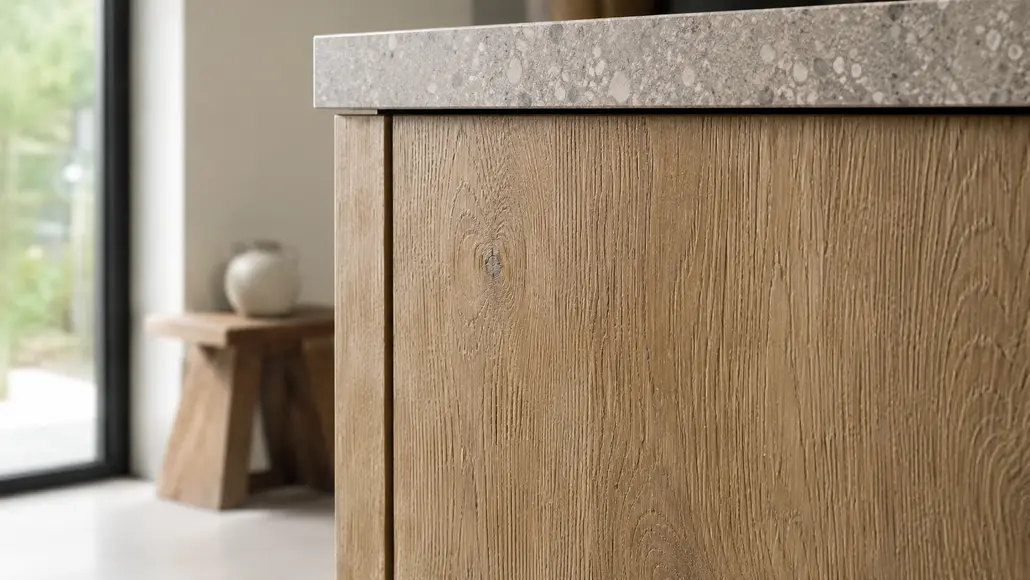
The most significant recent breakthrough in decor papers shaping premium interior surface design is the development of tactile synchronization, commonly known as Embossed-in-Register (EIR) technology. In the early days of decorative laminates, surfaces felt flat and plasticky, betraying their synthetic origin despite having realistic printed patterns. EIR technology has resolved this sensory disconnect by perfectly aligning the physical, embossed texture of the press plate with the printed visual pattern of the decor paper.
To achieve this, the press plates are engraved with microscopic textures using precise laser-etching technology. When the printed and resin-impregnated decor paper is fed into the press, highly advanced optical cameras detect registration marks printed on the paper web. The press machinery automatically aligns the steel press plate with the paper sheet down to a fraction of a millimeter. When the press closes, the physical textures—such as the deep grooves of weathered oak, the fine grain of brushed pine, or the cleft surface of natural slate are pressed directly into the melting melamine resin, permanently freezing them in place. The resulting surface not only looks like authentic wood or stone but feels exactly like it under the fingertips, providing a rich, multi-sensory experience that elevates the perception of laminate materials to a premium status.
Sustainability and Lifecycle Benefits
Beyond their aesthetic and performance capabilities, decor papers represent a highly sustainable choice for modern interior architecture. Because these substrates allow low-value, rapidly renewable wood products like particleboard to be clad in surfaces that rival rare, slow-growing hardwoods, they drastically reduce the pressure on global forestry resources. A single mature exotic hardwood tree, if harvested, yields a very limited amount of solid wood flooring or furniture. However, if the same aesthetic is replicated via printed decor papers and applied to engineered wood substrates made from recycled industrial wood waste, the yield is multiplied exponentially, preserving valuable forests.
Moreover, modern decor paper manufacturers and chemical suppliers are continuously improving the environmental footprint of their operations. Resin formulations have evolved to minimize formaldehydes, ensuring that finished laminates meet the strictest indoor air quality and low-emission certifications, such as the CARB phase 2 and TSCA Title VI standards. The pigments, water-based printing inks, and base fibers are sourced responsibly, often carrying FSC or PEFC certifications. The exceptional longevity of melamine-laminated surfaces also means that interior fittings do not need to be replaced frequently, reducing lifecycle resource consumption and waste generation in the construction sector.
The Evolution of Surface Materiality
As interior design trends veer toward organic textures, matte finishes, and personalized spatial branding, the capabilities of decor papers will expand further. Research into super-matte coatings that resist fingerprint smudges, anti-microbial additives for hygienic medical environments, and flexible papers that can wrap around complex, organic curves is already underway. Through continuous collaboration between specialty papermakers, chemical polymer engineers, and high-tech printers, decor papers shaping premium interior surface design will continue to stand as a benchmark of modern materials science, blending sensory indulgence with unmatched functional durability to shape the spaces where we live, work, and connect.

