




















The industrial converting sector operates at the intersection of extreme speed, microscopic precision, and intensive material stress. At the core of this complex manufacturing landscape lies a critical component that often remains unseen but is entirely indispensable: the release liner. Modern industrial processes demand that adhesive-backed materials be processed, slit, die-cut, and applied with absolute consistency, a requirement that has positioned specialty release papers as foundational elements of production. By exploring how advanced release papers improving industrial converting, it becomes evident that recent breakthroughs in base paper manufacturing, chemical coating technology, and surface engineering are redefining the limits of high-speed manufacturing and efficiency across global supply chains.
The Engineering Behind Specialty Base Papers
To appreciate how advanced release papers improving industrial converting, one must first examine the substrate itself. The foundation of any high-performing release liner is its base paper. Specialty paper manufacturing has advanced significantly, moving away from standard paper-making techniques to produce highly specialized substrates such as Glassine, Super Calendered Kraft (SCK), and Clay Coated Kraft (CCK). Each of these materials is engineered to possess highly specific physical properties designed to withstand the rigors of the converting environment.
Glassine paper, for instance, undergoes an intensive super-calendering process where the paper web is passed through alternating hot and cold steel and fiber rolls under immense pressure. This mechanical compression collapses the fiber network, resulting in an exceptionally dense, smooth, and translucent sheet. The primary benefit of Glassine in industrial converting is its high internal bond strength and uniform caliper. When converters run materials at speeds exceeding several hundred meters per minute, any variation in paper thickness can lead to catastrophic failures. Glassine’s uniform thickness ensures that rotary die-cutting blades can kiss-cut pressure-sensitive adhesives with micrometer precision, cutting through the face stock and adhesive without ever scoring or weakening the backing paper. This mechanical stability is crucial for ensuring that the high-frequency vibrations of high-speed machinery do not cause premature tear-outs or web breaks, which would halt the entire assembly line and result in substantial scrap rates.
Clay Coated Kraft, on the other hand, utilizes a mineral coating on one or both sides to create an incredibly flat and stable surface. This coating acts as a barrier, preventing silicone chemistry from penetrating too deeply into the paper fibers. The structural flatness of CCK is highly valued in sheet-fed converting applications, such as graphic arts and industrial decals, where curling or dimensional instability under changing humidity levels would render the product useless. By controlling moisture absorption and mechanical tension within the base paper, manufacturers ensure that the liner remains completely flat throughout printing, laminating, and die-cutting. The chemical barrier created by the clay coating also ensures that when the silicone layer is applied, it remains on the surface where it can perform its release function, rather than migrating into the porous structure of the paper, thereby maximizing both material efficiency and performance.
Super Calendered Kraft represents another pillar of this technology, offering an economical yet highly reliable solution for rotary die-cutting. SCK papers are manufactured using long-fiber Kraft pulps, which provide excellent tensile strength and tear resistance. This makes them highly suitable for high-speed labeling systems where the dispensing process subjects the liner to rapid acceleration and deceleration forces. The smooth surface of SCK is achieved through controlled moisture application and calendering, ensuring a consistent interface for the subsequent silicone coating process.
Coating Technology and Silicone Chemistry
The functionality of a release liner is determined primarily by its release coating, which is dominated by silicone chemistry. The interface between the adhesive and the release paper must be engineered to provide a predictable, consistent release force, whether the adhesive is peeled away at a snail’s pace or at high industrial speeds. Achieving this predictability requires sophisticated coating technology and an intimate understanding of cross-linking polymers.
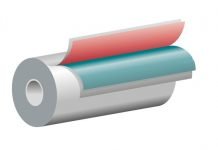
Silicone release coatings are typically applied as solventless, solvent-borne, or water-borne emulsion systems. Solventless silicones have become the industry standard due to environmental regulations and energy efficiency. These systems utilize thermal curing, where high-temperature ovens trigger a platinum-catalyzed hydrosilylation reaction, rapidly cross-linking the silicone polymers into a slick, continuous elastomeric network. The thickness of this silicone layer is incredibly thin, often measuring less than one micrometer, yet it must be perfectly uniform across kilometers of paper. Any microscopic void or “pinhole” in the silicone barrier would allow the adhesive to make direct contact with the raw paper fibers, resulting in an adhesive “lock-up” that halts the converting line. The chemistry must be calibrated precisely, matching the catalyst level, inhibitor balance, and polymer chain lengths to the specific adhesive system being paired with the release liner.
For temperature-sensitive substrates or to reduce energy consumption, ultraviolet (UV) and electron beam (EB) curing technologies have gained traction. These radiation-curable silicones cure almost instantly at room temperature, eliminating the thermal stress placed on the base paper. This preservation of the paper’s natural moisture content prevents post-cure curling and structural embrittlement, ensuring that the release paper retains its mechanical integrity during high-tension winding and unwinding phases of converting. Furthermore, radiation-cured silicones exhibit excellent aging stability, meaning the release force does not degrade or drift over time, even when stored in challenging warehouse environments.
The physical application of these silicone coatings requires highly advanced machinery. Five-roll or multi-roll coating heads are utilized to transfer ultra-low coat weights at high speeds with perfect uniformity. Control systems utilize beta-gauge or infrared sensors to monitor the coating thickness in real-time, allowing operators to make micro-adjustments on the fly. This level of process control ensures that every millimeter of the release liner performs identically, maintaining the strict quality standards required by modern high-speed industrial applications.
Optimizing Process Efficiency in High-Speed Converting
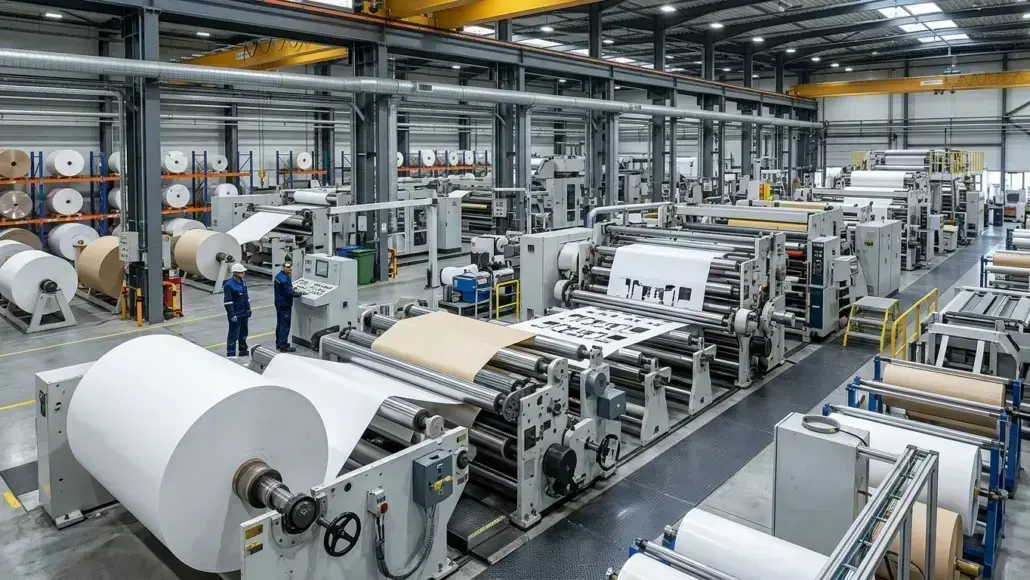
The true test of advanced release papers improving industrial converting occurs on the production floor. During high-speed converting, release liners are subjected to intense mechanical forces. Web tension must be carefully managed to prevent stretching, tearing, or wrinkling. A release paper that exhibits poor tensile strength or dimensional stability will stretch under tension, causing register shifts during printing or multi-layer lamination. This misalignment leads to high waste rates and costly downtime.
Furthermore, the stripping of the matrix the excess adhesive and face stock left over after die-cutting is a highly speed-sensitive process. The release force, which is the force required to separate the adhesive from the release paper, must be carefully balanced. If the release force is too low, the labels or die-cut parts may fly off the liner prematurely during matrix stripping or web guidance, a phenomenon known as “flying labels.” Conversely, if the release force is too high, the matrix will fail to strip cleanly, tearing and causing immediate machine stoppages. The dynamics of peel adhesion are highly non-linear, meaning that a liner which performs well at low peeling speeds might exhibit excessive resistance at high speeds.
Advanced release papers address this challenge through highly engineered release profiles. By utilizing specific silicone polymer blends and release modifiers, manufacturers can customize the release curve. A flat release curve ensures that the force required to separate the adhesive remains stable across a wide range of peeling speeds. This allows converters to increase their line speeds without fear of matrix tearing or pre-dispensing, directly boosting daily output and maximizing equipment utilization. By dampening the impact of speed fluctuations, these advanced substrates provide a wider operating window, allowing converters to run diverse adhesive formulations on the same production line with minimal setup adjustments.
Environmental Sustainability and Material Longevity
As global industries prioritize environmental responsibility, the specialty paper sector has responded with significant innovations in sustainable release liner technologies. Historically, silicone-coated papers presented challenges in recycling streams due to the difficulty of separating the cured silicone polymer from the cellulose fibers. Today, advanced pulp-recovery techniques and collaborative industry recycling loops are successfully reclaiming high-quality paper fibers from spent liners, diverting thousands of tons of waste from landfills.
Additionally, manufacturers are actively down-gauging release papers, reducing the basis weight and thickness of the liner without sacrificing mechanical performance. Down-gauging directly reduces raw material consumption, lowers transportation emissions, and allows more linear meters of material to be wound onto a single reel. For converters, longer rolls mean fewer roll changes, reduced changeover downtime, and higher overall operational efficiency. The reduction in packaging weight also yields logistics savings, helping companies reduce their carbon footprint throughout the distribution network.
The integration of bio-based silicones and FSC-certified wood fibers further enhances the ecological profile of these essential materials. By aligning high technical performance with stringent environmental standards, advanced release papers are helping converters meet both their productivity goals and their corporate sustainability mandates, proving that industrial efficiency and ecological stewardship can progress hand in hand. The transition toward circular materials is no longer merely a regulatory requirement but a competitive advantage that appeals to brand owners seeking to demonstrate authentic environmental responsibility.
The Future of Converting Innovation
Looking ahead, the evolution of industrial converting will continue to place new demands on release paper technology. The rise of printed electronics, smart packaging, and medical-grade transdermal patches requires liners with ultra-smooth surfaces and absolute chemical inertness. Any contamination or surface roughness at the nanoscale could disrupt sensitive electronic circuits or compromise sterile medical adhesives. The integration of RFID chips into self-adhesive labels also demands that the release paper possesses excellent thermal stability to withstand the high-temperature bonding processes used during chip insertion.
To meet these requirements, research is focusing on nano-engineered coatings and hybrid polymer systems that offer even greater thermal stability and chemical resistance. As converting machines push past historical speed barriers, the partnership between specialty paper manufacturers and chemical suppliers will remain paramount. Through continuous innovation in surface chemistry and paper-making physics, advanced release papers improving industrial converting will remain a quiet champion of industrial progress, driving efficiency and quality in manufacturing sectors worldwide. The continuous refinement of these substrates guarantees that as downstream applications become more complex and speed-dependent, the foundational release technology will always step up to meet the challenge, ensuring smooth, uninterrupted, and highly efficient manufacturing processes.

