

























Food packaging decisions are often reduced to three questions: What does the container cost? Does it fit the product? Can it be delivered on time? In practice, the right choice affects far more than the unit price. It influences food protection, shelf presentation, packing efficiency, freight utilization, consumer confidence and the amount of product lost before sale.
This is particularly important in categories such as fresh produce, bakery, salads and ready-to-eat foods. Containers that appear similar in a catalogue may perform very differently once they are filled, stacked, chilled, transported and displayed. Buyers therefore need a structured way to compare options before approving a pack for commercial use.
Key Takeaways
- Start with the food, filling process and distribution environment rather than the container shape alone.
- Match the material to temperature, visibility, rigidity and end-of-life requirements.
- Test closure strength, leak resistance, ventilation, stacking and denesting under realistic conditions.
- Compare total operating cost instead of relying only on the quoted price per unit.
- Evaluate the supplier’s documentation, tooling, quality controls and ability to maintain consistent supply.
Begin With the Product and Its Journey
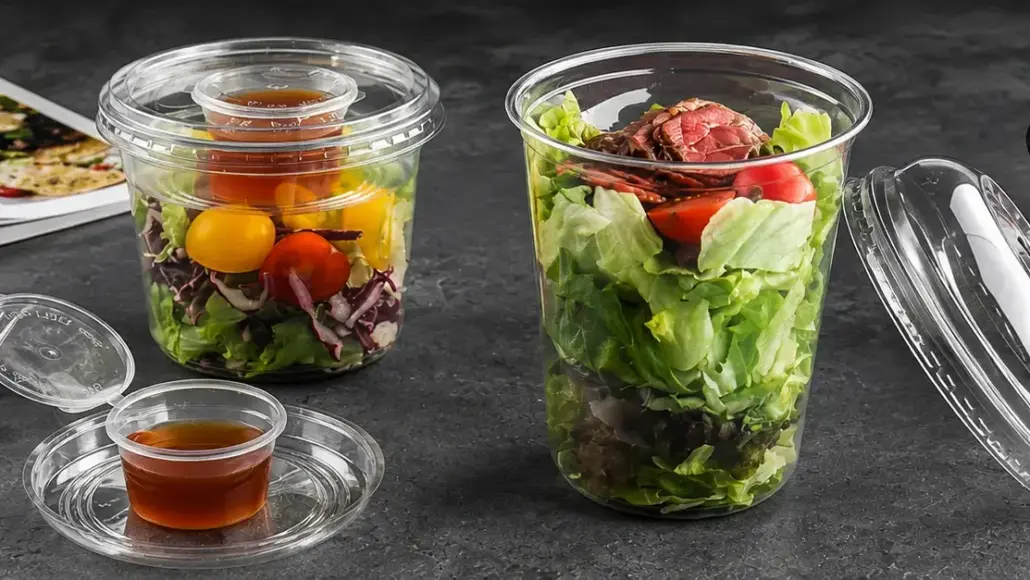
The selection process should start with the food itself. Buyers comparing disposable plastic food containers should first define the product’s temperature at filling, moisture and oil content, required shelf life, sensitivity to crushing or dehydration, and expected storage conditions.
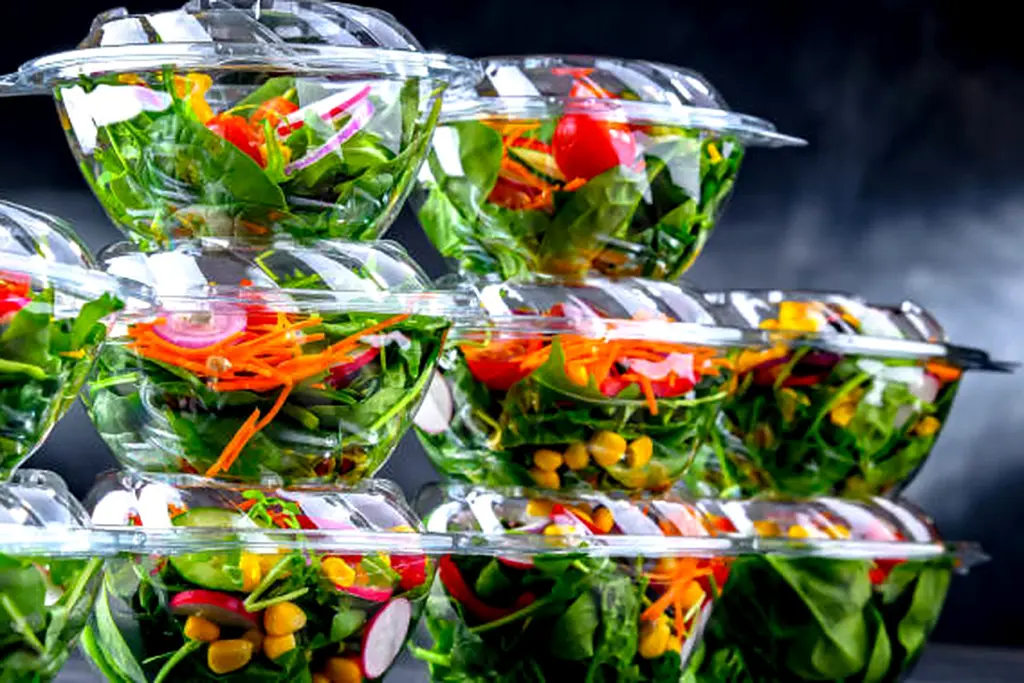
A cold-packed blueberry punnet has different performance requirements from a bakery clamshell or a prepared-food tray. Fresh produce may need controlled airflow and fast cooling. Cut fruit may require a dependable closure and better liquid retention. Cakes and pastries need protection from surface damage while remaining clearly visible. A grab-and-go salad may need tamper evidence and enough headspace to avoid compressing the ingredients.
The distribution route is equally important. Will the pack move through a refrigerated supply chain? Will cartons be palletized several layers high? Will consumers reopen and reclose the container? Is the product sold in a supermarket, through foodservice or via e-commerce? Defining the complete journey creates a practical specification and prevents buyers from selecting a container on appearance alone.
Match the Material to the Application
Different plastics offer different combinations of clarity, rigidity, impact performance and temperature resistance. PET is widely used for cold and room-temperature foods where high transparency and a rigid structure help present the product. It is commonly seen in fresh produce clamshells, bakery containers, cold-food trays and clear cups. Recycled-content PET, often referred to as rPET, can reduce reliance on virgin resin when the grade is suitable for the intended food-contact application and supported by the required documentation.
Polypropylene is frequently selected for applications involving warmer filling conditions or microwave reheating, while CPET is used for some ovenable and freezer-to-oven trays. These materials should not be treated as interchangeable. The intended use temperature, contact time and applicable market regulations must be confirmed before a package is approved.
Material thickness also requires balance. A heavier container is not automatically better, and aggressive downgauging can create problems with panel deformation, closure strength and stacking. The goal is to use enough material to deliver the required performance without adding unnecessary weight.
Examine the Closure and Tamper-Evident Design
A closure should remain secure throughout filling, packing, transport and retail handling. For hinged clamshells, buyers should inspect the hinge, lock geometry and the consistency of the lid-to-base fit. For separate-lid containers, rim accuracy and closure engagement are critical. Packs holding moist or cut foods may also need leak-resistance testing at different orientations.
Tamper evidence is increasingly relevant in retail grab-and-go, deli, bakery and prepared-food applications. However, a visible tamper feature must also be practical. It should be easy for staff to close correctly, clear enough for consumers to recognize and difficult to defeat without leaving evidence. A design that is secure but slows the packing line can add hidden labor cost.
Testing should use actual food or a realistic weight substitute. Empty-container demonstrations do not reproduce the forces created by filled packs, stacked cartons and temperature changes.
Treat Ventilation as a Product-Specific Requirement
For berries, grapes, tomatoes and other fresh produce, ventilation is a functional element rather than a decorative pattern. Hole size, number and position influence how quickly field heat can be removed and how air moves around the product during cold storage.
More ventilation is not always better. Excessive openings may increase moisture loss or expose delicate produce to contamination and physical damage. Too little airflow can slow cooling and allow condensation to accumulate. The correct configuration depends on the produce type, pack weight, cooling method, carton design and route to market.
Vent placement should also work with the way containers are stacked. Openings that are blocked by the pack above may provide less effective airflow than expected. Trials should therefore evaluate the container, carton and pallet as one system.
Test Packing-Line and Logistics Performance
Packaging can pass a product-protection test and still create operational problems. Buyers should evaluate how easily nested containers separate, whether they feed consistently into manual or automated packing, and how reliably they close at normal line speed. Static, flange variation or inconsistent nesting pitch can cause delays that outweigh a small saving in unit price.
Logistics data should be compared at the same level of detail. Useful figures include pieces per carton, carton dimensions, gross weight, cartons per pallet and estimated container loading quantity. A low unit price can be misleading if inefficient nesting increases freight and warehouse space.
Stacking performance must also be assessed after filling. The pack should resist top-load pressure without transferring damaging force to the food. For retail display, buyers should check whether stacked packs remain stable and whether labels, vents and product visibility are obstructed.
Compare Total Cost, Not Only Unit Price
The purchase price of the container is only one part of its commercial cost. A more complete comparison includes:
- Product damage or leakage
- Labor needed for separating and closing packs
- Rejected units caused by inconsistent forming
- Labels and secondary packaging
- Carton, pallet and container utilization
- Tooling or mold modification costs
- Stockholding requirements and replenishment lead time
A slightly higher-priced container can be the lower-cost option if it improves packing speed, reduces claims or fits more efficiently into the shipping carton. Buyers should run a controlled packing trial and calculate cost per saleable packed unit rather than cost per empty container.
Verify Food-Contact and Quality Documentation
Packaging suppliers should be able to provide documentation appropriate to the destination market and intended use. Depending on the application, this may include material specifications, food-contact declarations, migration test reports, recycled-content records, quality-management information and traceability details.
Buyers should confirm that documents apply to the actual material and construction being purchased, not merely to a similar resin or previous design. When recycled content is specified, the permitted percentage and food-contact status should be clear. Regulatory requirements vary by market, so approval should involve the buyer’s own technical or compliance team.
Consistency between sample approval and mass production is just as important as initial compliance. A good quality agreement defines critical dimensions, weight tolerance, appearance standards, closure performance, inspection method and the process for managing material or tooling changes.
Assess the Supplier Behind the Container
Supplier capability can determine whether a good design remains reliable at scale. Buyers should review the range of existing molds, control of sheet extrusion and thermoforming, sampling process, production capacity, quality checks, tooling maintenance and contingency planning.
An extensive mold library may allow a buyer to begin with an existing format rather than investing immediately in a custom tool. When customization is required, the supplier should explain what can be changed, how prototypes will be evaluated, who owns the mold and how production consistency will be maintained.
Manufacturers such as StlPak illustrate this integrated approach by combining an existing mold portfolio with thermoforming capacity, in-house sheet extrusion and OEM or ODM support. Whatever supplier is selected, these capabilities should be verified against the buyer’s expected volume, lead time and market requirements.
Make Sustainability Claims Specific
Sustainability should be evaluated through measurable design decisions rather than broad claims. Relevant questions include whether the container is right-sized, whether its components can be separated, whether the chosen material is collected in the destination market, whether recycled content is documented and whether the design helps prevent food loss.
A package that uses less material but fails during transport is not an improvement. Likewise, a technically recyclable container may still have limited recovery if local collection and sorting systems do not accept it. Buyers should align material selection and on-pack communication with the infrastructure and regulations of the market in which the container will be sold.
Conclusion
Choosing a disposable plastic food container is a product, operations and supply-chain decision. The strongest specification connects material, structure, closure, ventilation, packing performance, logistics and compliance to the actual food application.
Before approving a pack, buyers should test it with the real product, on the real packing process and under realistic transport and storage conditions. This disciplined approach makes it easier to compare suppliers, identify hidden costs and select packaging that protects both the food and the commercial value around it.