
























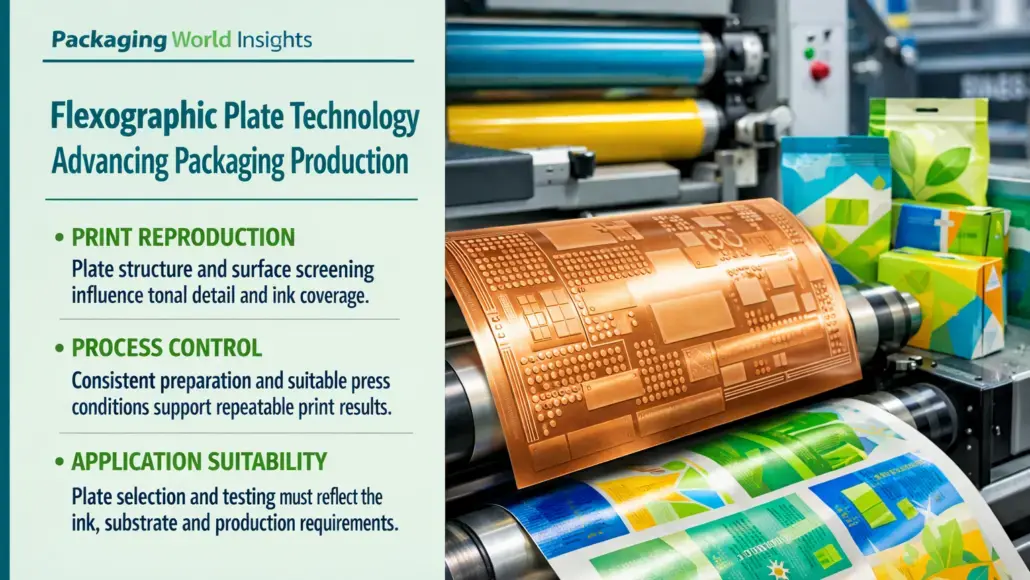

Flexographic printing remains important across packaging applications, including flexible packaging, labels, folding cartons and corrugated materials. Advances in plate construction, imaging and surface screening are changing how printers control image reproduction and ink transfer. A flexographic plate transfers ink to the substrate through raised image areas, making its physical characteristics important to the finished print.
However, achieving consistent results requires more than selecting a newer plate technology. Plate preparation, screening, ink, substrate and press conditions must work together to reproduce the intended design reliably. Understanding these relationships helps packaging businesses evaluate technical improvements against actual production requirements.
Plate Design Influences Ink Transfer and Image Reproduction
Developments such as flat top dot technology and surface screening can influence tonal reproduction, solid ink coverage and print consistency. The Flexographic Technical Association (FTA) discusses these approaches in its technical resources, highlighting the interaction between plate characteristics and the wider printing process. Flat top dots alter the shape of printable image areas, while surface screening introduces texture intended to influence ink distribution.
Their effects depend on the printing application, including the substrate, ink system and press configuration. A flexographic plate designed for one application should not automatically be considered the best choice for another. Technical evaluation and controlled testing remain necessary to establish whether a particular configuration produces the required results.
Technical Factors Shaping Plate Performance
-
Dot Structure: The shape and stability of printable dots influence how highlights, midtones and fine image details are reproduced.
-
Surface Screening: Surface texture can affect ink transfer and the appearance of solid printed areas, depending on the plate and printing conditions.
-
Imaging and Exposure: Controlled imaging, exposure and processing help establish the intended printable structures in the finished plate.
-
Application Compatibility: A flexographic plate must work with the selected ink, substrate, anilox roll and press settings to achieve the intended print quality.
These factors demonstrate why plate technology should be evaluated as part of the complete printing process. Improvements in dot formation or surface characteristics can expand the range of achievable print results, but they do not remove the need for process control. Packaging printers must still establish suitable operating conditions, verify print quality and maintain consistent plate preparation practices. The objective is not simply to adopt a newer plate, but to achieve repeatable results that meet the requirements of the packaging application.
Screening and Plate Preparation Shape Print Consistency
The performance of a flexographic plate depends on how its printable structures are created and how the finished plate interacts with ink and substrate. Flat top dot technology, surface patterning and screening methods can influence tonal transitions, solid coverage and image detail. However, their effects depend on the specific plate system and production conditions.
Controlled exposure, imaging calibration and processing help establish the intended plate characteristics, while print testing helps determine whether those characteristics translate into the required output. Improvements in plate technology therefore need to be evaluated through actual printing results rather than assumed from the preparation method alone.
Plate Preparation Considerations
-
Exposure and processing: Maintain controlled preparation conditions to achieve the intended printable structures.
-
Imaging calibration: Verify that imaging settings and equipment produce consistent results.
-
Screening selection: Match screening methods to the artwork, substrate and desired print characteristics.
-
Print verification: Evaluate the finished result to confirm that the plate performs as intended.
Repeatability Depends on the Wider Printing Process
A consistent print result depends on more than plate construction. Ink properties, anilox roll characteristics, substrate behaviour, mounting accuracy and impression settings can all influence the transfer of ink. The Flexographic Technical Association’s Flexo Quality Consortium investigated plate life under specific wide web flexible film printing conditions and found that solvent exposure could affect plate thickness and hardness. However, these measurements alone were not reliable predictors of every print defect. The findings illustrate why a flexographic plate must be evaluated within its actual production environment rather than against a universal performance assumption.
Maintaining Consistent Production Results
-
Process control: Monitor relevant press settings and maintain consistent operating conditions.
-
Plate inspection: Check plate condition for wear, damage and changes that may affect print quality.
-
Cleaning and storage: Follow appropriate handling procedures to maintain plate condition between production runs.
-
Application specific testing: Evaluate performance using the intended ink, substrate and printing conditions rather than relying on generic expectations.
These practices help connect plate technology with repeatable production outcomes. A flexographic plate may offer useful improvements in image reproduction or ink transfer, but consistent performance still requires controlled preparation, suitable press conditions and ongoing quality checks.
Integrating Plate Technology with Process Control
Advances in flexographic plate design can improve control over image reproduction, ink transfer and print consistency, but their effectiveness depends on the wider printing process. Plate selection must reflect the substrate, ink system and required print characteristics, while controlled preparation and appropriate press settings help maintain repeatable results. Technical improvements should therefore be evaluated against actual production requirements rather than assumed to deliver the same benefits across every application.
Priorities for Repeatable Print Performance
-
Technology selection: Match plate construction and screening to the intended printing application.
-
Process control: Maintain consistent plate preparation and press conditions.
-
Application specific testing: Verify print quality and monitor plate condition during use.
Reliable print reproduction also has commercial implications because setup requirements, repeatability and production constraints influence job planning. Understanding these factors provides a foundation for examining short run production economics where print run length and setup requirements shape converter decisions.
References
- Flexographic Technical Association, Flexo Quality Consortium – FQC’s Plate Life Indicator Project Report – 2023.
- Flexographic Technical Association – Following FIRST: Applying Methodology to Plate Making.
- Flexographic Technical Association – Spots, Dots, Rulings, Angles, Moirés and More: An Introduction to Screening for Flexography.