
























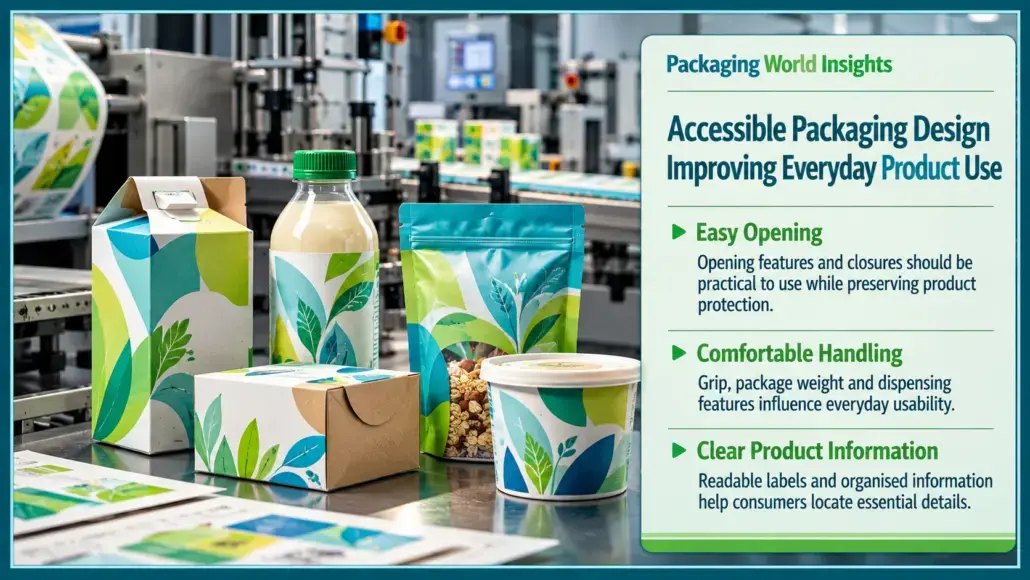

Packaging influences how people access, handle and understand the products they purchase. Opening a sealed container, gripping a bottle, removing contents from a carton or locating essential product information can present different challenges for people with different physical, sensory and cognitive abilities. Accessible packaging considers these differences during design rather than assuming that one format works equally well for every user. For packaging businesses, this means evaluating how people interact with the finished product alongside requirements for protection, presentation, manufacturing and safety. The objective is to identify avoidable barriers while preserving the package’s essential functions.
Packaging Usability Extends Beyond Ease of Opening
Accessible design covers several aspects of everyday product use. The International Organization for Standardization (ISO) addresses these through separate standards for ease of opening, handling and manipulation, and information and marking. Together, these areas provide a useful framework for evaluating accessible packaging across the consumer experience.
A package may be easy to open but difficult to grip, carry or reseal. Similarly, clearly printed information may remain difficult to use if its presentation does not account for differences in vision or information processing. Packaging teams therefore need to evaluate individual design features in the context of the complete user experience. Structured testing can reveal barriers that may not be apparent from a visual design review alone.
Dimensions of Accessible Packaging
- Opening and closing: Evaluate opening mechanisms, tear features, closures and resealing in relation to the intended user’s abilities and the package’s protective requirements.
- Handling and manipulation: Consider grip, lifting, twisting, carrying and access to the product, including how the package behaves during ordinary use.
- Information accessibility: Assess text readability, information hierarchy, instructions and appropriate ways of presenting essential product information.
- Usability testing: Evaluate prototypes with people who have different abilities to identify difficulties before final production specifications are approved.
These considerations require coordination between design, technical and production teams. Changes to materials, closures or package structure can affect manufacturing feasibility, product protection and other performance requirements. Accessible packaging should therefore be assessed through both user experience and technical validation, rather than treated as a visual design feature alone.
Opening, Handling and Manipulation Require Different Tests
Physical interaction is an important test of whether a package works for its intended users. Opening force, closure design, grip surfaces, package weight and the ability to remove contents can influence usability. The International Organization for Standardization (ISO) provides separate guidance through ISO 17480:2015, which addresses ease of opening, and ISO 22015:2019, which covers handling and manipulation. These standards help distinguish different aspects of accessible packaging rather than treating usability as a single outcome. A closure that is easy to open may still be difficult to grip, while a container that is comfortable to hold may be challenging to empty without spilling.
Packaging designers and technical teams can use prototype testing to identify these issues before specifications are finalised. Testing should reflect the intended use environment and include people with varied physical abilities, rather than relying exclusively on internal reviews or assumptions about consumer behaviour.
- Evaluate opening force: Check whether closures, tear strips and other opening features can be operated without excessive strength or difficult movements.
- Test complete handling sequences: Assess gripping, lifting, opening, dispensing and resealing to identify difficulties that emerge during ordinary use.
- Balance usability with protection: Validate any structural or closure changes against product integrity, leakage prevention, tamper evidence and relevant safety requirements.
Information Design Should Support Product Use
Physical usability must be considered alongside the ability to locate, read and interpret information. Labels can contain essential product details, instructions and warnings, yet their practical value depends on legibility, organisation and placement. ISO 19809:2017 addresses information and marking within accessible packaging design, although its scope excludes information and marking on medicinal products and medical devices. For other products, teams can assess whether information is easy to locate and understand in realistic use conditions.
Typography, contrast, spacing, language and information hierarchy all influence how readily consumers identify relevant details. These decisions must also accommodate mandatory labelling requirements and available space without compromising the accuracy of product information.
- Improve information hierarchy: Give essential instructions and product details a clear, consistent position so consumers can locate them efficiently.
- Review readability in context: Test labels under realistic lighting, viewing distances and handling conditions, including on curved or flexible surfaces.
- Validate with diverse users: Gather feedback from people with different visual, cognitive and physical abilities, then revise designs where recurring barriers emerge.
Design decisions should be based on observed usability rather than visual preference alone. Integrating user testing with technical checks allows accessible packaging improvements to be assessed against manufacturing feasibility, product protection and information requirements. This approach also helps teams distinguish meaningful usability gains from changes that look simpler but do not resolve practical difficulties.
Embedding Accessibility in Packaging Development
Making accessible packaging effective requires accessibility to be considered from early design decisions through prototyping, validation and production. International standards provide a framework for assessing opening, handling and information access, but user testing remains important for identifying difficulties that technical reviews may overlook. Testing with people who have different abilities can help teams prioritise design improvements while retaining product protection, manufacturing feasibility and applicable labelling requirements.
- Integrate accessibility early: Include usability criteria in design briefs and packaging specifications.
- Validate proposed changes: Test revised formats against user needs, technical performance and production constraints.
- Review throughout development: Reassess usability when materials, closures, formats or label layouts change.
Accessible design also depends on the systems used to develop and manage packaging artwork. Clear ownership, review processes and controlled revisions help teams maintain consistency as designs evolve. Related considerations are discussed in AI Generated Artwork Ownership.
References
- International Organization for Standardization. ISO 17480:2015 Packaging: Accessible Design: Ease of Opening.
- International Organization for Standardization. ISO 22015:2019 Packaging: Accessible Design: Handling and Manipulation.
- International Organization for Standardization. ISO 19809:2017 Packaging: Accessible Design: Information and Marking.