








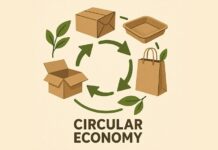


The concept of a circular economy has shifted from a theoretical environmental framework to an urgent operational requirement for the global packaging industry. In this context, moulded fibre circular packaging has emerged as a quintessential solution, embodying the principles of designing out waste, keeping materials in use, and regenerating natural systems. Unlike traditional petroleum-based plastics, which often end up in landfills or as environmental pollutants due to complex recycling requirements, fibre-based products offer a streamlined and intuitive end-of-life path. This article explores the multifaceted ways in which moulded fibre packaging supports circularity, focusing on material sourcing, manufacturing efficiency, and the critical role of biological loops in creating a truly sustainable industrial ecosystem.
To understand the impact of this material, one must first recognize the fundamental failure of the “linear” economy. In a linear system, resources are extracted, used once, and then discarded, leading to a perpetual state of resource depletion and waste accumulation. Moulded fibre circular packaging breaks this cycle by treating materials as nutrients that must be returned to the system. Whether those nutrients are technical (recycled back into new products) or biological (returned to the soil as compost), the goal remains the same: to minimize the need for virgin extraction and eliminate the concept of waste. This philosophy is now being adopted by some of the world’s largest consumer goods companies, who recognize that their long-term viability depends on their ability to decouple growth from resource consumption.
Rethinking the Foundation of Material Sourcing
At the heart of any circular system is the choice of raw materials. Moulded fibre packaging is uniquely positioned because it is typically derived from renewable biological sources. Most production facilities utilize post-consumer waste such as old corrugated containers and newsprint as their primary feedstock. This process turns a waste stream back into a valuable product, effectively “closing the loop” on paper and cardboard production. However, the circularity of the system extends beyond just recycling. The industry is increasingly exploring the use of agricultural side-streams, such as wheat straw, bagasse (sugarcane residue), and miscanthus. These fast-growing, renewable resources provide a sustainable alternative to virgin wood pulp, reducing the pressure on forest ecosystems and utilizing materials that would otherwise be burned or left to decompose in fields, often releasing methane in the process.
The use of agricultural residues is particularly significant because it creates a “cascading” use of resources. Instead of the plant being grown solely for its primary product (like sugar or grain), the secondary “waste” becomes a high-value input for the packaging industry. This not only improves the economic efficiency of the farming sector but also ensures that the carbon captured by the plants during their growth is stored within the packaging material for as long as possible. When the packaging eventually reaches the end of its life, that carbon can be returned to the soil, completing a natural cycle that has existed for millennia. This is the essence of moulded fibre circular packaging using nature’s own mechanisms to solve industrial problems.
The Lifecycle of Moulded Fibre in a Biological Loop
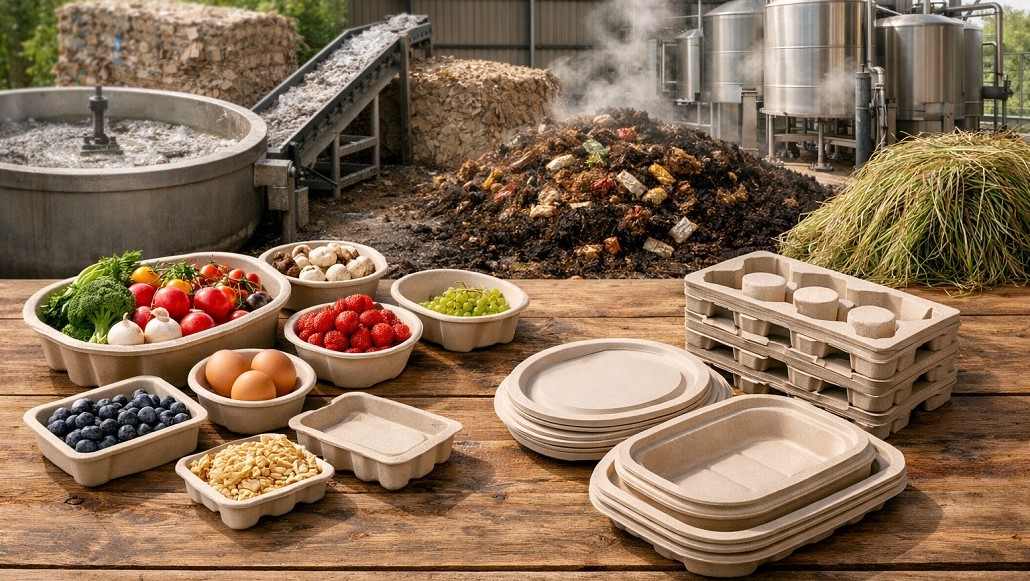
A distinguishing feature of moulded fibre circular packaging is its dual-pathway for end-of-life management. In many regions, the infrastructure for paper recycling is well-established and highly efficient. Moulded fibre products can often be processed alongside traditional cardboard, where the fibres are recovered and used to create new packaging products. This technical loop can be repeated multiple times before the fibres become too short for structural use. At that point, the material remains part of the circular economy through compostability. As a biological material, fibre can be broken down by microorganisms into nutrient-rich compost, which can then be used to enrich the soil, facilitating the growth of new plants. This create-use-return cycle is the very definition of a regenerative system.
The compostability aspect is crucial for the foodservice industry, where packaging is often heavily contaminated with food residues. Traditional plastic recycling is highly sensitive to contamination; even a small amount of oil or organic matter can ruin an entire batch of recycled plastic. Moulded fibre, however, thrives in this environment. When a fibre tray and its leftover food scraps are sent to an industrial composting facility, they break down together, creating a valuable soil amendment. This eliminates the need for consumers to meticulously clean their packaging before disposal, significantly increasing the actual diversion rates from landfills. This alignment with human behavior is a key factor in the success of sustainable packaging solutions.
Decarbonizing the Supply Chain through Material Efficiency
The transition to a circular packaging economy is intrinsically linked to the reduction of carbon emissions. Moulded fibre packaging contributes to this goal through its lightweight nature and efficient design. During the manufacturing process, advanced moulding techniques allow for the creation of nested designs, which significantly reduces the volume of the packaging during transport. Fewer shipments mean lower fuel consumption and a smaller overall carbon footprint. Furthermore, the energy required to produce moulded fibre is often lower than that of plastic or glass, especially as more manufacturers adopt renewable energy sources and closed-loop water systems within their factories. The focus on “material efficiency” ensures that we are achieving the maximum amount of protection with the minimum amount of material.
In a circular model, efficiency also means designing for the entire lifecycle. This includes the energy used during the pulping, forming, and drying stages. Modern fibre moulding plants are increasingly utilizing heat recovery systems to capture the energy from the drying process and reuse it elsewhere in the facility. Additionally, the move toward “dry-moulding” technology which uses significantly less water than traditional methods is a major step forward in reducing the environmental impact of the production stage. By optimizing every step of the journey, moulded fibre circular packaging helps companies meet their science-based targets for carbon reduction, providing a clear and measurable path toward net-zero operations.
Overcoming the Limitations of Linear Packaging Models
Traditional packaging models are built on a “take-make-dispose” philosophy that has led to the current global plastic crisis. Plastics, while versatile, are often composed of complex polymers and additives that make them difficult to recycle in a closed-loop fashion. Often, plastic is “downcycled” into lower-quality products that eventually reach a dead end in the waste stream. In contrast, moulded fibre packaging offers a more honest approach to circularity. The simplicity of the material primarily cellulose fibre and water ensures that it can return to the earth or the production line without introducing persistent toxins into the environment. This transparency is vital for companies looking to meet their ESG (Environmental, Social, and Governance) targets and satisfy the demands of a more informed public.
The inherent transparency of fibre materials also simplifies the “extended producer responsibility” (EPR) requirements that are becoming law in many jurisdictions. When a producer can easily track and verify the end-of-life path of their packaging, their financial and legal risks are greatly reduced. Moulded fibre circular packaging does not require the complex sorting and chemical recycling processes that many modern plastics demand. This simplicity makes it a more resilient choice in a world where waste management regulations are constantly evolving. By choosing a material that is naturally aligned with the earth’s cycles, brands can avoid the “greenwashing” traps that often plague the sustainability conversation.
Integration with Modern Waste Management Systems
For a circular system to function, the product must fit into the existing waste management infrastructure. Moulded fibre circular packaging excels here because it is easily recognized by sorting systems and consumers alike. There is no confusion about which bin it belongs in; its paper-like appearance signals its recyclability. This clarity reduces contamination in recycling streams, which is a major hurdle for plastic circularity. Additionally, for brands operating in the foodservice sector, the move toward compostable packaging allows for the co-collection of food waste and packaging, simplifying the disposal process for consumers and increasing the volume of waste diverted from landfills.
The role of the consumer in the circular economy cannot be overlooked. For a system to be truly circular, the user must take the final step of placing the material in the correct stream. Moulded fibre’s intuitive nature facilitates this. People instinctively know that “paper” goes in the recycling or the compost, whereas plastic often feels like a permanent material that belongs in the trash. This psychological alignment ensures that the theoretical circularity of the material translates into actual, real-world results. Furthermore, as municipal composting programs expand, the value of fibre as a “carrier” for organic waste will only increase, making it a critical component of the urban waste infrastructure.
Scaling Circularity for Global Impact
While the benefits of fibre packaging are clear, achieving global circularity requires scale. This involves not just building more factories, but also investing in the technology to make fibre packaging more durable and versatile. The industry is currently seeing a surge in “dry-moulding” technologies and advanced thermoforming, which produce high-quality finishes that rival plastic in appearance and performance. As these technologies become more widespread, the opportunity for moulded fibre circular packaging to replace plastic in high-volume sectors such as consumer electronics and cosmetics will grow exponentially. This expansion is a critical step in moving the entire global economy toward a more sustainable and less extractive model.
Scaling also means addressing the global supply of sustainable fibre. While recycled paper is a great start, the increasing demand for fibre packaging will eventually outstrip the supply of recycled materials. This is where the development of regional “fibre hubs” becomes important facilities that process local agricultural waste into packaging pulp. By decentralizing the supply chain and using locally available resources, we can further reduce the carbon impact of transport and create a more resilient global network of circular production. This localized approach to a global problem is a hallmark of the circular economy, where “global” goals are met through “local” action.
The Role of Design in Enhancing Circularity
Designers play a pivotal role in the circular packaging economy. By focusing on “design for disassembly” and material purity, they can ensure that every piece of packaging is optimized for its next life. For moulded fibre, this means minimizing the use of labels and adhesives that might interfere with the pulping process. Instead, brands are using techniques like embossing and debossing directly into the mould to convey branding and product information. This not only creates a sophisticated, premium look but also ensures that the packaging remains 100% monomaterial, a key requirement for high-quality recycling and composting.
When a designer approaches a project with a circular mindset, they ask: “Where will this go when the customer is done with it?” This question changes everything. It leads to the elimination of multi-material laminates that are impossible to separate. It encourages the use of nesting shapes that save space. It promotes the use of natural dyes and water-based inks. In the world of moulded fibre circular packaging, the design is not just about aesthetics it is the blueprint for the material’s entire future. By integrating these circular principles from the very beginning, we can ensure that the packaging of tomorrow is a solution, not a problem.