























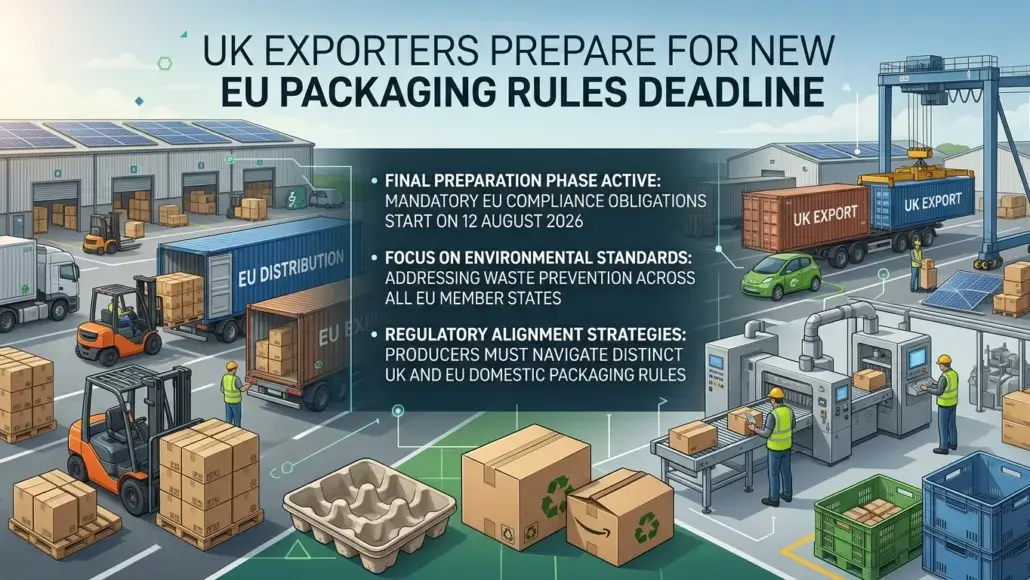

UK businesses that distribute goods to the European Union are entering the final preparation phase as new EU packaging rules are set to take full effect on 12 August 2026. Although the foundational regulation was established in early 2025, the upcoming date marks the commencement of mandatory compliance obligations regarding waste prevention and environmental standards across all member states. For packaging producers and exporters, distinguishing between the United Kingdom’s domestic extended producer responsibility for packaging (pEPR) and the European Union’s Packaging and Packaging Waste Regulation (PPWR) is now a business necessity. The primary objective of this harmonized regulation is to ensure that all packaging within the European market is economically viable for recyclability by the start of the next decade, effectively shifting the financial and operational burden of waste management back to the producers.
Mandatory Standards and Sustainability Requirements
The updated regulation replaces previous directives with a unified set of mandatory rules, though oversight for registration and reporting remains with individual national regulators. These EU packaging rules introduce rigorous requirements for the environmental sustainability and labeling of packaging throughout its entire life cycle. Notable provisions include a strict ban on polyfluoroalkyl substances (PFAS), often referred to as forever chemicals, in food-contact packaging above specific thresholds. Furthermore, the framework establishes clear refill and reuse targets. To maintain legal access to the market, every unique packaging type must be supported by technical documentation and a signed Declaration of Conformity. Without these credentials, products risk being barred from entry into the bloc, as compliance is now a prerequisite for any item placed on the market, regardless of its origin.
Strategic Implementation and Risk Mitigation
While the August 2026 deadline is the most immediate hurdle for exporters, the regulation includes a progressive rollout of requirements extending through 2040. This includes the implementation of eco-modulation by 2030, a mechanism that adjusts producer fees based on the recyclability and environmental impact of their materials. In Northern Ireland, the regime is being implemented under the Windsor Agreement, with specific exemptions noted for microenterprises. To avoid border rejections and supply chain disruptions, companies are advised to conduct a comprehensive packaging inventory audit. By stress-testing current specifications against new minimisation and recycled content thresholds, firms can ensure their technical documentation aligns with European Commission guidance. Ultimately, transitioning to these new designs has evolved from a corporate social responsibility goal into a fundamental compliance requirement for international trade.