























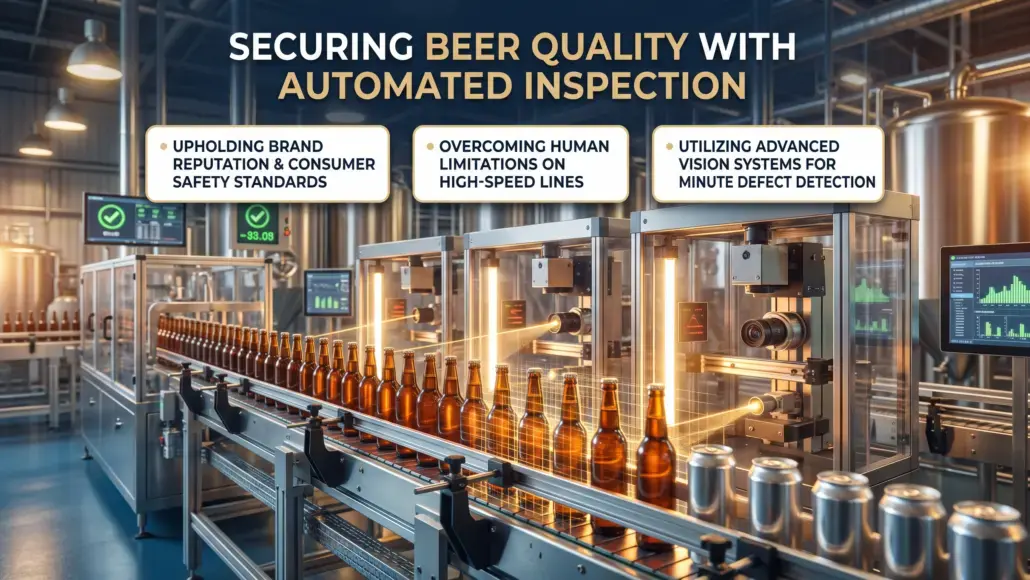

The rigorous application of Automated Packaging Inspection Improving Beer Container Quality has become a non-negotiable standard for breweries aiming to maintain brand reputation and consumer safety in a competitive global market. As packaging line speeds continue to climb, the ability of human operators to detect minute defects in bottles, cans, and labels has diminished, making sophisticated vision and sensor-based systems essential. These automated solutions operate at the speed of the line, analyzing every single unit for a wide array of potential flaws that could compromise the integrity of the product or the aesthetic appeal of the brand. From the initial inspection of empty containers to the final check of secondary packaging, these systems provide a continuous loop of quality assurance that minimizes the risk of costly product recalls and ensures that only perfect containers reach the retail shelf.
Modern inspection systems utilize a combination of high-resolution CMOS cameras, specialized lighting arrays, and advanced image processing algorithms to identify anomalies. For glass bottles, this includes detecting scuffs, chips in the rim, or the presence of foreign objects inside the container before the filling process begins. In the case of aluminum cans, the focus shifts to detecting dents, scratches, or deformations in the flange that could interfere with the seaming process. The integration of Automated Packaging Inspection Improving Beer Container Quality in these early stages is crucial, as identifying a defective container before it is filled saves both the product and the CO2 required for the filling cycle. These systems are capable of processing thousands of frames per second, allowing them to capture clear images of containers moving at high velocities without the need for mechanical stops.
Fill Level Monitoring and Closure Verification
Once the container has been filled and sealed, the focus of the inspection shifts to ensuring that the product meets the specified volume and that the closure is properly applied. Fill level monitoring is typically achieved using high-frequency infrared or X-ray sensors that can penetrate the container to measure the height of the liquid. These sensors are incredibly precise, capable of detecting deviations of just a few millimeters. This accuracy is essential not only for regulatory compliance but also for maintaining a consistent consumer experience. If a container is under-filled, it can lead to consumer dissatisfaction; if it is over-filled, it leaves insufficient headspace for gas expansion, which could cause the container to burst during pasteurization or transport. The automated system can instantly trigger a rejection mechanism to remove any outliers from the line without interrupting the flow of compliant products.
Closure verification is equally important for maintaining the shelf life and carbonation of the beer. For crown-corked bottles, vision systems inspect the crimp quality and ensure that the cap is not tilted or improperly seated. For cans, the inspection focuses on the seam integrity, checking for any signs of “false seams” or “droops” that could lead to leaks. Automated Packaging Inspection Improving Beer Container Quality also includes the detection of missing or damaged closures, which is a common occurrence in high-speed operations. By identifying these defects immediately after the capping or seaming station, breweries can troubleshoot mechanical issues in real-time, preventing a large batch of defective products from being produced. The data collected from these inspections is often used to adjust the torque or pressure settings of the closing machinery, providing a feedback loop that enhances overall process stability.
Label Alignment and Barcode Verification
The aesthetic quality of the package is a primary concern for brand owners, as the label is often the first point of interaction for the consumer. Automated vision systems are used to verify the presence, orientation, and alignment of labels on every container. This includes checking for bubbles, wrinkles, or tears that could detract from the premium appearance of the product. Sophisticated multi-camera setups can provide a 360-degree view of the bottle, ensuring that front, back, and neck labels are perfectly synchronized. This level of scrutiny is particularly important for high-end craft beers and limited-edition releases where the packaging plays a significant role in the brand’s value proposition. The system can also verify that the correct label is being applied to the correct product, preventing the costly error of mislabeling a batch.
In addition to visual aesthetics, these systems also perform critical functional checks on barcodes, QR codes, and date codes. Every container must be traceable throughout the supply chain, and a smeared or illegible code can lead to logistical failures and retail rejections. Automated Packaging Inspection Improving Beer Container Quality ensures that every code is scanned and verified for readability. If a code fails the check, the system can automatically flag the container for rejection and alert the operator to a potential issue with the coding equipment, such as a clogged inkjet nozzle or an exhausted ribbon. This real-time monitoring of traceability data is a key component of modern food and beverage safety standards, providing a digital record of every container that passes through the facility.
Advanced Technologies in Contaminant Detection
Beyond visual and volumetric checks, the inspection sector is increasingly adopting technologies to detect contaminants and structural weaknesses that are invisible to the naked eye. X-ray inspection systems are now being used to identify internal defects such as glass shards or metal fragments that may have entered the container during the manufacturing or filling process. These systems are capable of detecting very small particles, even in high-density liquids like stout or porter. The use of thermal imaging is also emerging as a way to detect leaks in pressurized containers. By monitoring the surface temperature of the container, the system can identify the cooling effect caused by escaping CO2, allowing for the detection of micro-leaks that would otherwise be missed by traditional pressure checks.
Another significant advancement is the use of spectroscopic analysis to verify the composition of the product inside the container. This can include checking for the presence of unwanted gases in the headspace or verifying the alcohol content and color of the beer. Automated Packaging Inspection Improving Beer Container Quality in this area provides an extra layer of protection against process deviations that could affect the flavor or safety of the product. As consumer demands for transparency and quality increase, the integration of these advanced sensing technologies will become more common in large-scale production environments. The ability to verify the internal state of the package without opening it is a powerful tool for quality control managers, allowing them to release batches with absolute confidence in their integrity.
Data Management and Quality Reporting
The massive amount of data generated by automated inspection systems is a valuable resource for continuous process improvement. Every rejection is logged with a specific reason, allowing production managers to identify patterns and trends in the defects. For example, if the system shows a sudden spike in label misalignment, it may indicate a problem with the adhesive temperature or the tension of the label reel. By analyzing this data, breweries can move from reactive quality control to a more proactive approach, addressing issues before they result in significant waste. The integration of inspection data into the factory’s overall ERP or SCADA system allows for the generation of detailed quality reports that can be used to demonstrate compliance with international standards such as ISO or GFSI.
The implementation of Automated Packaging Inspection Improving Beer Container Quality also reduces the reliance on manual sampling, which is often statistically insufficient for high-speed lines. Instead of checking one out of every thousand bottles, the automated system checks every single unit, providing a 100 percent inspection rate. This not only improves the overall quality of the product but also increases the efficiency of the quality control department by allowing them to focus on high-level analysis rather than repetitive manual checks. The digital record created by these systems also simplifies the audit process, providing a transparent and verifiable history of the production quality for each batch. In the modern packaging environment, the integration of automated inspection is the only way to achieve the level of precision and reliability required to compete at a global scale. The ongoing development of these systems, including the use of deeper neural networks and more sensitive sensors, will continue to push the boundaries of what is possible in beer container quality assurance.
Additionally, the adoption of collaborative inspection platforms allows different machines on the line to share data, enabling a holistic view of container integrity that spans the entire production lifecycle. This interconnected approach ensures that a minor defect identified at the filling stage can be cross-referenced with label application performance, providing a comprehensive data set for root-cause analysis. By investing in these sophisticated technologies, breweries not only protect their brand equity but also drive significant operational efficiencies through the reduction of rework and the optimization of resource consumption. The future of the industry lies in the unified integration of these sensory tools, creating a truly autonomous quality management ecosystem that adapts to the specific challenges of every production run. In this context, the role of automated inspection transitions from a simple gatekeeper to a vital source of operational intelligence, guiding the brewery toward higher levels of excellence and sustainability.