























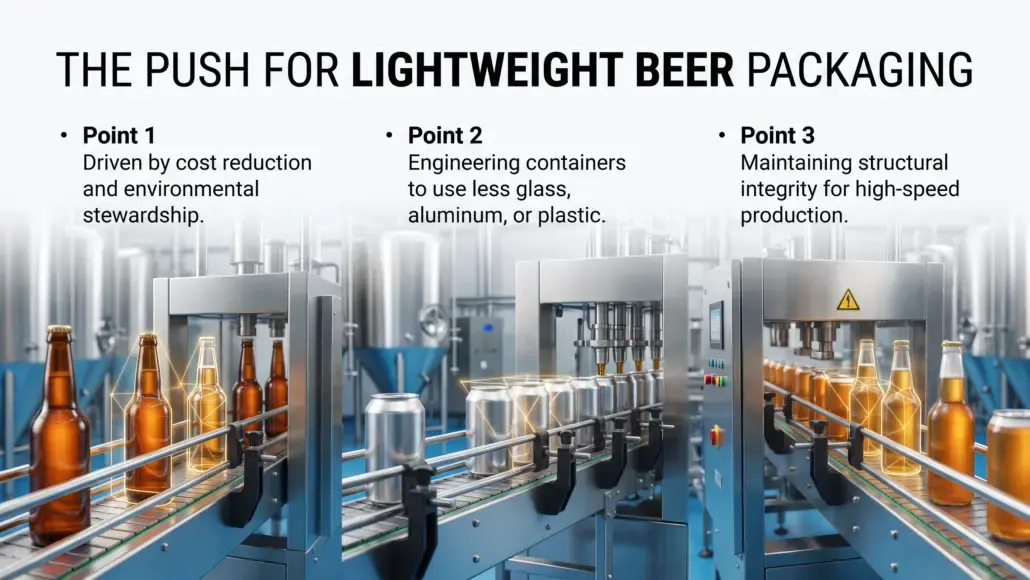

The systematic push toward lightweight beverage containers reducing material use in Beer Packaging has become a defining trend in the beverage industry, driven by the dual imperatives of cost reduction and environmental stewardship. Material lightweighting involves the engineering of containers to use less glass, aluminum, or plastic while maintaining the structural integrity required to survive the high-speed filling, pasteurization, and distribution processes. This technical challenge requires a deep understanding of material properties and mechanical stress, as even a minor reduction in wall thickness can significantly impact the container’s ability to withstand internal pressure and external handling. For breweries, the move toward lightweighting is not just about saving on raw material costs; it also reduces the energy required for transport and lowers the overall carbon footprint of the product, aligning with the sustainability goals of modern corporations and consumers.
In the glass sector, lightweighting is achieved through the transition from traditional blow-and-blow manufacturing to the Narrow Neck Press and Blow (NNPB) process. The NNPB method allows for more precise control over the distribution of glass in the bottle walls, resulting in a more uniform thickness and the elimination of “thick spots” that add unnecessary weight. By optimizing the geometry of the bottle, particularly in the shoulder and base areas, glass manufacturers have been able to reduce the weight of a standard 330ml beer bottle by up to 30 percent over the last two decades. Lightweight beverage containers reducing material use in Beer Packaging in the glass sector also benefit from advanced surface coatings that protect the thin glass from scratches and scuffs, which are the primary precursors to structural failure. These coatings ensure that the lightweight bottles remain durable throughout their lifecycle, from the brewery to the recycling bin.
Aluminum Can Optimization and Wall Thinning
The aluminum can has also seen significant material reductions through the process of wall thinning and base optimization. Modern two-piece aluminum cans are manufactured through a drawing and ironing process that stretches the metal to a thickness of less than 0.1 millimeters in the sidewalls. The challenge for engineers is to maintain the can’s ability to withstand the internal pressure generated by carbonated beer, which can exceed 90 psi during pasteurization. This is achieved through the design of the can’s dome-shaped base, which acts as a pressure vessel, and the use of high-strength aluminum alloys. Lightweight Beverage Containers Reducing Material Use in Beer Packaging in the aluminum sector also focus on reducing the diameter of the can end (the lid), as the lid is made from a thicker and more expensive grade of aluminum than the body. The transition from the 206 to the 202 end diameter has resulted in significant material savings across billions of units produced annually.
Beyond the weight of the metal, the design of the can’s neck has also been optimized to reduce material use. By tapering the neck of the can, manufacturers can use a smaller end, which not only saves aluminum but also reduces the weight of the secondary packaging required to hold the cans in place. These incremental improvements, when multiplied by the scale of global beer production, result in the saving of hundreds of thousands of tons of aluminum every year. The integration of high-speed vision systems on the production line ensures that these thin-walled containers are monitored for any signs of deformation or structural weakness, maintaining the high standards of quality and safety that the industry requires. The move toward lightweight aluminum packaging is a key component of the circular economy, as aluminum is infinitely recyclable and requires significantly less energy to process than virgin material.
Structural Integrity and High Speed Handling Challenges
Reducing the weight of a container presents significant challenges for high-speed packaging lines. Lightweight containers are more susceptible to deformation and structural failure when subjected to the mechanical stresses of the filling, capping, and conveying processes. For example, a lightweight glass bottle may be more prone to vertical crushing during the crowning process, requiring more precise control of the capping pressure. Similarly, lightweight aluminum cans are more likely to dent or buckle if they are handled roughly by the infeed or discharge systems. To address these issues, breweries are investing in “soft-handling” conveyor systems that utilize low-friction materials and synchronized drive systems to minimize bottle-to-bottle impact.
The transition to lightweight beverage containers reducing material use in Beer Packaging also requires the recalibration of the inspection and testing equipment. Vision systems must be able to detect thinner defects and micro-cracks that would not be an issue in a traditional, heavier container. Pressure testing protocols must also be adjusted to ensure that the lightweight containers can still withstand the rigors of the supply chain. Despite these challenges, the benefits of lightweighting are too significant to ignore. By reducing the mass of the container, breweries can increase the payload of their delivery trucks, leading to fewer trips and lower fuel consumption. This improvement in logistical efficiency is a critical factor in the overall profitability of the brewery, particularly in the face of rising energy costs and environmental regulations.
Material Science and Future Lightweighting Technologies
The future of lightweighting lies in the development of new materials and advanced manufacturing techniques that push the boundaries of what is possible. In the glass sector, this includes the use of chemically strengthened glass, which uses an ion-exchange process to create a high-strength surface layer that is much more resistant to breakage. This could allow for even thinner bottle walls and further weight reductions. In the aluminum sector, researchers are exploring the use of new alloys that offer higher strength-to-weight ratios, allowing for even thinner can walls without compromising pressure resistance. Lightweight Beverage Containers Reducing Material Use in Beer Packaging are also being explored in the area of composite materials, where plastic and glass are combined to create a container that offers the barrier properties of glass with the weight and durability of plastic.
Another significant area of research is the use of additive manufacturing, or 3D printing, for the prototyping and production of specialized containers. While not yet feasible for high-volume production, 3D printing allows for the creation of complex geometries that are impossible to achieve with traditional manufacturing methods. These optimized designs can provide the necessary structural support exactly where it is needed, while eliminating material in non-critical areas. The data-driven design of containers, utilizing sophisticated simulation software, allows engineers to test thousands of different configurations in a virtual environment before a single physical prototype is created. This accelerated design cycle is essential for keeping pace with the rapidly changing demands of the packaging market.
Sustainability Metrics and the Circular Economy
The success of lightweighting initiatives is measured not just in tons of material saved, but also in the broader context of the circular economy. By reducing the amount of material used in every container, breweries are reducing the total volume of waste generated by the beverage industry. Additionally, the reduction in weight makes the collection and transport of used containers for recycling more efficient and cost-effective. Lightweight Beverage Containers Reducing Material Use in Beer Packaging are a critical part of a holistic approach to sustainability that encompasses material selection, manufacturing efficiency, and end-of-life management. Many breweries are now setting ambitious targets for material reduction and are working closely with their packaging suppliers to develop the next generation of lightweight solutions.
The integration of lifecycle assessment (LCA) tools allows breweries to quantify the environmental impact of their lightweighting efforts, providing transparent data for sustainability reporting. This information is increasingly important for investors and consumers who are looking for companies that are taking concrete steps to reduce their environmental footprint. The move toward lightweighting is therefore not just a technical or economic decision; it is a central part of the brand’s identity and its commitment to a sustainable future. As the global beverage market continues to grow, the importance of material efficiency will only increase, ensuring that lightweighting remains at the forefront of packaging innovation for years to come.
The implementation of lightweight beverage containers reducing material use in Beer Packaging also requires a strategic approach to secondary and tertiary packaging. When the primary container is made lighter, it may provide less structural support to the overall pallet load, requiring reinforcements in the cardboard trays or the application of additional stretch wrap. Packaging engineers must analyze the entire packaging system to ensure that the material savings achieved at the primary level are not offset by increased requirements elsewhere. This integrated design approach ensures that the total volume of material used across the entire supply chain is minimized. By utilizing advanced palletization software, breweries can optimize the arrangement of these lighter containers to maximize load stability and transport efficiency. These technical considerations are essential for the successful adoption of lightweighting technologies in a high-volume production environment. The continued refinement of these containers, combined with the development of more efficient recycling systems, will ensure that the beer industry can meet the needs of the present without compromising the ability of future generations to meet their own.